The air you are breathing in Chandigarh is of “very poor” quality, and only rain can stop it from worsening. But that’s likely only in another five days, says the meteorological department. In the last week, the Air Quality Index (AQI) of the city has stayed in the 301-400 micrograms per cubic meter (µg/m³) bracket, which is categorised as ‘very poor’, as the acceptable limit is 100.
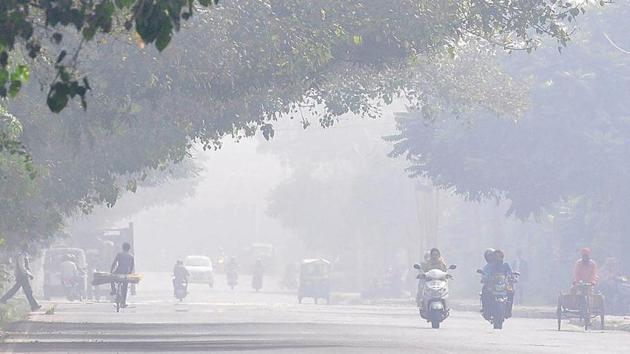
On Wednesday, just after 3pm the AQI was recorded at 352 in Industrial Area.
Met director Surender Paul said, at Chandigarh said, “After November 11, there is possibility of western disturbances, which will strengthen on November 13-14, so rain is likely during these days.”
The Chandigarh Pollution Control Committee has been measuring quality of air at four places — Kaimbwala village, Industrial Area Phase 1, IMTECH in Sector 39, and Sector 17. “Air quality has started deteriorating in the city from Diwali onwards; paddy stubble burning in the adjoining states has worsened the problem,” said PJS Dadhwal, member secretary of the CPCC.
{{/usCountry}}The Chandigarh Pollution Control Committee has been measuring quality of air at four places — Kaimbwala village, Industrial Area Phase 1, IMTECH in Sector 39, and Sector 17. “Air quality has started deteriorating in the city from Diwali onwards; paddy stubble burning in the adjoining states has worsened the problem,” said PJS Dadhwal, member secretary of the CPCC.
{{/usCountry}}He elaborated, “Delayed rain and a no-wind condition are the two other reasons. Chandigarh has not received any rain post-September, because of which particulate matter (air pollutants) remains suspended in the air.”
In Industrial Area, within six days the AQI has gone from 308 to 352. Further, the level of PM 2.5, small enough to get embedded in the lungs causing serious respiratory illness, was more than triple (187) the standard 60 µg/m³. The level of PM 10 (or RSPM) was double the limit at 261 against 100.
How smogs affects your health
Dr SK Jindal, a city-based pulmonologist, said the acute effects of smog include irritation of eyes and nose, cough, chest congestion, asthma attacks and other respiratory illnesses. Apart from this, smog has long-term effects too.
The doctor said that the best remedy is to avoid exposure to smog, especially during mornings and late evenings. Also, one should take adequate fluids and people suffering from respiratory illness should become extra careful and visit the doctor on time.