He was the younger brother of a classmate of ours. He walked with a slight limp, and thus was bullied by fellow students who knew no better. But he found solace in the company of physics, which he loved as much as I loved our physics teacher.
Thanks to a couple of surgeries and physiotherapy, his limp grew less and less pronounced as he grew older. With it, grew his confidence, and the love for physics, books of which he carried even when he came to the stadium to watch us play cricket. As he turned 15 and passed Class 10 with a score so high that it’s embarrassing for lowly people like yours truly to mention, he disappeared.
The Little Brother had been sent off to Kota. From the haloed town in Rajasthan which produces students for elite engineering colleges, he was destined to go to IIT, and then run the world.
We, the lesser mortals, had our own lives to run. Done with Class 12 in ‘arts’, we headed to the place that everyone in Punjab heads to if he can’t head to Canada. Chandigarh.
This was three years into the new millennium. And Chandigarh was already the Kota of the Upper North. We saw many such little brothers, some sisters, in our paying guest houses. But they could conveniently be ignored in favour of a culture shock that was much better company. We passed our inconsequential degrees, and got jobs as teachers, bankers, journalists, carrying out unimportant, non-engineering works.
{{/usCountry}}This was three years into the new millennium. And Chandigarh was already the Kota of the Upper North. We saw many such little brothers, some sisters, in our paying guest houses. But they could conveniently be ignored in favour of a culture shock that was much better company. We passed our inconsequential degrees, and got jobs as teachers, bankers, journalists, carrying out unimportant, non-engineering works.
{{/usCountry}}Then, a suicide last week by a girl in Kota made headlines, and I was reminded of Little Brother, more out of curiosity than concern.
I found him on Facebook, of course. A chat revealed he had never completed his quota of Kota. He had returned to our hometown, to sell cloth at the family shop. Every few lines into our FB chat, he meandered into the lanes of Kota, talking of how he could not ‘adjust’. “It felt like the world only needed engineers,” he wrote over chat one day, joking about how Kota had robbed him of his pure love for physics too. “Finally, I started falling in love with girls instead.”
He never studied beyond Class 11.
Kriti Tripathi, better known now as the #KotaSuicide girl, was different. She wanted to study, just not engineering. But her parents were determined. From Ghaziabad, they had shifted to Kota for two years so that Kriti could realise their dream. It was her nightmare. She did clear the IIT-JEE, but death seemed a better option. It wasn’t failure, but success forced down her throat, that killed her.
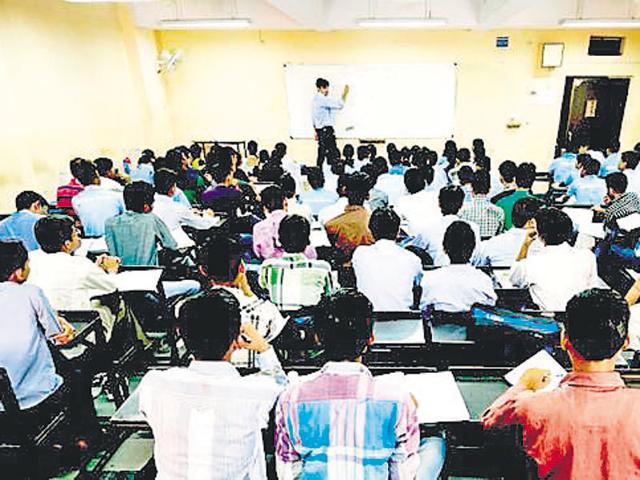
The suicide also broke the slumber of our many committees and commissions for child rights, and they looked towards institutions in Chandigarh. The findings of their inspections are shocking, but only if you live among the higher Himalayas, away from the real world — classes have 150 students each; there is one counsellor for 3,000 students, or none; and no one bothers about the students’ health.
Will anything happen now? No, not until parents start seeing beyond the neighbour’s child; not until the coaching centre owners grow into angels; and certainly not until humanities are not seen as essential to the world as they are. Contents of BA and MA courses have not changed for decades; so much so that notes given to correspondence-course students carry the same spelling mistakes for 20 years and counting! We are busy pitting nationalist IITians against anti-national JNUites. Mythology is the new history, and social studies the new enemy. No party sees humanities as more than grounds to recruit Kanhaiyas. No party sees scientific pursuit as more than a trophy achievement.
Indeed, BTech from non-elite institutions is losing its sheen, too. In Punjab, there are colleges and private universities seeing not only zero placement but also zero enrolment. Yet, don’t be mistaken that the business is dying. The bubble may be bursting at one place, but it’s flourishing at others. Even to sell pop fiction, people are using their engineering degrees. And it’s working. There is still no dearth of Kritis being sent to Kota.
Little Brother was lucky, I think.
(aarish.chhabra@hindustantimes.com)