The stars of the show stand out with their walking sticks held high. Squatting next to the stage, these boys and girls from the School for the Blind, Sector 26, are to lead people in a Blind Walk at the Sector-17 plaza on this sweaty October evening. For now, they are busy passing smiles around in general directions, not wearing too heavy their hearts and hats at an event that has them centrestage.
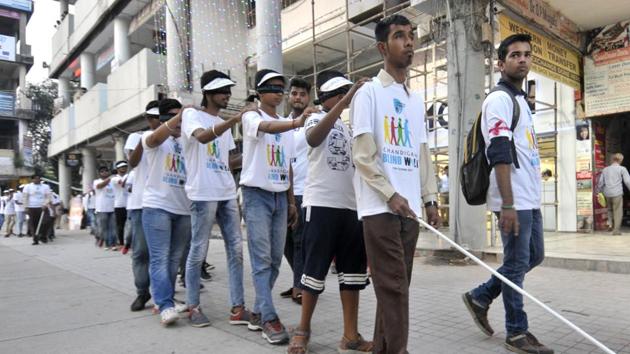
The walk is part of a multi-city initiative to make people understand what it feels like to be blind. A group of citizens, Dialogue Highway, has organised it here. Punjab minister Navjot Singh Sidhu, the chief guest, arrives on time and makes some gracious comments, promises Rs 5 lakh a year to the organising trust, and leaves the gathering with a thought: “They do not need your sympathy. They deserve your respect, ‘sammaan’.” The boys and girls clap, and Sidhu too walks a few feet blindfolded, guided by a volunteer.
I, meanwhile, have registered, collected my blindfold and cap, but failed to get a T-shirt despite several attempts. Never mind. This is fun, no?
{{/usCountry}}I, meanwhile, have registered, collected my blindfold and cap, but failed to get a T-shirt despite several attempts. Never mind. This is fun, no?
{{/usCountry}}No, nothing can prepare you for this. You tie the blindfold and the world disappears. Sounds amplify. Touch gets pronounced. You are on your own. Until someone holds your hand and puts it on a shoulder. We are in a single line of 10 “normal” persons led by a blind boy, we are told.
Before we realise, the line starts moving. And I am now at the mercy of a shoulder moving away from me, faster than I thought. A woman’s hand lands on my shoulder, then slips. Scared to let go of the shoulder ahead, I wave my arm frantically behind me. She catches it. Sighs. The man in front of me is now more careful, balancing the pace.
By the way, is that someone singing behind me? I heard the name Al Pacino. Are they talking about that scene from Scent of a Woman in which the blind ex-soldier goes, ‘I am in the dark here; I am in the dark here’? Probably not. Am I imagining stuff? The voices stop.
Ten more steps and I cannot even hear the volunteers’ steps beside me. The woman behind me presses my shoulder in a goodbye and leaves. I am in the dark here. My hand slips. I am now petrified. The man ahead yells: “Brother! Stop the line. Someone is left behind.” I find the shoulder. Why didn’t I just take the blindfold off?
“We are at Sindhi Sweets!” yells a volunteer. We take a U-turn after the longest 500 metres ever! There is still the journey back. But now I am reassured by the warmth of the shoulder ahead.
A few steps on, all I can hear are my feet shuffling and the sound of my breath. Helplessness has graduated from a dread to a companion, the fear of falling is now a friend; and I am now married to humility. She walks with me in a trance; our missteps, a quiet dance.
“We are here,” declares a young woman’s screechy voice, and my reverie breaks. Someone voluntarily unties the blindfold from behind my head. I catch the black piece of cloth in my palms. It feels damp. Must be the sweat.