The Aravallis are in the news again. Earlier this month, the Haryana government had issued a notification to delineate the Mangar Bani zone in the Aravalli hills of Mangar village and create a 500 m buffer as a no-construction zone. This brings the government closer to honouring its commitment to the NCR Planning Board in 2014 and 2015 to protect the Mangar Bani area, as demanded by the environmentalists in the Gurgaon-Faridabad-Delhi region.
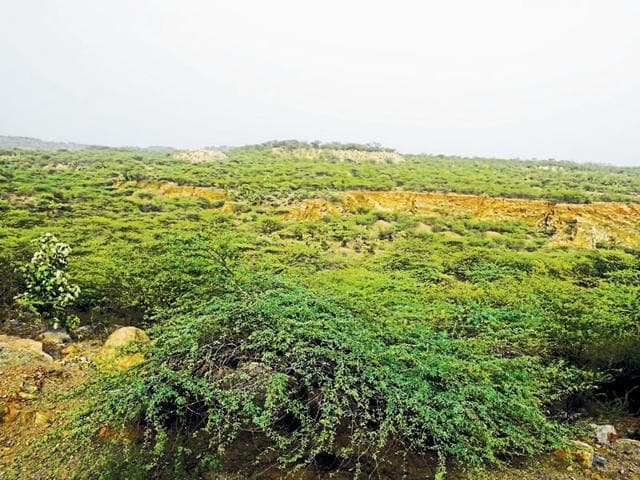
Mangar Bani covers about 650 acres in the Aravalli hills of Mangar and Bandhwari villages, while its 500m buffer encompasses about 950 acres across Mangar, Bandhwari and Kot villages. Land ownership rules vary in all these villages, and if one goes by environment and other laws, investing in land over here is fraught with risks. It is very important, therefore, to understand how the Aravalli common land was privatised, what its forest status is and where construction is allowed and not allowed.
Environmentalists say it is a mystery how village common land here went to private players. What used to be village common land was owned in the 1960s by the panchayat and the ownership of the entire hill area was recorded as panchayat deh in the revenue records of Mangar village. Land type was categorised as gair mumkin pahar (hilly land which is not cultivable). Under panchayat ownership it was managed as village common land forest (uncultivated land used for grazing, forests) and sale was not allowed. In the 1970s land ownership was transferred from the panchayat to community through a process which environmentalists labelled “dubious” . It was recorded as Shamlat deh (belonging to the community) in the revenue records and was not allowed to be sold.
By the late 1970s, land ownership was transferred to village proprietors, each getting land in proportion to his agricultural holding in the plains. Though it was a joint undivided share, the villagers later started selling their shares individually to investors from Delhi and elsewhere. In 1986, the hill was partitioned amongst the shareholders, when a process of consolidation of land or chakbandi was taken up (land was pooled before partition) that led to actual plot numbers being allotted and acreage of plot delineated. While consolidation was applicable only to agricultural areas, it was misused to partition the hill, areas of which had already been pooled. Unfortunately, the densely forested Mangar Bani area was also partitioned and trading ownership papers had started.
{{/usCountry}}By the late 1970s, land ownership was transferred to village proprietors, each getting land in proportion to his agricultural holding in the plains. Though it was a joint undivided share, the villagers later started selling their shares individually to investors from Delhi and elsewhere. In 1986, the hill was partitioned amongst the shareholders, when a process of consolidation of land or chakbandi was taken up (land was pooled before partition) that led to actual plot numbers being allotted and acreage of plot delineated. While consolidation was applicable only to agricultural areas, it was misused to partition the hill, areas of which had already been pooled. Unfortunately, the densely forested Mangar Bani area was also partitioned and trading ownership papers had started.
{{/usCountry}}In 2004, the Supreme Court ruled that the Aravalli hills had to be protected at all cost. In 2009, mining was banned in Gurgaon and Faridabad, but the issue of construction is still pending in the apex court. In 2012, the Jaspal Singh judgment of the Supreme Court held that ownership of the village common land should be restored to the panchayats across the country. This was, however, not implemented in true spirit.
After the 2014 National Green Tribunal ruling that the gair mumkin pahar could not be fragmented and that the forest should be identified, the Tribunal in 2016 fined a private company `1 lakh for cutting 50 trees, and ruled that the area was deemed forest as per SC orders.
Since 2014, too, the process of final identification of the NCZ has started after the Regional Plan 2021 for the NCR zoned the entire Aravallis of the NCR as a Natural Conservation Zone (NCZ) , where the limit on construction is 0.5% and that too for regional recreational activities through sanctuaries and regional parks.
“Thus the combination of forest laws, MoEF, SC and NGT pronouncements, and declaration of the Natural Conservation Zone over the entire Aravallis in 2005 by the NCRPB clearly show that the intention is to conserve the area and not to commercialise it,” says Chetan Agarwal, an environmental analyst.
In 2011-12 the news of a master plan led to a spike in transactions and doubling of prices, but it was stayed by the MoEF. The cumulative impact of the various judicial pronouncements and the NCZ zoning is that the NCZ has been sent for notification.