Near the coast of Dominica in the Caribbean, researchers documented a rare sperm whale birth in the open ocean, with members of the whale's social group gathered around the mother and newborn. The observations suggest that the calf received assistance from other whales immediately after birth, as they repeatedly supported and pushed it toward the surface. The study in the journal Scientific Reports is the first to provide detailed video, audio, photographic, and behavioral documentation of a wild sperm whale birth, combining aerial drone video, underwater audio, shipboard photography, and behavioral observations collected during the event. The researchers also drew on the group's long-term history as a well-studied social unit monitored by Project CETI, which helped them identify the whales and understand their social relationships.
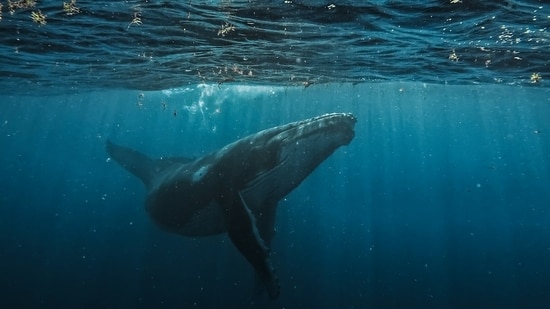
The birth was documented on July 8, 2023, when the CETI team encountered 11 sperm whales from the well-studied social unit known as Unit A. The whales initially appeared to be gathered closely together and making slow, shallow dives. About an hour after the first observation, the researchers saw the tips of the newborn's flukes emerging from the mother, and blood and other material appeared in the water near the end of the delivery. The mother's flukes emerged at 11:12 a.m. local time, and the birth was completed at 11:45:45 a.m. The observation is particularly notable because wild cetacean births are rarely documented in such detail, with only nine cetacean species having reported birth observations collected in the wild.
Labor observed by the whole family
What happened next produced the study's most notable findings. Newborn sperm whale calves appear to be negatively buoyant, meaning they tend to sink rather than float. This makes reaching the surface to breathe an important challenge immediately after birth. According to the study, all 11 members of Unit A were present and participated in the birth event. Within a minute after delivery, members of the group began lifting, pushing, and jointly squeezing the newborn, repeatedly bringing it toward the surface and at times raising it almost completely out of the water. This lifting behavior continued intermittently for about three hours. The group included the mother's own relatives as well as whales that were not genetically related to her, indicating that assistance was not limited to the mother alone.
{{/usCountry}}What happened next produced the study's most notable findings. Newborn sperm whale calves appear to be negatively buoyant, meaning they tend to sink rather than float. This makes reaching the surface to breathe an important challenge immediately after birth. According to the study, all 11 members of Unit A were present and participated in the birth event. Within a minute after delivery, members of the group began lifting, pushing, and jointly squeezing the newborn, repeatedly bringing it toward the surface and at times raising it almost completely out of the water. This lifting behavior continued intermittently for about three hours. The group included the mother's own relatives as well as whales that were not genetically related to her, indicating that assistance was not limited to the mother alone.
{{/usCountry}}Also Read: Why do wombats poop cubes? Scientists explain how their intestines shape the bizarre droppings
The calf took its first clearly observed breath in less than two minutes and was seen attempting to swim about three minutes after birth. The researchers noted that there had already been extensive activity around the newborn before these observations, including lifting and pushing, so they could not determine whether the calf had breathed or moved earlier. The group therefore continued providing physical support even after the first clear signs of breathing and swimming had been observed.
Sound was another part of the event. The researchers recorded thousands of sperm whale clicks, including patterned sequences known as codas, and found statistically significant shifts in coda vocal style during key moments, including the beginning of the birth and interactions with short-finned pilot whales that approached the group after the calf was born. The pilot whales repeatedly interacted with the sperm whales, while at least one adult female remained between the visitors and the newborn. At one point, a pilot whale rammed an adult female near the calf.
Also Read: How animals build complex ‘cities’ without blueprints: The science of self-organizing structures
The second study adds another piece of the puzzle
A research paper published in the journal Science examined the same birth using high-resolution drone footage, computer vision and network analysis to document how the whales interacted with the mother and calf during and after the delivery. The study examined the social relationships and interactions among the whales, including participation by individuals that were not genetically related to the newborn. Together, the findings provide additional evidence of cooperation among members of the sperm whale social unit during the birth event.
Beyond the immediate observations, the researchers said the event provides an opportunity to examine how social behavior may contribute to sperm whale births in the open ocean. The study also raises questions about whether the presence of multiple whales and their lifting behavior may help newborns reach the surface and avoid drowning. However, the researchers describe this as a question for further study rather than establishing that group assistance is necessary for calf survival.