IN JANUARY 2025 the upper section of a SpaceX Falcon 9 rocket launched two lunar landers towards the Moon. But that was not the end of this particular rocket’s contribution to science. That will come on August 5th when it crashes into the Moon’s surface at around 8,700kph (5,400mph).
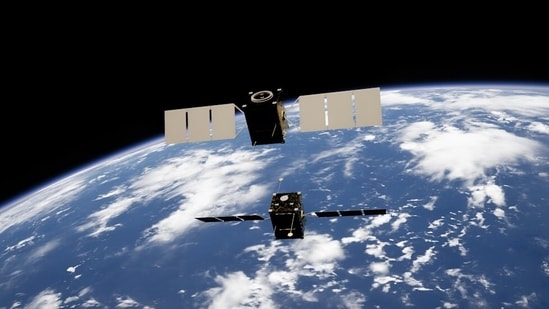
The rocket stage is one of thousands that have been discarded after completing their one and only flight. Typically, they are placed in low-earth orbit, where the wisps of atmosphere that
IN JANUARY 2025 the upper section of a SpaceX Falcon 9 rocket launched two lunar landers towards the Moon. But that was not the end of this particular rocket’s contribution to science. That will come on August 5th when it crashes into the Moon’s surface at around 8,700kph (5,400mph).
The rocket stage is one of thousands that have been discarded after completing their one and only flight. Typically, they are placed in low-earth orbit, where the wisps of atmosphere that still exist at such altitudes eventually slow them enough to tumble back to earth, burning up on re-entry. But this particular mission left the rocket stage too far from the earth for atmospheric drag to catch it.
The crash demonstrates a “certain carelessness” about how space hardware is disposed of, wrote Bill Gray, an astronomer in Maine who first noticed that the rocket was Moon-bound. Its estimated trajectory initially had it passing close enough to a South Korean lunar satellite to cause alarm.
Careless or not, the collision is a welcome bit of scientific serendipity. Meteoroids—chunks of space-going rock—strike the lunar surface regularly. But their arrival is unpredictable and their precise dimensions unknown. A few hundred impacts have been recorded since 1999, but scientists have had to infer the size of the rocks from the brightness and duration of the resulting flashes. The dimensions of the Falcon 9’s upper stage are known precisely. The advance warning of the impact therefore gives astronomers a chance to capture data that will let them properly calibrate their past measurements.
The crash will happen on the side of the Moon presently lit by the Sun, though its exact location is still uncertain. That is because the rocket stage’s orbit has been nudged over its months in space by the faint pressure exerted by solar radiation. That tiny force is sufficient to shift the impact location by a few kilometres. And the precise location matters. A crash into hard lunar bedrock would probably produce a flash too faint to measure. If it were to hit the softer dust that blankets most of the Moon’s surface, the resulting flash would be bright enough to be seen by earth-based telescopes.
But the flash is only half the story. Wherever it lands, the 4,000kg rocket will be one of the biggest lunar impacts ever recorded. It should send a shower of debris high above the Moon’s surface, where it would be lit by the sun against the blackness of space. These are ideal conditions to track the path of the debris and assess its composition based on the light that it reflects. “We’ve never seen an ejecta plume like this on the lunar surface before,” says Benjamin Fernando, an astronomer at Los Alamos National Laboratory and the first author of a preprint paper posted on July 16th that encouraged astronomers around the world to observe the crash.
The question of exactly how lunar dust and rocks behave after an impact is not just of academic interest. NASA’s Artemis IV mission, supposedly due to fly by early 2028, will be the first crewed landing on the Moon since 1972. America is seeking to build a permanent lunar outpost at the Moon’s south pole by 2032. China and Russia also aim to set up a lunar research station by some time in the mid-2030s.
If those plans come to fruition—which is, admittedly, quite a big if—lunar debris will be one of the many hazards that astronauts on the lunar surface will have to worry about. Without air resistance to slow it down, shrapnel from meteoroid impacts or spacecraft landings can travel for hundreds of kilometres at thousands of kilometres per hour. “If any of those fragments were to hit an astronaut or their habitat it could do a lot of damage,” says Dr Fernando. Forewarned, as ever, is forearmed.
One Subscription.
Get 360° coverage—from daily headlines
to 100 year archives.
Archives
HT App & Website