India's ambitious Chandrayaan-2 moon mission may have made a hard landing on the lunar surface in 2019, but the orbiter accompanying it has been providing useful information to scientists back on Earth. And earlier this week, a research paper revealed that the Chandrayaan-2 orbiter confirmed the presence of water molecules (H2o) and hydroxyl (OH) on the surface of the moon.
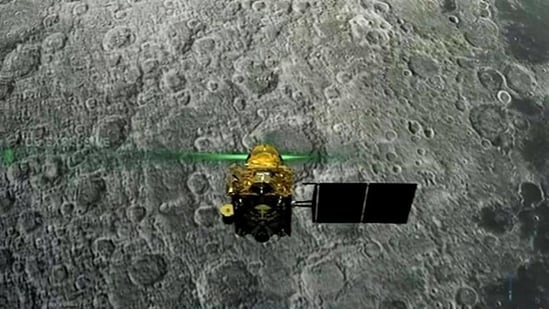
The findings were published in the journal Current Science. "The initial data analysis from IIRS clearly demonstrates the presence of widespread lunar hydration and unambiguous detection of OH and H2O signatures between 29 degrees north and 62 degrees north latitude," the August 10 research article said.
The discovery was made by the orbiter's imaging infrared spectrometer (IIRS).
"Plagioclase-rich rocks have been found to have higher OH or possibly H2O molecules when compared to the mare regions, which were found to have more dominance of OH at higher surface temperature," the group of researchers who studied the IIRS data further said.
The scientists also said that more data will be made available in the future, giving a complete picture.
The Chandrayaan-2 mission was launched by Indian Space Research Organisation (Isro) in July 2019. But Vikram lander on-board the mission crash-landed on the lunar surface just 2.1 km from its destination in September that year.
{{/usCountry}}The Chandrayaan-2 mission was launched by Indian Space Research Organisation (Isro) in July 2019. But Vikram lander on-board the mission crash-landed on the lunar surface just 2.1 km from its destination in September that year.
{{/usCountry}}However, its orbiter remains functional. Isro said that the Chandrayaan-2 orbiter, with its eight scientific instruments, will continue its seven-year mission to study the surface of the Moon.
Chandrayaan-2 was launched with the aim of mapping the variations in lunar surface composition, as well as locating and studying the surface of the Moon for the presence of water.
A successful moon landing would have made India the fourth country in the world to land a rocket on the moon after the US, the erstwhile USSR, and China, and the first to have landed close to the lunar South Pole.