
 E-Paper



Earth’s ‘mini-moon’ to depart after nearly two-month stay. What’s next?
An analysis of asteroid 2024 PT5 – ‘mini-moon’ – suggests it may have originated from material ejected from the moon following an ancient collision.

 Prefer HTon Google


Earth is bidding farewell to asteroid 2024 PT5, which has been orbiting as a “mini-moon” for about two months. The small, harmless space rock is set to leave Earth's vicinity on Monday, drawn away by the stronger gravitational pull of the sun. However, it is expected to make a brief return in January.
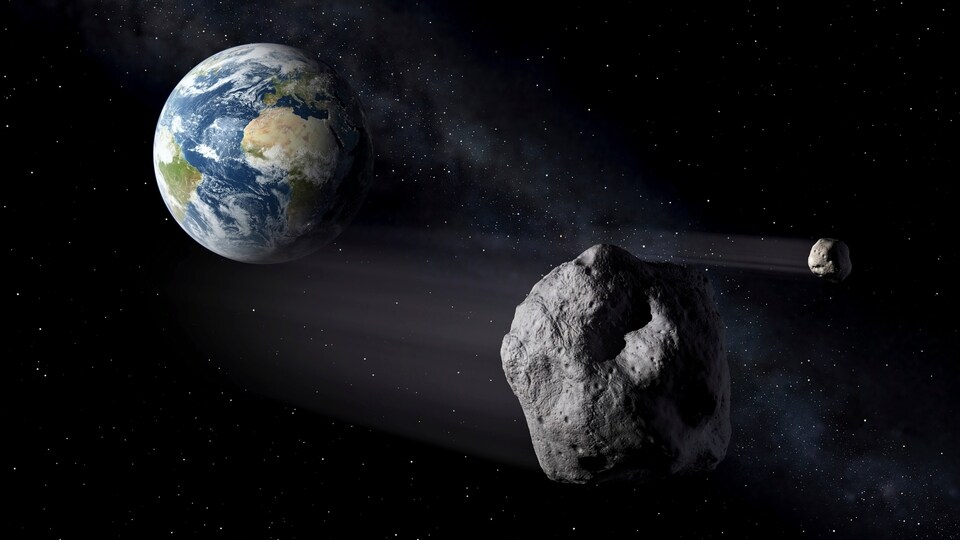
NASA then plans to use a radar antenna to study the 33-foot (10-metre) asteroid during its close approach. This observation could provide valuable insights into the object's nature, designated 2024 PT5, which might be a lunar boulder ejected by an asteroid impact that created a crater on the moon.
What will happen to 2024 PT5 next?
According to Space.com, analysis of asteroid 2024 PT5 suggests it may have originated from material ejected from the moon following an ancient collision that left the lunar surface marked with craters.
For an asteroid to become a "mini-moon," it must approach the Earth within approximately 2.8 million miles (4.5 million kilometres) and at a relatively slow speed of about 2,200 miles per hour (3,540 kilometres per hour).
These criteria were met by 2024 PT5 on September 29, 2024, at 3.54 pm Eastern Daylight Time (19.54 Coordinated Universal Time), when it was briefly captured by Earth's gravity.
However, this short stint will end on November 25 at 11.43 am Eastern Daylight Time (15.43 Coordinated Universal Time) when the sun's gravitational pull disrupts its orbit.
After leaving Earth's vicinity, the asteroid will return to the Arjuna asteroid family, its broader cosmic origin.
2024 PT5 never captured Earth's gravity
Although not technically a moon—NASA emphasises it was never fully captured by Earth's gravity or in orbit—it remains "an interesting object" for scientific study.
According to the Associated Press, astrophysicist brothers Raúl and Carlos de la Fuente Marcos from the Complutense University of Madrid, who identified the asteroid's "mini-moon behaviour," have conducted hundreds of observations using telescopes in the Canary Islands.
Currently, the asteroid is over 2 million miles (3.5 million kilometers) away and is too small and faint to be visible without a powerful telescope.
In January, it will come as close as 1.1 million miles (1.8 million kilometers) to Earth—nearly five times farther than the moon—before safely moving deeper into the solar system while orbiting the sun. It is not expected to return until 2055.
When was it first spotted?
Discovered in August, the asteroid began its brief journey around Earth in late September, influenced by Earth's gravity and tracing a horseshoe-shaped path.
However, when it returns next year, it will be travelling at over twice its September speed, making it too fast to stay, explained Raúl de la Fuente Marcos.
NASA plans to monitor the asteroid for over a week in January using the Goldstone Solar System Radar in California's Mojave Desert, part of its Deep Space Network.
Current predictions indicate that during its 2055 visit, the sun-orbiting asteroid might once again perform a short, partial orbit around Earth.
(With inputs from Associated Press)


