
 E-Paper



Milky Way’s black hole comes to light: How astronomers captured first image
The pictures take significance as observing a black hole is, by definition, impossible, since no light can escape it.

 Prefer HTon Google


An international team of astronomers on Thursday gave the first glimpse of the supermassive black hole at the centre of the Milky Way. The picture of the black hole known as Sagittarius A* (Sgr A* ) - only the second one ever to be imaged - was produced by a global research team called the Event Horizon Telescope (EHT) Collaboration, using observations from a worldwide network of radio telescopes.
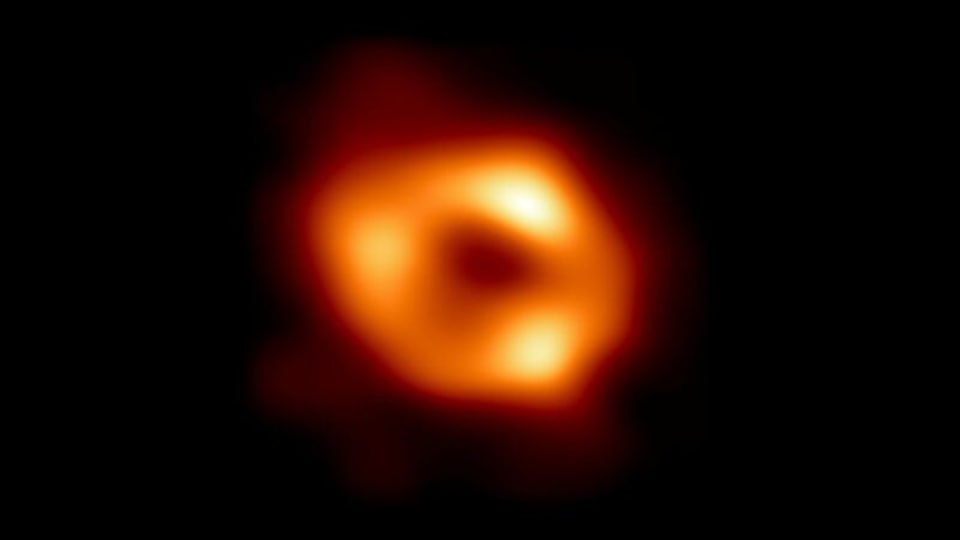
The pictures take significance as observing a black hole is, by definition, impossible, since no light can escape it.
The rare photo was captured with the help of the Event Horizon Telescope (EHT) which is a network of radio dishes designed to detect the light cast when matter disappears into the maw of a black hole.
How did the telescope capture the black hole image?
Astronomers used interferometry -- linking a pair of radio antennae trained on the same object in the sky, to create a "virtual" telescope called an interferometer. This can see fine detail, like the zoom lens of a camera.
The EHT project placed radiotelescopes at eight different observatories around the world -- from the Americas to Europe, Greenland to Antarctica -- to create a new and more vastly powerful telescope. This technique is known as very long baseline interferometry (VLBI).
As the Earth rotated, the different telescopes captured slightly different waves of light emitted by the matter around a black hole, and these patterns were then eventually combined to form the complete picture.
What is a Black Hole?
A black hole is a region of spacetime where gravity is so strong that nothing – no particles or even electromagnetic radiation such as light – can escape from it. The theory of general relativity predicts that a sufficiently compact mass can deform spacetime to form a black hole.
Astronomers believe nearly all galaxies, including our own Milky Way, have these giant black holes at their centre, where light and matter cannot escape, making it extremely hard to get images of them. Light gets chaotically bent and twisted around by gravity as it gets sucked into the abyss along with superheated gas and dust.
Is this the first photo of a black hole?
This is not the first black hole image. The same group released the first one in 2019 and it was from a galaxy 53 million light-years away. The Milky Way black hole is much closer, about 27,000 light-years away. A light-year is 5.9 trillion miles (9.5 trillion kilometres).
Relevance of the photo
The EHT's success in detecting M87* and now Sagittarius A* provides double proof of supermassive black holes -- a giant leap forward in consolidating concepts of how the cosmos is structured.
Einstein's general theory of relativity has so far been unable to explain what happens in a black hole at the most infinitely small scale.
(With inputs from AFP, AP)


