Xenotransplantation is the insertion of an organ from one species into another. When the organ is an animal’s and the recipient human (as with the transplant of pig kidneys into people whose own are failing), the idea is to prolong life. But what about the other way round—transplants from human to animal?
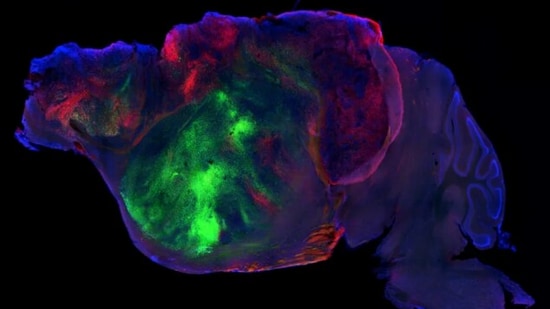
With one crucial distinction, that is what Sergiu Pasca of Stanford University and his colleagues have been up to. The distinction is that they have been transplanting, into
Xenotransplantation is the insertion of an organ from one species into another. When the organ is an animal’s and the recipient human (as with the transplant of pig kidneys into people whose own are failing), the idea is to prolong life. But what about the other way round—transplants from human to animal?
With one crucial distinction, that is what Sergiu Pasca of Stanford University and his colleagues have been up to. The distinction is that they have been transplanting, into mice, not actual human organs (which would be both unethical and physically impossible) but “organoids” grown from stem cells that derive, in turn, from human skin. The organoids in question are made of brain cells.
Xenocortication, as Dr Pasca calls this process, and which he and his colleagues describe in a paper just published digitally by Nature, results in rodents that have brains which are, literally, part human. The trick is to make room for the human neurons by engineering a mouse’s genes to stop most of the cells of its cerebral cortex and hippocampus developing. A human brain organoid composed of appropriate cells is then transplanted, in the first few days after the animal’s birth, into the void thus created. It makes itself at home and connects up with the outside world as if it were mouse tissue.
The purpose of this is to study early development of human brains, which is both practically and ethically impossible if the tissue in question is still in a human, but which is crucial to understanding the roots of many neurological illnesses. Developmentally, neurons march to the beat of an internal drum, so for the first few months of a mouse’s life they still behave like fetal cells, even as the animal itself matures.
Armed with their new tool, Dr Pasca and his colleagues plan to look into several conditions, starting with hypoxia-induced cerebral palsy (usually caused by a difficult birth), to which human neurons are particularly susceptible. Xenocortical mice deprived of oxygen suffer damage to their human neurons but not their murine ones. Comparing their behaviour with that of both unengineered controls and those lacking a cortex and hippocampus, but without compensating human cells, confirms the varied effect.
Other conditions the researchers have in their sights include fronto-temporal dementia, epilepsy and autism. Their hope in these cases is that modified animals might act as test beds for drugs. Testing neurological pharmaceuticals in unmodified animals has a notorious record of highlighting molecules that then turn out to be duds.
The idea of wiring up human neural tissue to help run another animal is, of course, something to be approached with caution. The team has consulted a range of experts, including neuroscientists, legal scholars and patient advocates, over and above the normal ethical oversight that would be applied to work like this. Any risk of some uniquely human quality emerging in these animals, however, is greatly mitigated by the mismatch between the developmental pace of human beings and mice, the small number of human neurons that will fit into a mouse cranium, and the evolutionary distance between mice and humans, which last had a common ancestor about 70m years ago.
Were someone to try something similar in, say, a monkey, that calculation would change. Such an experiment would certainly not pass ethical scrutiny. Whether it might nevertheless happen somewhere, sometime, is rather a different question.
One Subscription.
Get 360° coverage—from daily headlines
to 100 year archives.
Archives
HT App & Website