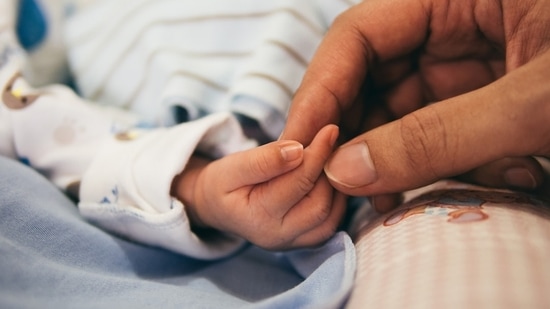
WHEN FREDDIE was born in April 2025, he seemed like a healthy baby. But at four weeks old, he was diagnosed with retinoblastoma, a rare and aggressive form of eye cancer. He was treated with photo-activated chemotherapy, in which a laser guides cell-destroying medicine to exactly where it is needed. Because Freddie’s cancer was caught early, he has a greatly improved chance of growing up with normal eyesight.
His diagnosis was so quick because of insights from his DNA. Freddie
WHEN FREDDIE was born in April 2025, he seemed like a healthy baby. But at four weeks old, he was diagnosed with retinoblastoma, a rare and aggressive form of eye cancer. He was treated with photo-activated chemotherapy, in which a laser guides cell-destroying medicine to exactly where it is needed. Because Freddie’s cancer was caught early, he has a greatly improved chance of growing up with normal eyesight.
His diagnosis was so quick because of insights from his DNA. Freddie is part of the Generation Study, an English programme which plans to sequence the complete genetic code of 100,000 babies. The idea is both to screen them for genetic diseases and to use the collected genomic data to boost medical research in future.
Similar trials are under way in America, Australia and parts of Europe, to test whether such screening should be offered for all newborns. Supporters hope to transform the diagnosis and treatment of rare diseases. Critics fret that genomic sequencing may cause needless worry for the parents of healthy babies, and require them to hand over some of the most sensitive data about their children that exists.
Many countries screen infants for diseases already. Around the world around 40m babies are screened each year, with about 40,000 having problems detected and treated. Doctors take a sample of the baby’s blood, usually by pricking its heel, and test for proteins and other markers associated with illnesses such as sickle-cell anemia or cystic fibrosis. The most comprehensive screens, such as Italy’s, look for markers of around 50 different diseases.
Looking at DNA rather than blood can increase that number dramatically, as well as spotting problems that are yet to emerge. The Generation Study is screening for around 200 genetic conditions that mostly arise during childhood. In America, the BabySeq2 project screened for around 1,000 genes linked to diseases, including some that emerge in adulthood such as breast or ovarian cancer.
But although there are big upsides to genetic screening, there are problems too. One is that genes are not always destiny. The average person carries scores of genetic variants that have been linked to diseases. But because of environmental factors, the influence of other genes or chance, most of those conditions never develop. Geneticists use the term “penetrance” to describe the proportion of people with a given disease-causing mutation that actually go on to become ill. Penetrance can vary greatly for different conditions—and there are reasons to think many estimates are too high. Many disease-causing mutations are identified by working backwards: studying people who have already become ill and only then analysing their genomes. That risks inflating the numbers.
Take retinoblastoma. Early studies estimated that RB1 mutations had penetrance of more than 90%. But a preprint paper posted in December, which examined several big health databases, found that less than a third of adults with risky RB1 variants have ever had the cancer. “I think historically people have equated genetic information with certainty,” says Caroline Wright a geneticist at the University of Exeter, who conducted the study, “which is quite outdated now”.
Testing hundreds of genes with low or middling penetrance could create a large cohort of “patients-in-waiting,” many of whom will never become ill. Uncertain diagnoses cause stress for parents, and for children when they are old enough to understand. In the case of cystic fibrosis there is a name for this sort of diagnostic purgatory: “cystic fibrosis, screen positive inconclusive diagnosis” (CFSPID). Parents of CFSPID children often question the usefulness of receiving the test results in the first place, says Anneke Lucassen, a geneticist at the University of Oxford.
Uncertainty is not the only worry. Some of the interventions that follow the detection of a genetic anomaly can cause harm themselves. In the case of retinoblastoma finding a worrying mutation triggers regular eye tests, which have few side-effects beyond inconvenience. But for conditions such as medullary thyroid cancer caused by mutations in the RET gene (where new research also suggests penetrance is much lower than had been thought), a common follow-up is to surgically remove the thyroid gland. Besides the risks from the surgery itself, that leaves patients dependent on artificial thyroid hormones for the rest of their lives.
There are solutions to some of these issues. Results could be given for only genetic variants which give rise to treatable illnesses, and which are known to have high penetrance—though that might upset those who would prefer to know everything. Careful communication with parents can also reduce stress and improve their understanding of a test’s limitations. Part of the goal for the trials is to explore exactly these sorts of questions.
Welcome to the gene pool
Screening is only half the story. A second goal of most of these programmes is to store the genomes, attached to each child’s medical records, and use them in future research. Such databases can be very useful. Data from the 100,000 Genomes Project, a British initiative that collected genomes from patients with rare diseases and their families, allowed a team of researchers at Oxford University to discover genetic variants that cause a neurodevelopmental disorder in children, for example.
The data could also be used to predict drug side-effects or how patients might respond to different treatments. Over the course of the babies’ lifetimes, the sorts of insights that are possible will almost certainly expand enormously. “I’m completely confident that our ability to understand the genome will improve,” says Ewan Birney, director of the European Bioinformatics Institute. “AI is giving us a massive boost to that.”
On the other hand, a person’s genome is among the most personal and sensitive information there is. For some researchers and parents, the idea of storing it indefinitely is a major sticking point. There have been several leaks of genetic or medical information in recent years. In 2023 hackers stole the genetic and personal information of 6.9m customers of 23andMe, a beleaguered direct-to-consumer genetic testing company. Earlier this year, the health information of around 500,000 people from the UK Biobank, a big repository of health and genetic data, was discovered for sale on Alibaba, a Chinese e-commerce website.
The same advances in genetics that enable new treatments are also likely to enable new uses for genetic information outside of medicine. In America, insurers can already use genetic test results when setting premiums (in Australia and Britain this is mostly banned). Insights from DNA could be used for blackmail, for instance around questions of paternity.
Jan Friedmen, a geneticist at the University of British Colombia, worries that many of the proposed screening programmes suffer from “mission creep”, with most requiring parents to sign up to both screening and the long-term storage of their child’s data for research. “You can’t take part in one without taking part in the other,” says Dr Lucassen of the University of Oxford, yet “they’re so different.”
Screening programmes are usually judged on whether the benefits to the patients being screened outweigh the costs of providing it. Medical research, by contrast, is justified by benefits that are uncertain, which lie years in the future, and often accrue to other people. Genomic screening programmes for newborns are attempting to do both at once, and with patients that are incapable of consenting to boot. The benefits could be enormous. But the ethics look fraught.
One Subscription.
Get 360° coverage—from daily headlines
to 100 year archives.
Archives
HT App & Website