Way before we had “read receipts” to tell us when a text message was received, a US Army team got a very different kind of response from the moon. On January 10, 1946, a small group at Camp Evans, New Jersey, bounced a radio signal off the surface of the moon and waited about 2.5 seconds for it to return. According to the team's research paper, published in the Proceedings of the I.R.E. in 1949, that single successful echo was the beginning of an entirely new field of science. The project is named Diana, for the Roman goddess of the moon.
A wartime concern under a codename
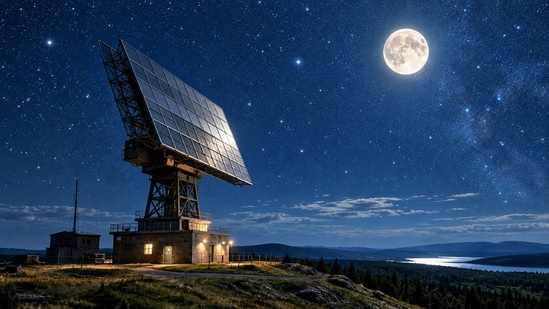
The story begins with fear, not curiosity. A year after Nazi Germany's V-2 rockets had made it to space in 1944, and around the time atomic weapons had been used in 1945, US military leaders began to worry about a threat that didn't even have a name yet: the intercontinental ballistic missile. The Pentagon had to know one thing: could radar track an incoming missile through the upper atmosphere of Earth, called the ionosphere? The job of finding out fell to Camp Evans, led by Lt. Col. John H. DeWitt Jr. DeWitt and chief scientist E. King Stodola laid out, in their research paper, precisely why the moon was next.
Why the test was aimed at the moon
No missile of the kind the Pentagon was worried about existed yet to practice on, so the team had to find a substitute. The V-2s the US had already captured were short-range weapons being tested at White Sands. They were useful, but not a stand-in for the still-hypothetical intercontinental missile the Pentagon actually needed to track. The paper says they chose the nearest large object in space, the moon. The crew, including mathematician Walter McAfee, modified a pre-existing radar set and built a large antenna on a 100-foot tower. The moon traversed the sky, so they only had about 40 minutes a day when it was in the right place. Most early efforts were failures. There were equipment glitches and timing problems, and a host of doubts, until finally the team got it right.
The 2.5-second wait that changed everything
On the morning of January 10, 1946, everything worked. The radar pulse left New Jersey, bounced off the moon, and came back about 2.5 seconds later. The paper reports this as clear proof that radio waves could penetrate the ionosphere, something no one had verified before. That one fact was important because it meant scientists could someday send and receive signals from outside the Earth, the prerequisite for satellites, space probes, and eventually human spaceflight.
A field of science born mostly by accident
{{/usCountry}}On the morning of January 10, 1946, everything worked. The radar pulse left New Jersey, bounced off the moon, and came back about 2.5 seconds later. The paper reports this as clear proof that radio waves could penetrate the ionosphere, something no one had verified before. That one fact was important because it meant scientists could someday send and receive signals from outside the Earth, the prerequisite for satellites, space probes, and eventually human spaceflight.
A field of science born mostly by accident
{{/usCountry}}The original missile-tracking application behind Project Diana never came to pass. No ICBM yet existed to track, so the military use case quietly faded. But the underlying scientific question it answered changed everything. A history of planetary radar astronomy published by NASA credits the January 1946 experiment with helping to launch radar astronomy, the practice of studying distant objects by reading their radio reflections. NASA's own record links the achievement directly to the Space Race of the Cold War that followed just over a decade later.
The hobby that keeps the experiment alive
This is where it still feels relevant today. The method used in Project Diana has a modern name: Earth-Moon-Earth, or EME, communication. Amateur radio operators all over the world still use it, bouncing signals off the Moon with much smaller gear than DeWitt’s team had. Rarely does a military test from the Cold War become a weekend hobby.
Project Diana never tracked a missile. But it showed that humans could send a signal into space and get an answer, more than a decade before satellites existed. Sometimes the biggest breakthroughs can often be the result of projects that were built to solve an entirely different problem.