E-Paper



Vaccinations to prevent cervical cancer have plummeted in Britain
Blame declining confidence, a lack of convenience and rising complacency


 Prefer HTon Google


HUMAN PAPILLOMAVIRUS (HPV) is an unwelcome consequence of a joyful pursuit. Skin-to-skin contact during sex allows the virus to spread, which can lead to genital warts and cancers of the reproductive system. In Britain HPV causes about 3,500 cases of cervical cancer each year and 900 deaths. A vaccination programme that inoculates against the virus—once a runaway success—is floundering.

The HPV vaccine is given to children aged between 12 and 15 before they are typically sexually active. Take-up in girls was around 90% in the years up to 2017. Today the rate foryear-ninegirls is 74%, on a par with Sierra Leone. In boys, who have been offered the jab for five years, it has fallen by nine percentage points to 69%. In some areas, such as Luton and Leicester, less than half of children are vaccinated.

Vaccination rates have fallen in all of Britain’s child-immunisation programmes, but the drop is sharpest for HPV. The evidence of the vaccine’s efficacy is unequivocal: a study from Scotland in 2024 found no cases of cancer-causing HPV virus among women who received it a decade earlier. The National Health Service (NHS) wants to eliminate cervical cancer by 2040, but says it needs to achieve a 90% vaccination rate by 2030. To do so means tackling the three Cs of vaccine hesitancy: confidence, convenience and complacency.
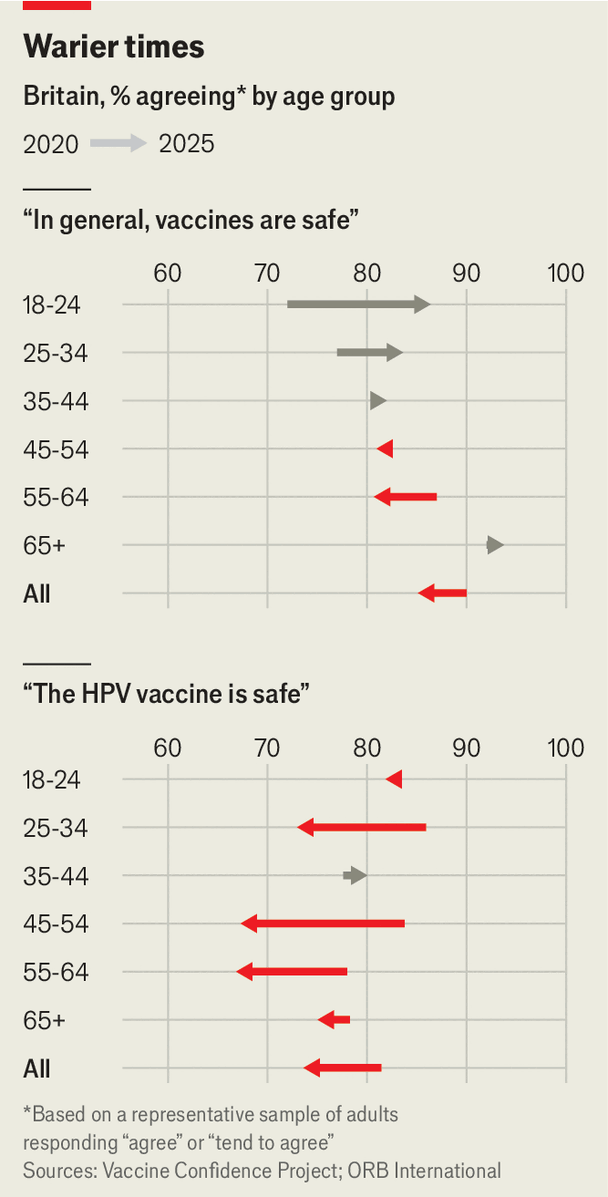
Confidence in vaccines was dented during the coronavirus pandemic. Surveys conducted by the Vaccine Confidence Project (VCP), a research outfit, find that the share of respondents who agreed that vaccines are “safe” and “important for children” declined sharply during the pandemic in many countries, but the drop was especially pronounced in Britain.
New survey data from the VCP on vaccine attitudes in Britain, shared exclusively with The Economist, show that confidence in vaccines in general has since improved. Among a representative sample of adults, 85% agree that “in general, vaccines are safe”, 15 percentage points up on 2023. But when asked specifically about the safety of the HPV vaccine, that figure drops to 74%.
Blame disinformation. Anti-vax parents allege that it causes ovarian failure and other issues. In 2019 Robert F. Kennedy junior, now America’s health secretary, called it “the most dangerous vaccine ever invented”. Numerous studies have found that its adverse effects are similar to, and no more frequent than, other common vaccines. The UK Health Security Agency (UKHSA) says that the rates of ovarian failure and other illnesses are no greater than would occur naturally in adolescent girls.
Are today’s schoolchildren affected by anti-vax views? Surveys of teenagers show that they know where to seek information they trust about vaccines: from their parents. Worryingly, the latest VCP survey shows that middle-aged people (ie, the parents of teenagers) are the least likely to say the HPV vaccine is safe.
The HPV vaccine is administered in schools, but parents must sign a form to consent to their child being inoculated. The UKHSA says that many go unsigned, not because a parent actively objects but because of a lack of convenience. It wants to tackle this by allowing children to self-consent if the nurse giving the vaccine believes that they are mature enough—though only one in five teenagers say they alone should decide whether to get vaccinated, rising to one in three by age 16.
Some parents worry that vaccination might affect their child’s behaviour. Dr Tehseen Khan, a GP in the London borough of Hackney, says Orthodox Jews he works with believe the vaccine is unnecessary because their children will have only one life-long partner. Although there is no evidence that having the vaccine changes sexual behaviour, some parents fear that it promotes promiscuity. In Scotland, which (unlike England) publishes data by ethnicity, Pakistani and Polish children have the lowest HPV vaccination rates; white British and Chinese the highest.
Complacency may also lead children and parents to wonder why the vaccine is necessary. Helen Bedford of University College London says parents often ask: “Why do I need to get my child who is not yet sexually active vaccinated against something which may or may not happen to them in 20 or 30 years time?” Vaccination programmes are often victims of their own success, making cervical cancer less common and parents less worried about it.
The NHS recently launched a catch-up campaign, targeting some 400,000 women aged under 25 who did not get inoculated in school. Whether they will get a jab may not be down to the facts. Margaret Stanley at the University of Cambridge, whose research helped develop the HPV vaccine, says at this stage you should “forget the science, it’s all about the marketing.”
For more expert analysis of the biggest stories inBritain,sign upto Blighty, our weekly subscriber-only newsletter.