
Astrophysicists have discovered the largest known merger of two black holes to form a larger single hole about 225 times the mass of the sun.
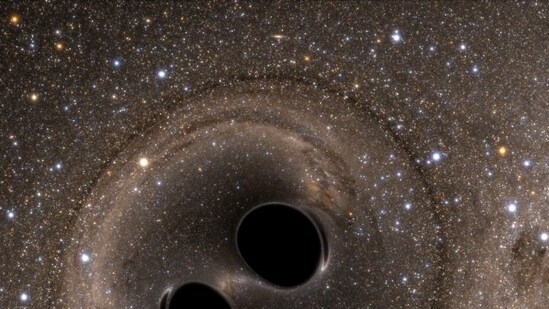
The violent collision between the spinning objects, one about 100 times the mass of the sun and the other about 140 times that amount, produced a gravitational wave that rippled across the universe.
Scientists detected the faint signal using the Laser Interferometer Gravitational-Wave Observatory (LIGO), a facility that uses 2.5-mile long, L-shaped instruments in Hanford,
Astrophysicists have discovered the largest known merger of two black holes to form a larger single hole about 225 times the mass of the sun.
The violent collision between the spinning objects, one about 100 times the mass of the sun and the other about 140 times that amount, produced a gravitational wave that rippled across the universe.
Scientists detected the faint signal using the Laser Interferometer Gravitational-Wave Observatory (LIGO), a facility that uses 2.5-mile long, L-shaped instruments in Hanford, Wash., and Livingston, La., in unison to detect and measure cosmic gravitational waves.
The signal, only 0.2 second long, was picked up in 2023 and announced July 13 at a conference in Glasgow. The findings have been posted ahead of peer review on the preprint server arXiv.
A black hole is an astronomical object with a gravitational pull so strong that nothing, not even light, can escape. While scientists have predicted the existence of black holes since the 18th century, direct evidence has only turned up recently.
In 2015, scientists used the LIGO to make the first-ever detection of a gravitational wave, a distortion in the fabric of space caused by the acceleration of massive objects such as black holes or neutron stars. Gravitational waves carry information about their origins and the nature of gravity itself. The effort won the researchers a Nobel Prize in 2017.
In 2019, scientists released the first image of a black hole at the center of a galaxy roughly 55 million light years from Earth, showing a fuzzy ring of oranges and yellows surrounding a dark center, where light is trapped by the object’s massive gravitational pull.
Because the 2023 gravitational wave only produced a small amount of data, scientists don’t know exactly how far away the object is.
“It’s kind of ridiculous to say, but it’s sort of between three or four billion light years away and 12 to 13 billion light years away,” said Mark Hannam, an astrophysicist at the University of Cardiff in the U.K., and a member of the scientific team that discovered the object, named GW231123 for “gravitational wave” and the date it was discovered.
Hannam said there is still a lot that scientists are learning and that the two black holes could have formed through earlier mergers of even smaller black holes.
“We don’t know how many black holes were merged in this process,” Hannam said.
The two black holes could also have formed from stars colliding and forming more massive, highly spinning stars which then collapsed to form black holes, according to Vicky Kalogera, professor of physics and astronomy at Northwestern University and a member of the team that analyzed the signal.
Either way, this finding has opened up new lines of research using gravitational wave detectors, according to Alessandra Corsi, professor of physics and astronomy at Johns Hopkins University who wasn’t involved in the paper.
“What excites me is finding different ways of studying the cosmos that are telling you, hey, there’s surprising things that are going on,” she said.
Write to Eric Niiler at eric.niiler@wsj.com
One Subscription.
Get 360° coverage—from daily headlines
to 100 year archives.
Archives
HT App & Website