Monday, August 31, 2026, marked the end of an era. And this time, it sure is a certainty, with no chance of a turnaround.
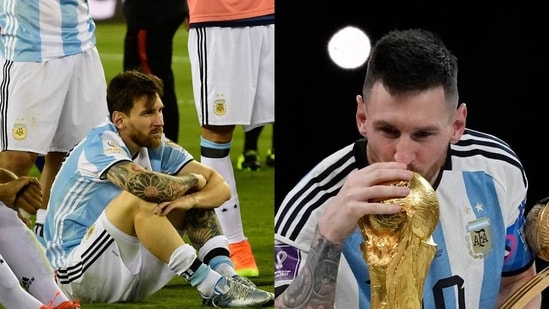
For Lionel Messi had retired from the Argentina national team before. Back in 2016, a heartbroken 29-year-old had walked away from international duty. Ten years later, he announced his retirement for the second time, this time with his head held high, his tone and decision far more content. For between then and now, Messi had scripted the most improbable second act in football history.
Incidentally, the only commonality between the two was the MetLife Stadium in New Jersey, which hosted both of his final bows.
Before 2016: The genius without a crown
Deep Dive
What were Lionel Messi's major achievements with the Argentina national team before his retirement?
Why did Messi announce his retirement from international football after the 2026 World Cup?
How did Messi's performances in the World Cup influence his legacy?
By the mid-2010s, Messi had achieved it all at club level, and the numbers were insane. He had been awarded the Ballon d’Or five times by then, won eight La Liga titles and four Champions League trophies with Spanish giants Barcelona. Messi had touched greatness with those records, but his Argentina story denied him the status Diego Maradona, the player to whom he has been forever compared, had attained.
Having made his Argentina debut in 2005 and played at the 2006 World Cup, Messi, until 2016, had only an Olympic gold medal, won in 2008, to show as his major international honour from 113 appearances.
{{/usCountry}}Having made his Argentina debut in 2005 and played at the 2006 World Cup, Messi, until 2016, had only an Olympic gold medal, won in 2008, to show as his major international honour from 113 appearances.
{{/usCountry}}However, the announcement came after Argentina went down in a fourth straight major final in nine years. After the 2007 Copa América defeat, the next three came in consecutive years — the 2014 World Cup against Germany, followed by back-to-back Copa América finals in 2015 and 2016, both lost to Chile on penalties.
In the 2014 World Cup, Messi had won the Golden Ball. Two years later, with a superb free-kick in the semi-final of the Copa América, he became Argentina’s highest scorer with 55 goals, eclipsing striker Gabriel Batistuta’s 54-goal mark.
But for Messi, those were mere consolation. The heartbreak of three major final losses in a row was too heavy to overcome, and on June 27, 2016, he announced his retirement from international duty, three days after his 29th birthday.
“For me, the national team is over,” he had said after defeat by Chile in the Copa América final, where he missed a penalty in the shootout. “I’ve done all I can. It hurts not to be a champion.”
Twenty-nine years old, zero major honours, and seemingly done.
But that lasted less than two months. Public outcry and talks with the Argentine Football Association prompted a change of heart in August 2016, and Messi returned to the Argentina fold for the World Cup qualifiers for the 2018 tournament.
The turnaround
The start, however, remained the same.
At the 2018 World Cup in Russia, Argentina suffered a Round of 16 exit against France after barely scraping through the group stage. It was a chaotic campaign for the former champions, who saw their coach leave soon after the elimination.
This was followed by severe criticism from Maradona over Messi’s leadership and his continued failure in the Argentina jersey.
“He’s a great player but he’s not a leader. It’s useless trying to make a leader out of a man who goes to the toilet 20 times before a game,” he had said.
But Jorge Sampaoli’s exit opened the door for Lionel Scaloni, who did not build a squad around Messi but built one to serve him — and the results arrived quickly.
Messi and Argentina’s long-awaited first major international trophy arrived in 2021, when they beat Brazil at the Maracanã. Qatar 2022 delivered the one prize that had eluded him, a moment labelled as the one in which “Messi completed football”.
It was the crowning moment of his career, coming after Argentina avenged their 2014 World Cup loss to Germany by beating France 4-2 on penalties after a 3-3 draw in a final widely regarded as one of the greatest ever played. Messi collected his second Golden Ball award that year.
The Finalissima against Italy followed in 2022, then a second Copa América title in 2024, with Messi still scoring and assisting deep into his late thirties.
Along the way, he became Argentina’s most-capped player and the third player in men’s international football history to score more than 100 goals. More importantly, he found a team that was learning to be his team — and he allowed himself to lead it that way.
Where Messi stands
The final numbers: 207 caps, 125 goals, 65 assists, a World Cup, two Copa America titles, a Finalissima and Olympic gold from 2008. Two World Cup Golden Balls. Argentina’s all-time leading scorer and most-capped player, full stop.
But more importantly, Messi ended his career well beyond the Maradona comparison that once held him back — not just in terms of numbers, but also in terms of legacy.
Between two retirements at the same stadium, Messi turned unfinished business into the fullest international career the sport has seen.