Savita Punia remains as grounded as ever. This is despite her becoming India’s most capped women’s hockey player on Monday.
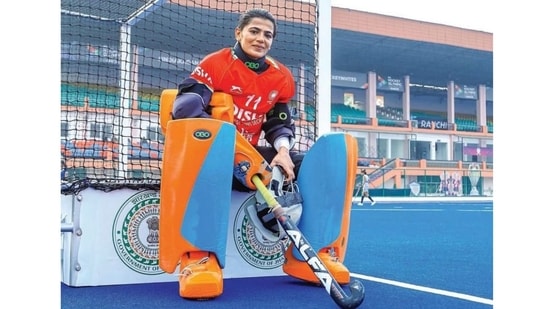
With 321 international caps, surpassing retired great Vandana Katariya’s previous record of 320, the seasoned goalkeeper has rewritten Indian women’s hockey history. She broke this record during India's dominant 17-1 victory over Indonesia in a Pool B match at the Asian Games.
True to her leadership style, the former India skipper views the historic milestone not as an individual victory, but as a tribute to the team culture and the icons who paved the way.
Deep Dive
What record did Savita Punia break during the Asian Games?
Why did Savita Punia view her milestone as a tribute to the team?
How has the frequency of international matches changed for hockey players today compared to past generations?
“Breaking the record of Vandana, who was the most hardworking and fit player in our team, it is definitely a big thing for me,” Savita told HT from Kakamigahara, the hockey venue of the Asian Games.
“Vandana has always been our idol. If someone can learn how to play without fear, it is her. To see how many times she suffered facial injuries and kept coming back after multiple stitches to the pitch with courage is commendable. If I surpass someone like her, it’s an honour for me and my family.”
Savita also kept modern era’s fixture density into perspective, acknowledging how international exposure has evolved compared to past generations.
{{/usCountry}}Savita also kept modern era’s fixture density into perspective, acknowledging how international exposure has evolved compared to past generations.
{{/usCountry}}“When Manpreet (Singh) broke Dilip (Tirkey) sir’s record (in June), we remembered how few official matches they used to get back then. Dilip sir playing over 400 matches with limited exposure was incredible,” said the 36-year-old.
“Today, with tournaments like the Pro League, we get at least 16 matches a year, so we are blessed with more opportunities to represent the country.”
The milestone comes on the heels of a historic World Cup campaign where India secured a fifth-place finish, their best show at the quadrennial showpiece since finishing fourth in the inaugural edition in 1974. Despite the accolades, the team’s consensus is clear — good is not enough.
“Everyone knows the World Cup was a good tournament for us, but there is always room for improvement. The coach’s message is simple: whatever happened is over. With the same discipline and focus, we have to start this new journey,” said Savita, who was honoured with Padma Shri — India’s fourth highest civilian honour — this year.
Sharpening circle-entry conversion
Having arrived early in Japan to acclimatise for the Asian Games, the squad logged 12-13 practice matches following an initial recovery week after the World Cup in India. A major focus in training has been sharpening their circle-entry conversion.
While India’s defensive structure earned praise against top-tier opposition, the team has worked heavily on clinical finishing upfront, drawing confidence from an effective attacking display against Germany, which they won 3-1 in the World Cup.
India have already started to address the shortcomings at the Asian Games with a 19-0 win against Uzbekistan following it up with a 17-1 victory against Indonesia.
Addressing expectations surrounding the Asian Games, Savita warned against looking too far ahead or buying into external chatter about an inevitable final against China.
Recalling how tournament brackets flipped unexpectedly at the previous Asian Games, where India finished with bronze and couldn’t qualify for the final, the squad is maintaining a strict quarter-by-quarter focus.
“We don't keep the final result in our head,” explained Savita, who debuted in 2009. “We only focus on the 15 minutes we are playing. Teams like Japan never let us win easily; they make us work hard for every goal. Then South Korea has strong high balls and flicks that we’ve specifically prepared for. We start with games against Uzbekistan and Indonesia to build our rhythm, but we take no opponent lightly.”
India will next play Thailand (September 23) before taking on hosts Japan (September 25) and Singapore (September 27) with the top two from the group qualifying for the semi-finals.
In a recent interview with this daily, former India chief coach Neil Hawgood, who guided the team to their first Olympic qualifying in 36 years at Rio 2016, suggested the squad lacks individual game-changers like Rani Rampal or Vandana. But Savita firmly pushed back against the critique.
“I respect the advice, but I don't agree,” countered Savita. “Earlier we might have relied on two key players; now we have 4-6. Look at what Deepika (Sehrawat) and Navneet (Kaur) did at the Nations Cup, or how young players like Ishika, Sakshi (Rana), Lalremsiami, and Neha (Goyal) step up. We have immense trust in our attacking unit. It’s about collective strength now.”
With a tested squad, a new mandate and a historic milestone now securely in her gloves, Savita’s outlook is clear — India’s real strength lies in their unity and unwavering self-belief as they eye gold at the Asian Games to seal a berth for the 2028 Los Angeles Olympics.