
 E-Paper



Hockey World Cup: How India is revamping its game to beat the best
A vulnerability against the suffocating physical man-to-man marking systems favoured by European heavyweights has hurt them in the past

 Prefer HTon Google


As the Indian hockey team gears up for a gruelling stretch that includes both the World Cup (Aug 15-30) and Asian Games (Sept 19-Oct 4), a glaring tactical blind spot has forced a rethink inside the management.
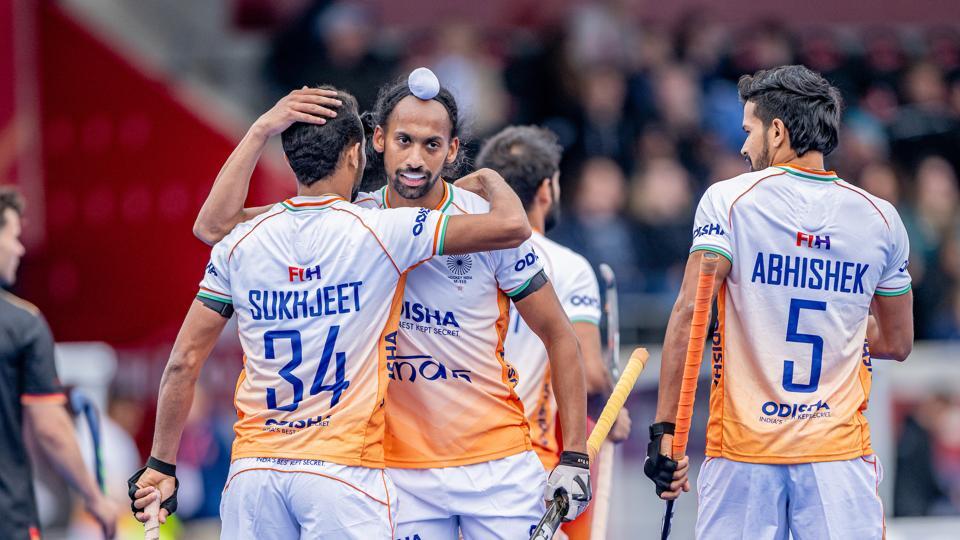
The issue? A vulnerability against the suffocating physical man-to-man marking systems favoured by European heavyweights. But the team is confronting the issue head on.
The first half of the 2025-26 FIH Pro League season proved the same. At the home leg in Rourkela in February, India lost all four games against Belgium and Argentina (two each). In Hobart in the same month, the Harmanpreet Singh-led side performed better, suffering one outright loss, two shootout losses and one shootout win.
But the Craig Fulton-coached team fared much better in Rotterdam in June where they won two and lost two each against world champions Germany and Olympic gold medallists Netherlands. Having found their rhythm, India ended their campaign with one shootout win and loss each against hosts England in London, followed by two successive victories against Pakistan.
India vice-captain Hardik Singh believes fatigue from a cramped domestic schedule (Hockey India League) contributed to the team’s poor showing early in the campaign, which exposed structural and tactical gaps.
“We are very good in the zone (zonal structure) but we struggle a lot in man-to-man,” Hardik told HT in a candid chat.
For a team desperate to end a 51-year wait for a World Cup medal, figuring out man-to-man hockey is not optional anymore, it is a prerequisite.
Zonal defence allows players to cover specific areas of the pitch, relying on spatial awareness and collective pressing. But man-to-man demands relentless tracking, superior one-on-one tackling, and an immense physical toll.
At the World Cup, to be held in the Netherlands and Belgium, India’s pool features teams — England, Wales and Pakistan — known to play this style of hockey. Progressing deeper into the quadrennial showpiece will inevitably mean clashing with Olympic champions Netherlands, a side that essentially wrote the modern playbook on man-to-man pressing.
“In the World Cup, all teams in our pool play man-to-man. So, we are working on that right now. In man-to-man, we need to be physically fit and strong. And when it’s man-to-man, we don’t need to be scared of anything, be it physical contact or intense matches,” says Hardik.
To beat the world’s best at a physical game, a team must be physically unyielding. Hardik points out that fitness has superseded everything else, primarily because the margins in man-to-man marking are defined by stamina. If a player loses a step in the fourth quarter, the entire marking system can collapse.
“Our focus is more on fitness because we have back-to-back matches. The World Cup and Asian Games are separated by just two weeks, so fitness is our first priority, followed by tactical adjustments—how fast we adjust,” adds the ace midfielder.
This tactical necessity has birthed what Hardik describes as the hardest physical evaluation of his international career — the demanding one mile (1.6km) test. Players must sprint eight laps of the pitch within a constrained time. The test is a standard physical assessment used to measure cardiovascular endurance and estimate VO2 max to qualify fitness standards.
Coupled with the Yo-Yo test where the entire squad hovers around level 22 — a benchmark that Hardik recalls reaching right before their historic Olympic medal run — the team is building for the two major events ahead.
This has resulted in specialised training sessions over the last few months. Forwards are undergoing isolated shooting drills, while the midfield engine is focusing on passing and receiving under intense pressure. Defenders, meanwhile, are logging extra hours on tracking runs and clean tackling techniques. These extra repetitions are aimed at eliminating the late-game defensive collapses that have plagued India traditionally.
The vice-captain remains optimistic about the team’s trajectory, viewing the Pro League turnaround as a vital learning curve, adding that their gritty performances against top teams was a sign of underlying strength.


