Mumbai: It is easy to spot Sanju Devi on the kabaddi mat. At 5-foot-10, she is the tallest player in the Indian women’s kabaddi team.
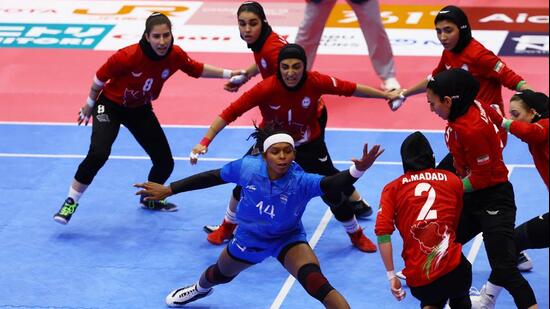
Within the circles of her sport though, it is her skill and strength that sets her apart. Former India captain Mamtha Poojari calls her the team’s “X-factor.”
And you could tell why. Through her long levers, she picks up touch points with relative ease, and with her power, she overcomes tackles and defenders almost at will. These skills were well on display at the Aichi-Nagoya Asian Games on Saturday as Sanju put in a star performance again to help the India women’s team to win a second consecutive gold medal.
With Iran threatening to inflict another upset over the defending champions like they did in the final of the 2018 edition, Sanju was sent in to raid and restore order, as India held on to win 37-34 and clinch their fourth Asian Games gold.
“She is a player who can turn a match around at any moment. She plays a high-risk game, and whenever raiding becomes tough with five defenders on the mat, we send her in and she brings back points, almost always,” Poojari, the deputy coach of the team, told HT over the phone from the Games venue.
It’s for what Sanju brings to the squad that the team held its breath earlier this year, as their star-raider underwent surgery on her right shoulder.
{{/usCountry}}It’s for what Sanju brings to the squad that the team held its breath earlier this year, as their star-raider underwent surgery on her right shoulder.
{{/usCountry}}Growing up in the Kerakachhar village in Korba district of Chhattisgarh, kabaddi was never a serious activity for her.
“Masti ke liye khelte the. (I used to play for fun),” the 24-year-old had told HT. “There was never a thought of playing for the national team. Lots of the girls in my neighbourhood and village used to play in school, so I joined them.”
It was only after she finished her 12th standard and was selected for the district team did she start training seriously at an academy around 50 km away from home.
“They had a place for us to stay, but we had to handle our food and nutrition ourselves,” she said. “But I didn’t have the money for (extra supplements). So, I used to try and make do without it.”
What she didn’t know was that her body was not getting the nutrients she needed to recover from the physical strain of a contact sport. And it came to haunt her at the worst possible time – when she made it to the national team.
“I was selected to play for India for the first time at the Asian Championships last year. At that time, things were getting better for me diet-wise, but some damage had already been done,” she said. “I picked up a shoulder injury during the tournament. I was told it may need surgery, but I don’t come from a financially stable background. My parents are farmers. We didn’t have the funds for a surgery.”
So she did what she had done whenever she faced a setback – soldiered on.
She performed well enough to earn a spot in the Indian team once again for the World Cup in December. It was a fruitful tournament for her as she won the player of the tournament award while India won the title. But the injury aggravated and she desperately needed surgery.
“Since I did well, the state government recognised my contribution and looked after my treatment,” she added.
The surgery took place in January. But the Indian coaches were clear that they wanted Sanju in the team for the Asian Games.
The training sessions were modified a bit for Sanju. In the early stages they gave her plenty of cardio work to keep her fit, before adding more upper-body work as she recovered.
By the time the Asian Games came, she was back to full fitness, and back to her defence-splitting ways.
Against a tough Iranian defence, the team relied on Sanju to give them breakthroughs.
“In high-pressure situations, we send Sanju,” Poojari added. “We know she can deliver.”
On Saturday, she did just that.