-- Nitin Narang (AICF President)In sports, some centuries come slowly, but with a majestic gait, and make a deep impact for a long time to come. For Indian chess, it took 38 years and 11 months to turn a solitary milestone into a century. In a sport like chess, where it is the mind that matters, and not pace but perseverance that counts, India getting its hundredth Grandmaster is no ordinary news.
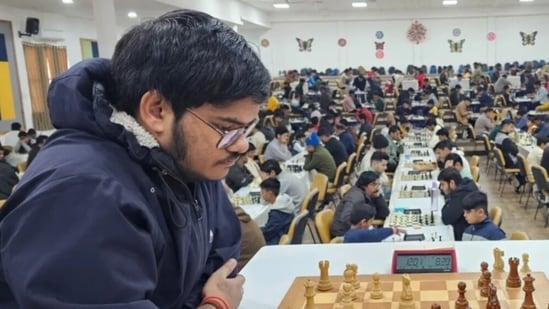
The 22-year-old International Master Anuj Shrivatri from Madhya Pradesh has earned the distinction of becoming India's 100th Grandmaster after winning the 7th ASEAN+ Individual Open Chess Championship. Coincidentally, India got its 100th Grandmaster on Diwali day. His victory was as thunderous as the bursting of Diwali crackers and as soothing as the glow of Diwali lights.
India has become only the fourth country to have a century of Grandmasters. This milestone refreshes our memory of 1988, when 18-year-old Viswanathan Anand brought glory to India by becoming the nation's first Grandmaster.
For long, India faced a peculiar kind of irony. India was proud of being the nation that gifted the world this cerebral game, which not only offers entertainment but also sharpens logical thinking and strategic skills. Indians have a cultural connection with chess as it has been one of the most popular games in our sporting tradition.
{{/usCountry}}For long, India faced a peculiar kind of irony. India was proud of being the nation that gifted the world this cerebral game, which not only offers entertainment but also sharpens logical thinking and strategic skills. Indians have a cultural connection with chess as it has been one of the most popular games in our sporting tradition.
{{/usCountry}}Indians are born with a knack for manoeuvring on 64 squares. For centuries, Indian villages and towns have had unsung veterans and youngsters possessing outstanding playing skills. Yet we lagged behind in chess itself at the international level because of a lack of resources, adequate exposure and opportunities.
In India, chess gradually gained wider recognition and support, with growing encouragement from institutions, organisations and the sporting fraternity.
Behind the success of most of our chess players are parents who make enormous personal, professional and financial sacrifices to support their children's ambitions. Some even put established careers on hold to accompany them to international tournaments, training camps and global circuits. Gukesh's father, Dr Rajini Kanth, for instance, gave up his career as an ENT surgeon to travel with his son, while the father of Savitha Sri left his job in Singapore to support her chess journey. These sacrifices often remain an important, though less visible, part of a young player's success.
Yet, these challenges often become a driving force, motivating our young players to work harder and make their parents and families’ sacrifices worthwhile.
Our young chess stars, from D Gukesh and R Praggnanandhaa to Parimarjan Negi, Raunak Sadhwani, Nihal Sarin, Bharath Subramaniyam, Aryan Chopra, Leon Mendonca, Arjun Erigaisi and Pranav Anand, clinched the Grandmaster title aged between 12 years and 7 months and 15 years and 10 months.
India also has a remarkable crop of young chess talents, or wonder kids, such Jeshua J, Devanarayanan Kalliyath, Prayank Gaonkar, Aaradhyo Guin, Aaranya R, Arpitangshi Bhattacharya and Saiaastha Singh, who, at such a young age, are already showing signs of future Grandmasters. They are winning medals and tournaments, making their parents, society and the nation proud. More importantly, their achievements are encouraging other children and their parents to recognise and explore their own potential.ALSO READ: India's GM century: The high cost of chasing a chess dream
One of our players Anish Sarkar, who deserves to be called the ‘Chhote Sarkar’ of this cerebral game, made the nation proud by receiving the prestigious Bal Puraskar from President Droupadi Murmu. As a three-year-old, he became the youngest player to achieve a FIDE rating of 1555, adding another remarkable chapter to India's chess story.
From 44 Grandmasters in 2016, India’s tally rose to 100 in 2026, with 56 players earning the coveted title in the intervening decade. This in itself demonstrates the calibre of Indian chess talent at the global level. With the right nurturing, structured support and a little extra push, India has the potential to become the undisputed powerhouse of world chess.
Our bright young players have already transformed this national aspiration into reality, establishing India as a chess superpower. Gukesh became the 18th and the youngest undisputed World Chess Champion in 2024, India secured the FIDE World Cup after 23 years, and in the same year India won a historic six gold medals at the 45th FIDE Chess Olympiad held in Budapest. That was the beginning of the 2.0 era of Indian chess.
Chess is one of the most accessible and low-cost indoor sports. It requires very little space and minimal infrastructure; a simple tabletop is sufficient to play the game. Hence it is very easy to introduce chess into the sporting curriculum of our schools and colleges.
The All-India Chess Federation (AICF) and the Indian chess fraternity have always been optimistic and forward-looking, believing that it is better to prepare for the golden era ahead than to lament the era gone by.
Guided by this spirit, AICF has adopted a multi-pronged, long-term strategy focused on identifying and nurturing talent, building the sport’s brand, securing corporate endorsements and launching ‘CHESS+’ to bring structured chess education into schools.
But the most important strategy was to provide quarterly financial assistance to India’s most promising young players. Launched in June last year, the initiative aims to help them pursue the sport without having to worry about the costs of training and competition.
In the first phase, 42 promising players from the Under-7 to Under-19 age groups, across the Open and Girls categories, were selected for financial assistance. Their selection was based on their performances in the 2024 National Championships. Each player receives between ₹60,000 and ₹1.5 lakh. The total financial outlay under the scheme is ₹6,15,60,000.
The quarterly stipends are intended to meet the players’ coaching and travel expenses, enabling them to participate in international competitions and pursue higher goals. This initiative draws inspiration from Prime Minister Shri Narendra Modi’s call to empower athletes at the grassroots and reflects AICF’s commitment to translating that vision into action.
It is a key component of the national chess development blueprint. By investing in young talent and easing the financial burden on promising players, we are laying a strong foundation for the next phase of Indian chess and nurturing the champions who will raise India’s standing in global chess even higher.
Whether in politics, polity or sports, the right leadership and the right policies matter. The year 2014, when Shri Narendra Modi became India's Prime Minister, proved to be a catalyst for the transformation of the Indian sporting ecosystem.
Indian chess, too, has benefited from the special attention of the Prime Minister. Here is a Prime Minister who encourages young talent, engage with them and celebrate their successes.
Today, India is not just hosting global events like the FIDE World Cup and Chess Olympiad, it is also setting the global discourse. The younger generation has come forward to further consolidate India's global dominance, with a far greater commitment to restoring the old glory of chess in India.
This historic hundred is not going to satiate that hunger; rather, it has triggered an even greater hunger for Grandmaster titles.