
 E-Paper



5 things you should check before buying a home theatre system for your living room
Buying a home theatre system is about more than speaker count or power output. Here are five important things to check.


Our Picks
FAQs
Our Picks
| Product | Rating | Price |
|---|---|---|
Sony SA-D40M2 All in One 4.1ch Home Theatre System with 100W Power Output and Powerful Subwoofer – Black (Model no.YY2090C)View Details  | ₹9,480 | |
 | ||
Sony HT-S40R Real 5.1ch Dolby Audio Soundbar for TV with Subwoofer & Wireless Rear Speakers, 5.1ch Home Theatre System (600W, Bluetooth & USB Connectivity, HDMI & Optical Connectivity, Sound Mode)View Details | ||
| ||
Unlock Personalized ₹1,580x 6 months₹9,480  100% Secure 100% Secure Flexible EMI Tenure Flexible EMI Tenure | ||
boAt Aavante Bar 3600/3500, 500W Signature Sound,5.1CH, Wall Mountable Design, Bass & Treble with Master Remote Control, Bluetooth Sound Bar, Home Theatre Soundbar Speaker (Premium Black)View Details | ₹10,999 | |
| ||
Sony Bravia Theatre System 6(HT-S60) Real 5.1ch 1000W,Dolby Atmos/DTS:X Soundbar Home Theatre with Powerful subwoofer & Wireless Rear Speakers,Voice Zoom3,BCA App, Bluetooth,HDMI eARCView Details | ₹49,990 | |
| ||
Zebronics Juke Bar 9560 950W Soundbar 2026 Launch, 5.1 CH Surround Sound, Dolby Audio, 30.48cm Wireless Subwoofer, Dual Rear Satellites, BTv5.3, HDMI ARC, USB, LED Display, Wall MountableView Details | ₹25,199 | |
| ||

Research-Backed Choices
Every product we recommend is chosen through a combination of Primary Research and Secondary Research.
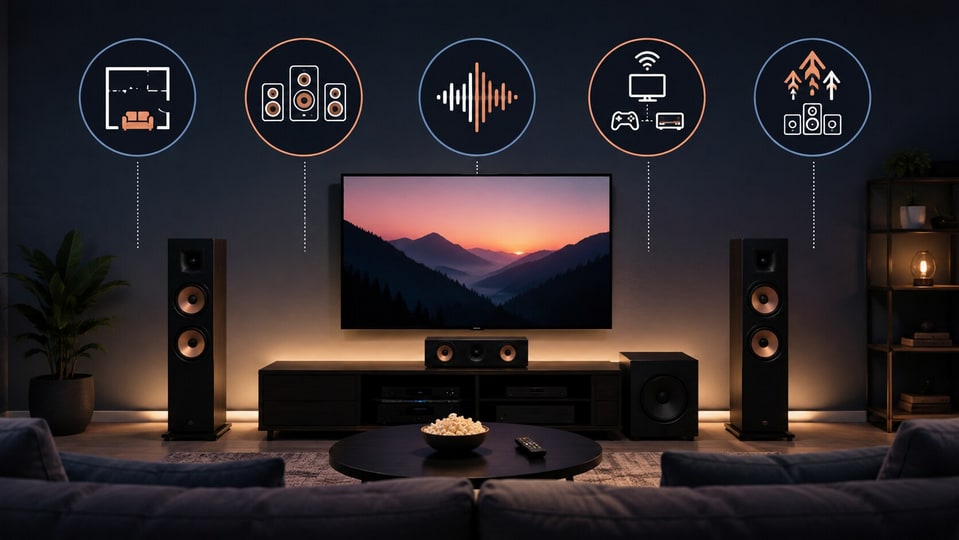

A home theatre can transform your movie-watching experience altogether; once you have experienced movies and shows with a home theatre, it's hard to go back. But choosing one is no simple task; you need to consider room size, speaker placement, audio formats and connectivity, which can all affect how the system actually sounds in your home.
Unlike a television, where specifications such as screen size and resolution are relatively easy to compare, home theatre systems require you to think about how several components work together. A system that sounds impressive in a showroom may not deliver the same experience in a small living room.
Before spending your money, here are five things worth checking
| What to check | What to look for | Why it matters |
|---|---|---|
| Room size and layout | Speaker size, placement options and available space | Ensures the system suits the room rather than overwhelming it |
| Speaker configuration | 2.1, 3.1, 5.1, 7.1 or Atmos layouts | Determines the level of surround and spatial audio you can experience |
| Audio format support | Dolby Digital, DTS, Dolby Atmos and DTS:X | Ensures compatibility with modern films, shows and games |
| Connectivity | HDMI ARC/eARC, optical, Bluetooth and Wi-Fi | Makes it easier to connect TVs, consoles, streaming devices and phones |
| Placement and upgrades | Wall mounting, wireless speakers, calibration and upgrade options | Helps you get better performance and keeps the system flexible |
Start with your room, not the speaker count
The size and layout of your room should be the starting point when choosing a home theatre system. A large 7.1-channel system may sound impressive on paper, but it can be excessive in a compact living room where there is little space to position the rear speakers correctly.
For smaller rooms, a 2.1 or 3.1-channel setup can often provide a noticeable improvement over a TV's built-in speakers without taking up too much space. If you have a larger dedicated entertainment area, a 5.1 or 7.1-channel system can make more sense.
You should also consider the position of your sofa, television and walls. Surround speakers work best when they can be placed around the listening position rather than simply sitting next to the TV.
Room acoustics matter too. Bare walls and hard floors can create reflections, while curtains, carpets and furniture can help absorb unwanted echoes. This is why the same home theatre system can sound very different in two homes.
Do not judge a system by wattage alone
Power ratings are among the easiest specifications to notice when shopping for speakers, but they do not tell you everything about sound quality.
A higher wattage does not automatically mean better or louder sound. The quality of the speakers, amplifier, drivers and overall tuning also plays an important role. Some systems may advertise very high peak power figures that do not accurately represent how they perform during normal use.
Instead, look at the overall speaker configuration and the type of experience you want. A system with a dedicated centre speaker can be particularly useful for films and TV because dialogue is generally anchored to the centre channel.
A separate subwoofer is also worth considering if you enjoy action films, music or gaming. It handles low-frequency effects such as explosions, rumbling engines and bass-heavy soundtracks, allowing the main speakers to focus more on voices and other details.
Check which surround sound formats are supported
Audio formats can make a bigger difference than many buyers expect. If you are investing in a proper home theatre setup, check whether it supports the formats used by your TV, streaming services, Blu-ray players and gaming consoles.
Dolby Digital and DTS are common surround sound formats, while Dolby Atmos and DTS add height information to create a more three-dimensional soundstage.
However, there is an important distinction between supporting a format and actually having the hardware to reproduce it properly. Some systems may advertise Atmos support but use virtual processing rather than dedicated upward-firing or height speakers.
That does not necessarily make them bad systems. Virtual surround processing can work well when physical speakers are difficult to install. But if immersive audio is one of your main reasons for buying a home theatre system, check exactly how the system creates those effects.
Look closely at connectivity
A home theatre system is likely to become the central audio hub for several devices, so connectivity should not be treated as an afterthought.
HDMI is particularly important. Look for HDMI ARC or eARC support if you want to send audio from your TV to the home theatre system through a single HDMI connection. eARC offers greater bandwidth and can support higher-quality audio formats.
Think about everything you currently use or may add later. A gaming console, streaming box, Blu-ray player and set-top box can quickly occupy several ports.
Wireless connectivity is also useful. Bluetooth makes it easy to play music from a phone, while Wi-Fi support can offer access to streaming services and other network-based features on compatible systems.
Before buying, check the number and type of ports rather than assuming that every home theatre system will accommodate all your devices.
Think about placement and future upgrades
The final thing to consider is how the system will fit into your home over the long term. A home theatre system is not something you should choose purely from a specification sheet.
Check whether the speakers can be wall-mounted, placed on stands or positioned on furniture. Rear speakers may require longer cables, while wireless surround speakers can make installation easier but may still need power connections.
It is also worth considering whether the system allows future upgrades. If you are starting with a basic setup, being able to add rear speakers or a better subwoofer later can extend its useful life.
This becomes particularly important if you are investing in a receiver-based system with separate speakers. Such setups generally offer more flexibility than all-in-one systems, although they can also require more space, wiring and setup.
Ultimately, the right home theatre system is not necessarily the one with the biggest speaker count or the highest power rating. It is the one that fits your room, supports the audio formats you actually use and gives you enough connectivity and flexibility for your setup. Taking a little time to check these five areas can help you avoid spending more on features that your room or devices cannot properly use.
Similar articles for you
Planning to buy a Bluetooth speaker? These deals deserve your attention
Top 10 Bluetooth speakers with big sound for your home Christmas party
Big bass, lower prices: Party speaker deals that stand out on Flipkart
Disclaimer: At Hindustan Times, we help you stay up-to-date with the latest trends and products. Hindustan Times has an affiliate partnership, so we may get a part of the revenue when you make a purchase. We shall not be liable for any claim under applicable laws, including but not limited to the Consumer Protection Act, 2019, with respect to the products. The products listed in this article are in no particular order of priority.