EARLIER THIS month Monte Carlo hosted the annual get-together of the world’s insurance firms, including the reinsurers who insure them. The “Rendez-Vous de Septembre” is a swanky affair. Rooms at the main venue often cost more than $2,000 per night. Attendees can choose to arrive via helicopter. The organisers discourage any side-events that might compete with the “Official Cocktail”. Yet at this month’s gathering the gin drinkers’ thoughts drifted to less glamorous locales: the dusty deserts, flat farms and desolate
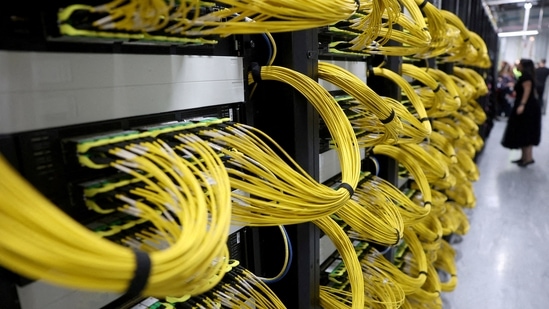
EARLIER THIS month Monte Carlo hosted the annual get-together of the world’s insurance firms, including the reinsurers who insure them. The “Rendez-Vous de Septembre” is a swanky affair. Rooms at the main venue often cost more than $2,000 per night. Attendees can choose to arrive via helicopter. The organisers discourage any side-events that might compete with the “Official Cocktail”. Yet at this month’s gathering the gin drinkers’ thoughts drifted to less glamorous locales: the dusty deserts, flat farms and desolate shrublands where data centres are being built.
Despite their downmarket locations, such centres are worth vast sums of money. Their owners are thus keen to insure them against natural catastrophes, cyber-hacks and a host of other dangers. Premiums tied to such projects are set to rise from $11bn today to $24bn by 2030, reckons Swiss Re, a reinsurance giant. That makes data centres a welcome source of growth in an industry that is anxious about a looming downturn. But like a good cocktail, the rush can also induce some headaches.
For a start, data centres are big undertakings, physically as well as financially. Although some have been in use—and insured—since the dot-com boom, the greater scale required by artificial intelligence can scramble conventional risk models. The larger the data centre, the greater the chance that a tornado might rip through it. Some 40% of America’s data-centre capacity sits in zones often exposed to such dangers, Swiss Re notes. More than a quarter are at risk of being pelted by large chunks of hail multiple times each year. Many centres are clustered together in spots like Virginia and Texas. If a natural disaster affects one, it will probably affect others.
Inside the big boxes, the layouts of many centres also worry underwriters. Operators are eager to place power storage, including lithium batteries, as close as possible to the AI chips. Builders reckon this cheek-by-jowl arrangement helps ensure a consistent power supply. But proximity also increases the chances that a battery fire will engulf semiconductors and other ultra-pricey kit. The concentration of expensive assets, especially chips, in a single building means a single event could inflict eye-watering losses.
The internet has always been vulnerable to power failure, cyber-attacks and other mishaps that can sever connections and disrupt business. These business interruptions are often covered by cyber-insurance policies. But in the case of data centres, such interruptions may be unusually costly, says Alexis Dyschkant of Covington & Burling, a law firm, because of the sheer scale of economic activity that could be tied to a single centre. Given bottlenecks in many parts of the AI supply chain, replacing damaged kit could take a while. The precise terms of coverage will therefore matter a great deal. Some policies may only begin payments after the first 12 or 24 hours of disruption—plenty of time for millions of dollars of losses to occur.
Assuming they can iron out the details of mega-policies, insurers then face a second hurdle: how to fund them. The largest insurance bundles today typically cover up to $8.5bn of value for projects worth up to $25bn in total. Policy writers then cover their own exposure through reinsurance, says Jimmy Keime of Swiss Re. Even if today’s coverage limits increase in the coming years, many large projects will be insured to less than half their value.
Projects seeking additional cover will have to get creative. One option is to add on “surety bonds”, which already play a role in the industry. They are sometimes issued by insurance companies on behalf of builders at the insistence of the builder’s clients. The client can then get compensated even if the builder falls down on their obligations.
Indeed, insurance-linked securities as a whole are becoming an increasingly important asset class. CalPERS, one of the world’s largest pension funds, has increased its investments in catastrophe bonds and other insurance-linked securities by some 70% this year to about $2.5bn. Although such securities are mainly linked to homeowners’ policies, the industry has been chattering about similar products tied to data centres.
Beyond creativity, tech firms will have to rely on their own financial muscle. The “hyperscale” cloud-computing giants like Amazon and Oracle that spend heavily on data centres have deep pockets. This allows them “to take on quite a bit of risk themselves”, notes Darren Tasker of Allianz, an insurance company. Some firms have created their own mini insurance companies to help them handle their exposure. According to Captive Review, a trade publication, premiums for such “captive” insurance worldwide rose by 8% in 2025 to roughly $240bn.
For now insurance bosses speak of data centres with glee. But where there are premiums, there will eventually be payouts. Earlier this month Amazon revealed that Iranian drone attacks had damaged some of its Gulf data centres, leading to irreversible losses of customer data. The incident was a reminder of the digital world’s physical vulnerabilities, particularly since the Middle East is another data-centre hot spot. A single “shock loss” would not erase the industry, says Caroline St. Clair of Aon, a broker. But it might make insurers marginally less gleeful. Drink up.
One Subscription.
Get 360° coverage—from daily headlines
to 100 year archives.
Archives
HT App & Website