I have used quite a few mirrorless cameras over the years, but the Fujifilm X-T30 III is easily one of the smallest cameras I have used in a long time. The moment I picked it up, it almost felt like a toy in my hands, and considering how compact the body is, that is not necessarily a bad thing. The camera is small enough to carry around without thinking twice, but still gives you the feeling of using a proper camera with physical controls, interchangeable lenses and Fujifilm's famous Film Simulation modes.
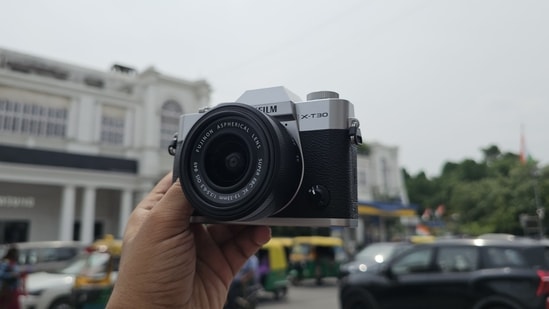
Priced at ₹1,11,499 with the XC 13 33mm lens, the X-T30 III is aimed at people who want to step up from a smartphone or compact camera without jumping into a much larger and more complicated setup. I am not a professional photographer myself, and that actually made using this camera more interesting because despite all those buttons and dials, I never felt completely lost. After spending weeks shooting mostly buildings, monuments and street scenes, here's how I found the Fujifilm X-T30 III.
Fujifilm X-T30 III: Specifications
| Specification | Details |
|---|---|
| Sensor | 26.1MP APS-C X-Trans CMOS 4 |
| Processor | X-Processor 5 |
| Kit Lens | XC 13-33mm F3.5-6.3 OIS |
| Focusing | Subject detection AF (Face/Eye) |
| Viewfinder | 2.36 million-dot EVF |
| Display | 3-inch tilting touchscreen (1.62M dots) |
| Video Capability | 6.2K at 30fps or 4K at 60fps |
| Battery Life | ~425 frames (Economy mode) |
| Weight | 378g (including card and battery) |
| Price Tag | ₹1,11,499 with the 13-33mm kit |
Fujifilm X-T30 III: Design
The first thing you notice about the X-T30 III is just how small it is. This is one of the most compact mirrorless cameras I have ever used, and even with my relatively small hands, the camera looks tiny. The good thing is that I actually enjoyed this compact form factor because it makes the camera incredibly easy to carry around. You can put it in a small bag and forget about it until you actually need to take a picture.
The problem is that Fujifilm has somehow managed to fit more than a dozen buttons, dials and switches onto this tiny body. A lot is going on here, and I can imagine someone with larger hands struggling to get around all these controls comfortably. I personally loved having physical controls because I could change settings without digging through menus, but there were times when I felt the camera was trying to give me more controls than I actually needed.
The good thing is that most of them can be customised, so a professional photographer who knows exactly how they want to shoot will probably appreciate this much more than I did.
The design itself is classic Fujifilm. You get a combination of metal and soft-touch plastic that feels solid while keeping the weight impressively low. There is also a built in flash, and thankfully Fujifilm has gone with a proper Xenon flash. My only major complaint here is the lack of weather sealing. Considering this is a compact camera designed to be carried around, some level of weather protection would have made it much more reassuring for travel and outdoor photography.
Fujifilm X-T30 III: Controls
The physical controls are probably the most intimidating part of this camera if you are coming from a smartphone or even a basic camera. You have dedicated dials and switches covering almost every aspect of photography, and initially I found myself wondering how much of this I would actually use.
But Fujifilm has included something I really appreciated: a dedicated Auto switch. Flip it and the camera takes care of almost everything for you. You can simply choose your Film Simulation, point the camera at your subject and take the picture without worrying about shutter speed, aperture or ISO. For someone like me who isn't a professional camera person, this makes a huge difference.
And when you do want more control, you can simply switch back and start using the physical dials. I eventually found myself using them more often because they make the whole process of taking a photograph feel much more involved than simply tapping a screen.
Fujifilm X-T30 III: Display
The X-T30 III comes with a 3-inchlo touchscreen that is large enough for framing shots and going through the menus, but brightness isn't its strongest point. During my testing, I found myself struggling a little under harsh sunlight, and this is one area where a brighter panel would have made the experience better.
The screen also doesn't fully articulate. It can tilt upwards and downwards, which is useful when you want to shoot from a lower angle while keeping the camera closer to your body, but it isn't the kind of display I'd recommend for someone who plans to vlog or record themselves regularly.
The camera does have a 2.36 million dot EVF, but I mostly used the screen because I'm simply more comfortable shooting that way. For someone who is used to using an EVF, the experience could obviously be different.
Fujifilm X-T30 III: Film Simulations
I am primarily an architectural photographer, so most of my sample images with this camera involve buildings, monuments and city scenes. And this is where I really started enjoying the X-T30 III.
The pictures themselves are excellent, but the Film Simulation modes are what made me want to keep experimenting. Fujifilm gives you a huge selection of looks, and I spent quite a bit of time switching between them to see how the same building or monument could look completely different without having to edit the image afterwards.
Two simulations that particularly stood out to me were Nostalgic Neg and REALA ACE. Nostalgic Neg gives the images a warmer, more vintage look, while REALA ACE feels more natural and works really well when I want the colours to stay closer to what I actually saw. These are also two of the Film Simulations that camera reviewers have particularly liked on the X-T30 III.
I also spent some time with ETERNA BLEACH BYPASS, especially for architectural shots where I wanted more contrast. It is not a true monochrome mode, but the combination of very low colour saturation and high contrast gives the images an almost black-and-white look while retaining a little colour
Fujifilm X-T30 III: Image Quality
There is no major change to the sensor here. Fujifilm is still using the 26.1MP X Trans CMOS 4 sensor, but the combination of that sensor with the newer X-Processor 5 produces excellent results.
In my testing, I was particularly impressed with night photography. There is visible grain if you zoom into the photographs, but unless you are really pushing into the image, it is difficult to notice. The overall photograph still looks clean and detailed, and I was genuinely happy with the results.
During the day, the camera delivers the kind of image quality you would expect from a good APS C mirrorless camera, with plenty of detail and excellent colours. More importantly, the Film Simulations give the images a character that I personally enjoy much more than heavily processed smartphone photographs.
Fujifilm X-T30 III: Autofocus
This is one of the biggest upgrades in the X-T30 III. The new X Processor 5 brings Fujifilm's newer subject detection system to this compact camera, and I was genuinely impressed with how quickly it worked.
Even when shooting wider scenes, the camera could quickly detect faces and adjust focus without me having to constantly move the focus point around. For the kind of photography I was doing, this made the camera feel much more responsive and reliable.
Fujifilm X-T30 III: Video
The X-T30 III looks like a camera designed primarily for photography, but the video specifications are surprisingly serious. It can record 6.2K at 30fps using the full sensor, along with 4K at 60fps and high frame rate recording at 1080p. Fujifilm also supports 10-bit internal recording, which gives creators considerably more flexibility when grading footage.
There is one obvious limitation, though. This tiny body doesn't have active cooling, and there are recording time and heat limitations during demanding video modes. I didn't personally perform a long-duration 4K or 6.2K overheating test, so I won't pretend otherwise. If video is your primary reason for buying this camera, I'd still look at something with better thermal management and a fully articulating screen.
Fujifilm X-T30 III: Battery
Battery life was another pleasant surprise. I mostly used the camera for still photography, and during my testing I barely felt the need to change the battery. Fujifilm rates it for up to 425 shots in Economy mode, and my experience suggests that still photographers should have very little to worry about during a normal day of shooting. And when you do run low, the camera can be charged through USB, so carrying a power bank is enough to keep it going while travelling.
I also don't really use camera companion apps, so I never relied on wireless transfers. I prefer taking the SD card out and using a card reader with my laptop, which is still the fastest and simplest way for me to move a large batch of photographs.
Fujifilm X-T30 III: Pros and cons
Pros
- Extremely compact and lightweight
- Excellent image quality and colour reproduction
- Fantastic Film Simulation modes
- Fast and capable subject detection autofocus
- Excellent low-light photography
- Useful Auto mode for beginners
- Great 13- 33 mm kit lens for travel and street photography
- Impressive 6.2K video capabilities
- Excellent battery life
- Physical controls will appeal to enthusiasts
Cons
- No weather sealing
- Display isn't bright enough in harsh sunlight
- Screen doesn't fully articulate
- Large number of controls can feel overwhelming
- No IBIS
- Body size may feel cramped for users with larger hands
Fujifilm X-T30 III: Should you buy it
The Fujifilm X-T30 III isn't the camera to buy if you want the most advanced hardware in this price range. But if you want a small, lightweight camera that takes fantastic pictures and makes photography fun, this is an easy camera to like. I especially enjoyed the Film Simulations, compact design and Auto mode, which made the camera approachable even for someone who isn't a professional photographer.
At ₹1,11,499 with the 13- 33 mm lens, it also makes a lot of sense as an everyday or travel camera. The lack of weather sealing, IBIS and a fully articulating screen are compromises you need to accept, and there are more capable alternatives if video is your priority. But for still photography, especially if you love experimenting with colours and want something small enough to carry everywhere, the Fujifilm X-T30 III is one of the most enjoyable cameras I've used in this category.
Similar articles for you
Canon EOS R6 Mark III camera review: Built for photographers, perfected for creators
BenQ RD270Q monitor review: A monitor that takes long screen hours seriously
Oppo Reno 16 5G review: A compact camera masterpiece held back by one major compromise
Disclaimer: At Hindustan Times, we help you stay up-to-date with the latest trends and products. Hindustan Times has an affiliate partnership, so we may get a part of the revenue when you make a purchase. We shall not be liable for any claim under applicable laws, including but not limited to the Consumer Protection Act, 2019, with respect to the products. The products listed in this article are in no particular order of priority.