 E-Paper



I would choose mirrorless camera today, but here is why I still miss DSLRs
DSLRs still have their strengths, but mirrorless cameras have changed how I look at autofocus, size, video and the future of camera systems.


Our Picks
FAQs
Our Picks
| Product | Rating | Price |
|---|---|---|
Sony Alpha ILCE-6700 APS-C Interchangeable-Lens Mirrorless Camera (Body Only) | Made for Creators | 26.0 MP | Artificial Intelligence Based Autofocus | 4K 120p Recording - BlackView Details  | ₹1.18L | |
 | ||
Canon EOS R100 24.1 MP Mirrorless Camera (Black) with RF-S18-45mm f/4.5-6.3 is STM Optical Zoom Lens | 4k VideoView Details | ||
| ||
Unlock Personalized ₹19,665x 6 months₹1.18L  100% Secure 100% Secure Flexible EMI Tenure Flexible EMI Tenure | ||
Fujifilm X-T5 40MP APS-C X-Trans Sensor|Smartchoice|Pixel Shift|IBIS System|Ultra high Resolution mirrorless Camera|6.2k 30p|Subject Tracking|Touchtracking|Quick Lever for Photo/Video - SView Details | ₹1.46L | |
| ||
Canon EOS R6 Mark II Smartchoice 24.2 MP Mirrorless Camera-Body Only (Black)View Details | ₹1.60L | |
| ||

Research-Backed Choices
Every product we recommend is chosen through a combination of Primary Research and Secondary Research.
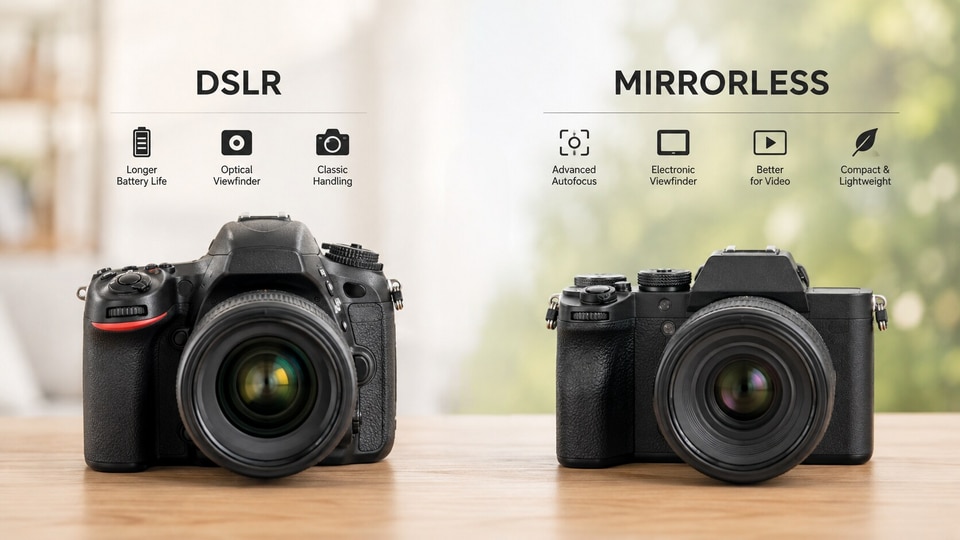

There was a time when choosing a camera meant choosing between different DSLR models. Canon and Nikon dominated the conversation, and if you wanted a serious camera for photography, a DSLR was the obvious choice. But things have changed a lot.
If I were buying a new interchangeable lens camera today, I would choose mirrorless. The autofocus is faster, the bodies can be smaller, electronic viewfinders show you what the final exposure will look like and video capabilities are much better than they used to be.
But after spending time with both, I would not say that DSLRs are simply bad cameras now. In fact, there are a few things about DSLRs that I still prefer.
Quick comparison between DSLR and mirrorless cameras
| Feature | DSLR | Mirrorless |
|---|---|---|
| Viewfinder | Optical | Electronic |
| Autofocus | Very good | Generally better on newer models |
| Battery life | Usually better | Usually lower |
| Size | Larger | Usually smaller |
| Video | Good on many models | Generally better |
| Lens ecosystem | Huge used market | Strong and growing |
| New technology | Limited | Where most new development is happening |
| Best for | Budget buyers and existing DSLR users | New buyers, hybrid shooters and creators |
The biggest difference is inside the camera
The basic difference between the two is actually quite simple.
- A DSLR uses a mirror inside the camera. Light comes through the lens, hits the mirror and is directed towards the optical viewfinder. When you press the shutter, the mirror moves out of the way so that light can reach the sensor.
- A mirrorless camera removes that mirror mechanism. Light goes directly to the image sensor, and you see the scene through an electronic viewfinder or the rear display.
This sounds like a small engineering change, but it affects almost everything else about how the cameras work.
Mirrorless cameras can be smaller and lighter, autofocus can be handled directly through the sensor and the electronic viewfinder can show exposure, white balance and other settings before you take the picture.
I prefer the mirrorless viewfinder now
The optical viewfinder on a DSLR has one thing that an electronic viewfinder cannot completely replicate: you are looking directly through the lens. There is no screen between you and the subject. It feels natural, immediate and very photographic.
But once I got used to an electronic viewfinder, I started missing its advantages whenever I went back to a DSLR. With a mirrorless camera, I can see how changing exposure settings will affect the image before pressing the shutter. In difficult lighting, this can save time and reduce the number of test shots.
You can also see things such as focus peaking, histograms and other information directly in the viewfinder. For someone learning photography, I think this can actually make the camera easier to understand.
Autofocus is where mirrorless has pulled ahead
This is probably the biggest practical difference for me. Modern mirrorless cameras have become extremely good at subject detection and tracking. Depending on the model, they can recognise people, animals, birds, vehicles and other subjects and keep tracking them across the frame.
That makes a big difference for wildlife, sports, events and even casual photography where the subject is moving unpredictably. DSLR autofocus can still be very good. Professional DSLRs were used for years to photograph sports and wildlife, after all.
But camera development has moved towards mirrorless, and the latest autofocus systems are one of the clearest examples of why.
Battery life
Because a DSLR's optical viewfinder does not need an electronic display, the camera can generally last much longer on a single battery compared with many mirrorless cameras. A mirrorless camera has to power the sensor, electronic viewfinder and other electronics continuously when you are composing and shooting.
Battery technology has improved, and modern mirrorless cameras are much better than early models. But if I am going on a long shoot and do not want to think about charging, a DSLR still feels reassuring.
Size is where mirrorless makes the most sense
Removing the mirror and optical viewfinder mechanism gives manufacturers more freedom with the body design. Many mirrorless cameras are noticeably smaller and lighter than comparable DSLRs.
That does not mean every mirrorless camera is tiny. A professional full-frame mirrorless body with a large telephoto lens can still be a very big setup. But when you are travelling or carrying a camera around all day, saving even a few hundred grams can make a difference.
For me, this is one of those advantages that sounds insignificant in a specification sheet but becomes obvious after carrying a camera for several hours.
Video makes the decision even easier
Mirrorless cameras were designed around continuously reading the image sensor, which makes them particularly well suited to modern video features. Newer models offer advanced autofocus during video, high-resolution recording, high frame rates and features aimed specifically at creators.
DSLRs can shoot excellent video too. Some became extremely popular with filmmakers and YouTubers because of their large sensors and interchangeable lenses.
Mirrorless cameras are now being designed from the beginning as hybrid photography and video machines rather than cameras where video is an additional feature.
So should you still buy a DSLR?
If you are buying your first serious camera today, however, I would lean towards mirrorless. You get newer autofocus technology, better video capabilities, electronic viewfinder features and a camera system that manufacturers are actively developing.
The used market is actually one of the most interesting reasons to consider one. Older DSLR bodies and lenses can offer excellent value, especially if photography is your main priority and you do not need the latest autofocus or video features. The used DSLR market has remained active even as new DSLR shipments have declined.
Similar articles for you
Buying your first camera feels confusing? These beginner friendly picks make it simple
Top 7 mirrorless cameras on Flipkart that every creator should check out
Buying a Sony camera in India? These are the ones that make the most sense
Disclaimer: At Hindustan Times, we help you stay up-to-date with the latest trends and products. Hindustan Times has an affiliate partnership, so we may get a part of the revenue when you make a purchase. We shall not be liable for any claim under applicable laws, including but not limited to the Consumer Protection Act, 2019, with respect to the products. The products listed in this article are in no particular order of priority.