E-Paper



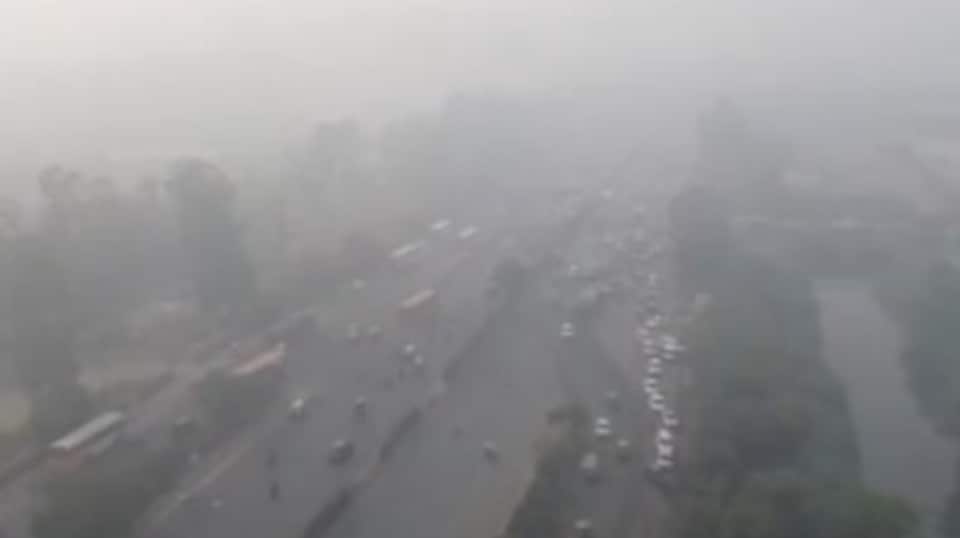
Drone footage exposes Delhi's air crisis as thick toxic smog blankets the city. Watch
Delhi's air pollution worsened to ‘severe’ levels on November 15, with drone footage from Anand Vihar showing thick smog blanketing the city.

 Prefer HTon Google


The air quality across Delhi and its neighbouring areas plunged into the “severe” category on Friday morning, as a thick layer of smog enveloped the National Capital Region (NCR), including Noida, Ghaziabad, and Gurugram. A drone video from the Anand Vihar area, shared by news agency ANI, shows a dense haze covering the area, with footage captured at around 9:30 am. The clip, captioned, “Drone visuals from the Anand Vihar area shows a thick layer of haze in the air,” highlights the extent of Delhi’s ongoing pollution crisis.
Watch the clip here:
AQI soars to hazardous levels in multiple areas
According to Swiss air technology company IQAir, the Air Quality Index (AQI) in some parts of Delhi reached hazardous levels, with readings ranging between 800 and 1,100. Anand Vihar, Dwarka-Sector 8, and Vasant Vihar’s Block C recorded AQI readings of 1,105, 1,057, and 1,041 respectively. IQAir gathers data from government monitoring stations and its own sensors to assess AQI levels, revealing the alarming severity of Delhi’s air quality.
(Also read: CEO slams people for not wearing masks amid rising AQI in Delhi-NCR)
Meanwhile, the Central Pollution Control Board’s (CPCB) Sameer app reported an overall AQI of 413 for Delhi around the same time, classifying the air quality as “severe.” Many areas in the city showed AQI levels between 401 and 500, underscoring the intensity of pollution impacting the residents.
Top 10 most polluted areas
At around 11 am, according to IQAir, the worst-affected areas in Delhi included:
Anand Vihar (DPCC): 1,105
Vasant Vihar Block C (DPCC): 1,057
Dwarka-Sector 8 (DPCC): 1,041
Burari Crossing (IMD): 967
Mundka (DPCC): 945
Rohini (DPCC): 836
Narela (DPCC): 808
DTU (CPCB): 766
ITO (CPCB): 749
Najafgarh (DPCC): 613
(Also read: TV reporter bathes himself in toxic white froth in Yamuna boat ride in Delhi. Watch)
GRAP stage III restrictions imposed
As Delhi’s air quality continued to worsen, the Graded Response Action Plan (GRAP) Stage III restrictions were implemented on Friday. GRAP outlines four stages for addressing Delhi’s air pollution: Stage I (‘poor’), Stage II (‘very poor’), Stage III (‘severe’), and Stage IV (‘severe plus’). Stage III restrictions include a ban on non-essential construction and demolition, closure of stone crushers, and prohibition of BS-III petrol and BS-IV diesel vehicles.
In case of escalation to Stage IV, further stringent measures will come into effect, including a ban on inter-state buses (except electric and CNG), suspension of mining activities, a shift to online classes for younger students, and daily water sprinkling on major roads.