Hungarian freediver Zsófia Törőcsik has set a new world record after diving to a depth of 108 metres, or around 354 feet, on a single breath. The feat took place at the AIDA World Apnea Depth Championships in Limassol, Cyprus, where athletes compete to test the limits of human endurance underwater.
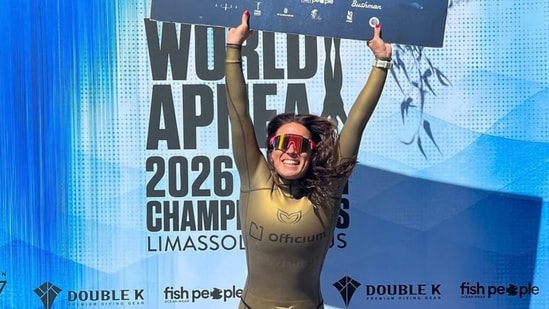
A video of the remarkable dive was featured by The Washington Post, capturing the moment the Hungarian athlete returned to the surface after her record-setting performance.
Zsófia Törőcsik breaks freediving world record
According to Divernet, Törőcsik completed the dive in four minutes, setting a new record in the women's free immersion category. She improved on her previous record of 107 metres, which she had established earlier in 2026.
In free immersion diving, athletes descend and return to the surface by pulling themselves along a rope with their hands, without using fins or an underwater breathing apparatus.
(Also Read: Why does South Africa have three capital cities? Here's what each one does)
Törőcsik also won the overall women's world championship title for the second consecutive year, according to Divernet. Her latest achievement came after a closely contested season in which she and Ukrainian freediver Nataliia Zharkova repeatedly challenged each other's records.
{{/usCountry}}Törőcsik also won the overall women's world championship title for the second consecutive year, according to Divernet. Her latest achievement came after a closely contested season in which she and Ukrainian freediver Nataliia Zharkova repeatedly challenged each other's records.
{{/usCountry}}Reflecting on the milestone, Törőcsik told Divernet, “My happiness was sky-high today.”
She also spoke about the personal significance of pushing her limits, saying, “Every time you defeat yourself, it brings you closer to that voice in your head that finally says: yes, you are indeed capable of it.”
What makes free immersion diving so challenging?
Freediving differs from scuba diving because athletes rely on the oxygen stored in their bodies rather than carrying breathing equipment underwater. According to a scientific review published in Frontiers in Physiology, deep breath-hold diving places the respiratory system under stress as water pressure increases and oxygen availability becomes limited.
In free immersion, competitors use a rope to guide their descent and ascent, pulling themselves along it with their hands without using fins, according to AIDA Philippines. Every movement must be carefully controlled as divers attempt to reach the declared depth and return to the surface while following the sport's safety protocols.
Törőcsik's record shows how much physical training and mental strength the sport requires. In a competition where even a few metres can make a difference, her 108-metre dive is another major achievement in women's freediving this year.