A fourth-generation entrepreneur is being praised after sharing that she sacrificed client revenue to enforce strict rules at her company that promote work-life balance for her team. While some clients left for teams that answered calls on weekends or worked late at night, she stood firm, arguing that well-rested employees produce far better work in the long run.
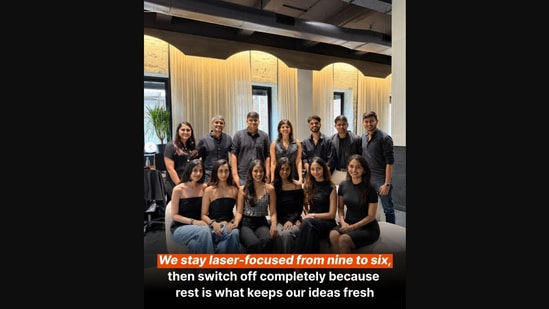
“Running design projects across 18 cities, I still send my team home by 6 pm every day. I used to think good design meant working through the night. If a deadline was close, I stayed until it was done, even if that meant missing dinner with my kids or working through a Saturday,” Mumbai-born fourth-gen entrepreneur Sarah Sham wrote on LinkedIn.
Also Read: ‘Sir, I'll need a 30-minute nap every afternoon’: IITian founder reacts to Gen Z candidate’s request
She continued that over the years, her outlook on work-life balance had changed. “Over time, I started paying attention to which projects actually turned out well. It was rarely the ones we pushed through exhaustion. The best ideas came from designers who had just had a proper weekend off.”
The co-founder shared that after this realisation, she began to view creativity in a different light. “I started comparing creativity to a well instead of a tap. A tap never runs empty. A well does, and once it does, no amount of pushing brings the water back faster. Push too hard without rest, and it runs dry, no matter how skilled the person is.”
{{/usCountry}}The co-founder shared that after this realisation, she began to view creativity in a different light. “I started comparing creativity to a well instead of a tap. A tap never runs empty. A well does, and once it does, no amount of pushing brings the water back faster. Push too hard without rest, and it runs dry, no matter how skilled the person is.”
{{/usCountry}}Hence, she decided to change the way her team worked. She wrote, “We start at nine and close by six, five days a week. No weekend calls. No Sunday deadlines. When a project runs behind, I hire another designer instead of asking my team to give up their weekend.”
She acknowledged that the decision came with a cost. “Some clients have left because of this. They chose to keep the rule instead of a team that would answer calls on Saturday. I let them go and kept the rule.”
Sham added, “A tired designer does not run out of ideas all at once. The work just slowly gets less interesting, and nobody notices until a client points it out,” as she concluded her post.
How did social media react?
An individual wrote, “I completely agree that normalising severe exhaustion completely destroys our true internal emotional peace Sarah Sham. Forcing yourself through massive creative burnout constantly traps an overwhelmed human body inside chronic survival mode. Consciously guarding absolute boundaries gently provides the profound biological regulation you need.”
Another commented, “I resonate with this, though perhaps not to the extent that you do. On most days, I make it a point not to have my team work late. And yes, on a few special occasions, I shamelessly do. I aspire to be where you already are. Posts like this inspire me—and reassure me that I’m moving in the right direction: that building sustainably, rather than constantly burning the midnight oil, is the way to go.”
A third shared, “Sarah, letting clients walk to protect the rule is the real test — most people say ‘boundaries’ but fold the first time revenue is on the line. Rested teams don't just work better, they design better, and that's a harder thing to fake on a deadline.”
A fourth expressed, “I hope that in the near future, more Indian professionals within the AEC industry realise the same thing that you'd realised. Creativity is like a well. The best and the most effective design comes from a well-rested professional, not a burned-out one.”
Who is Sarah Sham?
Her LinkedIn bio reads, “I was born into the Essajees family in Mumbai as a part of the 4th generation. Ours is a 130-year-old legacy of antiques. Art and history have enriched my life. So, when it came to my degree, I chose Art History.”
After serving as principal designer at Essajees Atelier for 12 years, she co-founded Jea, a Dubai-based luxury interior design company.