A haunted look in the eyes of Amal Hussain, an emaciated 7-year-old lying silently on a hospital bed in northern Yemen, seemed to sum up the dire circumstances of her war-torn country.
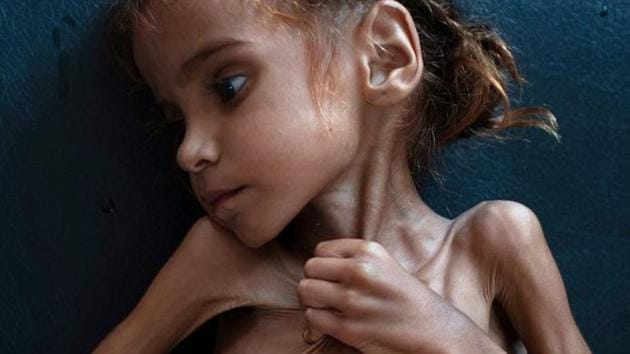
A searing portrait of the starving girl published in The New York Times last week drew an impassioned response from readers. They expressed heartbreak. They offered money for her family. They wrote in to ask if she was getting better.
On Thursday, Amal’s family said she had died at a ragged refugee camp 4 miles from the hospital.
“My heart is broken,” said her mother, Mariam Ali, who wept during a phone interview. “Amal was always smiling. Now I’m worried for my other children.”
The grievous human cost of the Saudi-led war in Yemen has jumped to the top of the global agenda as the outcry over the killing of Saudi dissident Jamal Khashoggi prompts Western leaders to re-examine their support for the war.
Recently, the United States and Britain, Saudi Arabia’s biggest arms suppliers, called for a cease-fire in Yemen. Defense Secretary Jim Mattis said it should take effect within 30 days. “We have got to move toward a peace effort here, and we can’t say we are going to do it some time in the future,” Mattis said Tuesday.
{{/usCountry}}Recently, the United States and Britain, Saudi Arabia’s biggest arms suppliers, called for a cease-fire in Yemen. Defense Secretary Jim Mattis said it should take effect within 30 days. “We have got to move toward a peace effort here, and we can’t say we are going to do it some time in the future,” Mattis said Tuesday.
{{/usCountry}}Riveting images of malnourished Yemenis like Amal — one of 1.8 million severely malnourished children in Yemen — have put a human face to fears that a catastrophic man-made famine could engulf the country in the coming months.
The United Nations warns that the number of Yemenis relying on emergency rations, 8 million, could soon rise to 14 million. That’s about half Yemen’s population.
Aid workers and now political leaders are calling for a cessation of hostilities, as well as emergency measures to revive the battered economy of Yemen, where soaring food prices have pushed millions to the brink.
On a trip to Yemen to see the toll the war has taken, we found Amal at a health center in Aslam, 90 miles northwest of the capital, Sanaa. She was lying on a bed with her mother. Nurses fed her every two hours with milk, but she was vomiting regularly and suffering from diarrhea.
Dr. Mekkia Mahdi, the doctor in charge, sat by her bed, stroking her hair. She tugged on the flaccid skin of Amal’s stick-like arms. “Look,” she said. “No meat. Only bones.”
Amal’s mother was also sick, recovering from a bout of dengue fever that she had most likely contracted from mosquitoes that breed in stagnant water in their camp.
Saudi airstrikes had forced Amal’s family to flee their home in the mountains three years ago. The family was originally from Saada, a province on the border with Saudi Arabia that has borne the brunt of at least 18,000 Saudi-led airstrikes in Yemen since 2015. Saada is also the homeland of the Houthi rebels who control northern Yemen and are seen by the Saudi crown prince, Mohammed bin Salman, as a proxy for rival Iran.
The geopolitics of the war seemed distant, however, in the hushed hunger wards in Aslam.
Amal is Arabic for “hope,” and some readers expressed hope that the graphic image of her distress could help galvanize attention on a war in which tens of thousands of civilians have died from violence, hunger or disease. Last year, Yemen suffered the largest cholera epidemic in modern times, with over 1 million cases.
Amal was discharged from the hospital in Aslam last week, still sick. But doctors needed to make room for new patients, Mahdi said. “This was a displaced child who suffered from disease and displacement,” she said. “We have many more cases like her.”
The family took Amal back home, to a hut fashioned from straw and plastic sheeting at a camp where relief agencies do provide some help, including sugar and rice. But it was not enough to save Amal.
Her condition deteriorated, with frequent bouts of vomiting and diarrhea, her mother said. On Oct. 26, three days after she was discharged from the hospital, she died.
Mahdi had urged Amal’s mother to take the child to a Doctors Without Borders hospital in Abs, about 15 miles away.
But the family was broke. Fuel prices have risen about 50 percent in the past year, part of a broader economic collapse, and that has pushed even short, potentially lifesaving journeys beyond the reach of many families.
“I had no money to take her to the hospital,” Ali said. “So I took her home.”