
 E-Paper



A way to expand Earth’s arable land
The land Mr Alamaro has his eyes on for his latest venture is the sort classified as semi-arid


 Prefer HTon Google


“BUY LAND,” the saying goes. “They’re not making it anymore.” The odd drainage-and-reclamation project or new volcanic island aside, that is true. But Moshe Alamaro thinks he has a work-around. He reckons he can take land that is currently of little worth and turn it into something useful and valuable—and that he can, moreover, do so cheaply.
Mr Alamaro is an intriguing character. He started his career at the Massachusetts Institute of Technology but now works independently as what is, in effect, a one-man ideas factory. Proposals he has come up with include stocking up on fresh water for use in summer by building mountains of ice in winter with snow-making machines of the sort used in ski resorts, erecting greenhouses next to power stations to benefit from their warm, carbon-dioxide-rich exhaust gases, employing second-hand aircraft engines to control hurricanes and (separately) to get rid of smog, and reforesting denuded areas by bombarding them with seedlings contained in biodegradable conical canisters.
The land Mr Alamaro has his eyes on for his latest venture is the sort classified as semi-arid. This has enough moisture to support some vegetation, but not enough to grow crops easily. About 15% of Earth’s terrestrial surface falls into this category, while arable land constitutes a mere 10%. If part of the former could be converted into the latter, it would be a big deal.
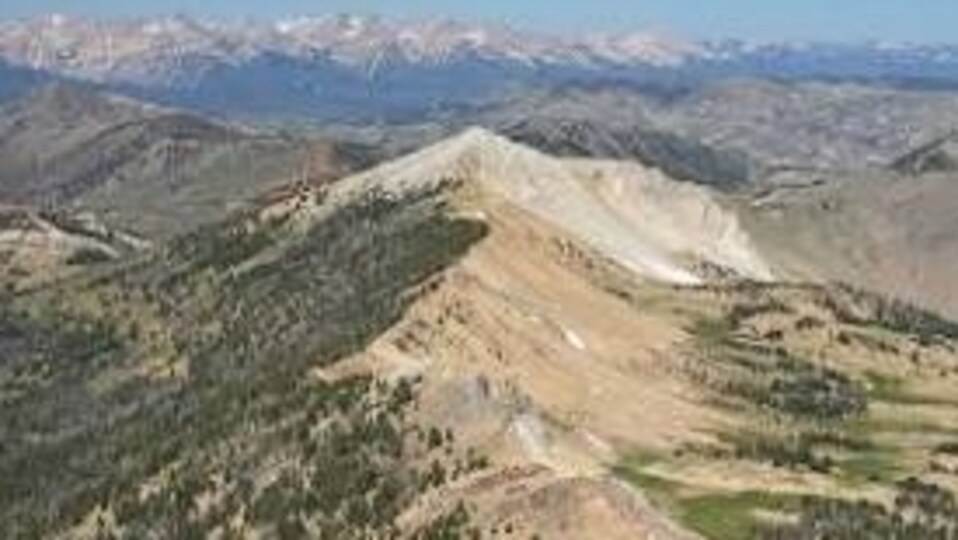
To understand Mr Alamaro’s idea, study the photograph above. It shows part of Idaho. The slope on the left, facing north, is vegetated. That on the right, facing south, is not. The reason is the same as that which makes the poles cold and the tropics hot: the angle of incidence of the sun’s rays when they hit the ground. In the Arctic and Antarctic, where the sun is always near the horizon, this angle is shallow. In the tropics, where the sun arcs almost directly overhead during the middle of the day, it is much steeper.
Similarly, in the northern hemisphere, where the sun usually appears in the southern part of the sky, its rays merely graze a north-facing slope while striking a south-facing one full on. That makes a south-facing slope hotter, and therefore drier, than a north-facing one—and the opposite is true in the southern hemisphere. In semi-arid climes, the resulting difference in moisture is often sufficient to discourage or encourage plant growth.
Mr Alamaro’s idea is thus almost laughably simple: use earthmoving equipment to reshape semi-arid landscapes into ridges that run east-west and have broad, shallow slopes facing away from the sun and narrow, steep ones facing into it. That done, plant the former with crops. To this end, he has joined with Renato Morbidelli of Perugia University to start ReSlope Global, an organisation that will run two field trials, one in Italy and one in Kenya, each on a two-hectare plot. These will establish both the cost of reshaping the landscape to Mr Alamaro’s requirements, and the optimum way of doing so.
The Italian trial will test the best angle for north-facing slopes in that part of the northern hemisphere. The one in Kenya will be different. Kenya straddles the equator, meaning the sun alternates, over the course of the year, between the northern and southern parts of the sky. Here, the idea is to keep the slopes equal in inclination and area, and grow crops alternately on the north-facing and south-facing sides of a ridge, according to the time of year.
Win some, lose some
Mr Alamaro’s previous thoughts have had mixed success. The idea of pumping power-station exhaust gases into greenhouses has fared well, and aerial reforestation is becoming popular with the advent of drones to carry the seedlings. Tinkering with hurricanes was, however, a bit of an over-reach. And, though smog-dispersal and creating terrestrial icebergs would probably work technically, they have never been implemented. Whether his attempt to re-engineer parts of Earth’s surface will succeed remains to be seen. If it does, though, it could be transformative. It might, indeed, give a whole, new meaning to the expression, “a fertile mind”.
Curious about the world? To enjoy our mind-expanding science coverage, sign up to Simply Science, our weekly subscriber-only newsletter.


