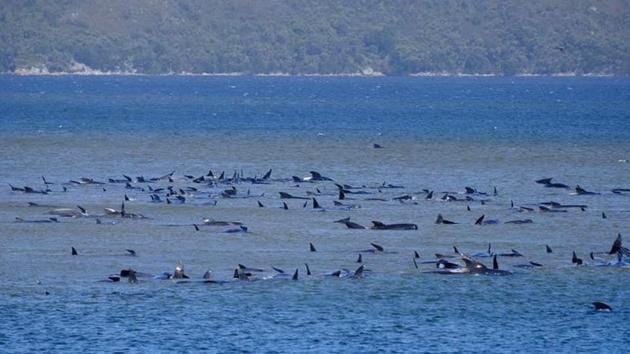
Around 270 whales stranded on sandbar off Australia’s Tasmania
Tasmania’s Department of Primary Industries, Parks, Water and Environment said the whales were stranded in three groups in shallow water at Macquarie Heads, some 200 kms (120 miles) northwest of the state capital Hobart.
Marine biologists were planning the rescue of around 270 whales stranded on a sandbar off the remote west coast of the Australian island of Tasmania on Monday.
Stranded pilot whales are seen in Macquarie Heads, Tasmania, Australia on September 21, 2020. (Ryan Bloomfield via Reuters)
Government scientists said it appeared that at least 25 of the animals, believed to be pilot whales, had already died. Pilot whales are a species of oceanic dolphin that grows 7 metres (23 ft) long and can weigh up to 3 tonnes.
{{^htLoading}} {{/htLoading}}
“While strandings are not uncommon in Tasmania, and while strandings of this scale aren’t (unprecedented), we certainly haven’t had one for at least 10 years,” Nic Deka, a regional manager for Tasmania Parks and Wildlife Service, said.
Tasmania’s Department of Primary Industries, Parks, Water and Environment said the whales were stranded in three groups in shallow water at Macquarie Heads, some 200 kms (120 miles) northwest of the state capital Hobart.
Rescuers with specialised equipment arrived at the site on Monday afternoon to assess the situation. They were expected to regroup on the shore as it grew dark to discuss a rescue strategy.
Officials usually respond to reports of strandings of dolphins and whales in Tasmania once every two or three weeks, on average.
{{^htLoading}} {{/htLoading}}
{{^usCountry}}
Government scientists had first thought the mass stranding involved about 70 whales when it was viewed from the air, but a closer inspection revealed the larger number.
{{/usCountry}}
{{#usCountry}}
Government scientists had first thought the mass stranding involved about 70 whales when it was viewed from the air, but a closer inspection revealed the larger number.
{{/usCountry}}
The last mass stranding off the coast of Tasmania was in 2009, when around 200 whales beached themselves. In 2018, more than 100 pilot whales died after beaching themselves off the coast of New Zealand.
It is not known why whales, which travel together in pods, sometimes beach themselves but they are known to follow a leader, as well as gather around an injured or distressed whale.
“Their social groups and strong bonding between the groups causes often all of them to strand,” Olaf Meynecke, a whale researcher and Project Manager of whales and climate at Griffith University, told Reuters.
{{^htLoading}} {{/htLoading}}
(Reporting by Paulina Duran in Sydney; Editing by Jane Wardell)
Follow the latest breaking news, major developments and agenda-setting stories from India and around the world with the newsdesk at Hindustan Times. Operating round the clock, the desk brings together experienced editors, reporters and correspondents to deliver fast, accurate and contextual reporting across subjects that influence public policy, governance, business, society and international affairs. The HT News Desk covers politics, elections, government policies, the economy, business and markets, science and technology, the environment, law and order, infrastructure, education, climate issues and geopolitics, while closely tracking developments across states, institutions and global capitals. The team also leads coverage of major breaking news events, policy announcements, court proceedings, natural disasters, public emergencies and significant international developments. Reports published by the newsdesk are based on information gathered from reporters on the ground, official statements, government agencies, court records, regulatory filings, recognised institutions and other authoritative sources. Stories undergo editorial scrutiny and verification processes to ensure accuracy, fairness and relevance, and are updated as events evolve and additional information becomes available. Whether covering a key political decision in New Delhi, an economic policy shift affecting millions, a landmark court ruling or a major global event, the HT News Desk aims to provide readers with reliable, fact-based journalism that delivers not only the latest developments but also the context and analysis needed to understand their wider implications.
Get the latest World News, breaking headlines and global updates from the US, UK, Pakistan, Bangladesh, Russia and other countries. Follow major international events on Hindustan Times.
Get the latest World News, breaking headlines and global updates from the US, UK, Pakistan, Bangladesh, Russia and other countries. Follow major international events on Hindustan Times.