South Korea's constitutional court on Monday started proceedings to decide on the validity of impeachment of President Yoon Suk Yeol, who has been suspended from office over his failed bid to impose martial law.
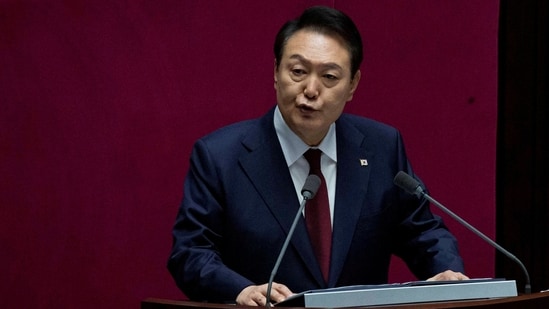
Yoon was removed by South Korea's parliament on Saturday over his short-lived attempt to suspend civilian rule, which plunged the country into its worst political turmoil in years.
The Constitutional Court has around six months to determine whether to uphold the impeachment. Fresh elections must be held within two months if he is removed.
For now, the leadership of the country is in the hands of Prime Minister Han Duck-soo.
A separate investigation into Yoon and his inner circle over the December 3 martial law declaration has rumbled on as the turmoil deepened. He remains under a travel ban while the probe is underway.
The prosecution said in a news release on Sunday that they had summoned Yoon for questioning over the insurrection allegations "but he refused to comply".
They said they would issue a "second summons", with reports suggesting that those could come as soon as Monday, AFP reported.
{{/usCountry}}They said they would issue a "second summons", with reports suggesting that those could come as soon as Monday, AFP reported.
{{/usCountry}}Police arrested both the current and former heads of the Defence Intelligence Command on Sunday in connection to the insurrection allegations, Yonhap reported.
Prosecutors said they were also seeking an arrest warrant for the head of the Army Special Warfare Command Kwak Jong-keun, according to Yonhap.
Kwak is accused of sending special forces troops to parliament during the martial law bid, sparking a dramatic confrontation between soldiers and parliamentary staff.
The head of Yoon's ruling People Power Party (PPP), who has not been linked to the martial law bid and expressed support for impeachment, said on Monday that he would resign.
"I sincerely apologise to all the people who have suffered due to the emergency martial law incident," Han Dong-hoon told a news conference in Seoul.
What led to the impeachment?
Yoon Suk Yeol declared that he was imposing martial law on December 3, stating that the country was facing threats from ‘North Korean sympathisers’. It was the first time since 1980 that such declaration was made. He also sent special forces to shut down the parliament and stop the lawmakers to override his order.
190 lawmakers still managed to assemble at the parliament and unanimously voted to lift the martial law and Yoon obliged. The whole ordeal lasted for about six hours.
Protests erupted in South Korea for Yoon’s removal and a bid for his impeachment failed for the first time as his People Power Party boycotted the vote. A second attempt saw the President being impeached.
North Korean state media decried Yoon as a "ringleader of rebellion" on Monday, its first reaction to his impeachment.
The state-run Korean Central News Agency (KCNA) said Yoon had attempted to shift responsibility for the "foolish emergency martial law declaration" onto opposition parties.
"The investigation into puppet Yoon Suk Yeol, the ringleader of the rebellion, and his accomplices is under way," KCNA said.
"The puppet Constitutional Court will finally decide" on whether to remove Yoon, it said.