The night before long-time leader Sheikh Hasina abruptly fled Bangladesh amid deadly protests, her army chief held a meeting with his generals and decided that troops would not open fire on civilians to enforce a curfew, two serving army officers with knowledge of the discussions told Reuters.
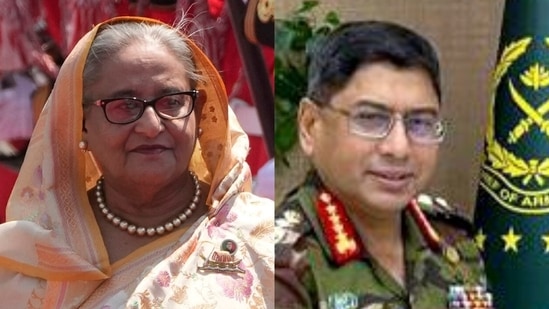
Gen. Waker-Uz-Zaman then reached out to Hasina's office, conveying to the prime minister that his soldiers would be unable to implement the lockdown she had called for, according to an Indian official briefed on the matter.
The message was clear, the official said: Hasina no longer had the army's support.
Also read | Who is Waker-Uz-Zaman, Bangladesh army chief who announced Sheikh Hasina's ouster?
Details of the online meeting between military top brass and the message to Hasina that she had lost their backing have not previously been reported.
They help to explain how Hasina's 15-year rule, during which she brooked little dissent, came to such a chaotic and sudden end on Monday, when she fled from Bangladesh to India.
The nationwide curfew had been imposed after at least 91 people were killed and hundreds injured in nationwide clashes on Sunday, the deadliest day since student-led protests against Hasina began in July. Army spokesman Lt. Col. confirmed the Sunday evening discussions, which he described as a regular meeting to take updates after any disturbance. He did not provide details when presented with additional questions about decision-making at that meeting.
{{/usCountry}}The nationwide curfew had been imposed after at least 91 people were killed and hundreds injured in nationwide clashes on Sunday, the deadliest day since student-led protests against Hasina began in July. Army spokesman Lt. Col. confirmed the Sunday evening discussions, which he described as a regular meeting to take updates after any disturbance. He did not provide details when presented with additional questions about decision-making at that meeting.
{{/usCountry}}Hasina could not be reached and her son and advisor, Sajeeb Wazed, did not respond to repeated requests for comment.
Also read | Bangladesh Army chief unveils plan to restore ‘normalcy’ in country
Reuters spoke to ten people familiar with the events of the past week, including four serving army officers and two other informed sources in Bangladesh, to piece together the final 48 hours of Hasina's reign. Many of them spoke on condition of anonymity due to the sensitivity of the matter. Hasina, who has ruled Bangladesh for 20 of the last 30 years, was elected to a fourth term leading the country of 170 million in January, after arresting thousands of opposition leaders and workers. That election was boycotted by her main rivals. Her iron-fisted grasp on power has been challenged since summer by protests triggered by a court ruling to reserve government jobs - heavily coveted amid high youth unemployment - for certain segments of the population. The decision was overturned but the demonstrations had quickly morphed into a movement to oust Hasina.
Zaman has not publicly explained his decision to withdraw support from Hasina. But the scale of the protests and a death toll of at least 241 made supporting Hasina at all costs untenable, three former senior Bangladesh army officers told Reuters.
"There was a lot of uneasiness within the troops," said retired Brig. Gen. M. Sakhawat Hossain. "That is what probably (put) pressure on the chief of army staff, because the troops are out and they are seeing what is happening."
Zaman, who is related to Hasina by marriage, had showed signs of wavering in his support for the prime minister on Saturday, when he sat on an ornate wooden chair and addressed hundreds of uniformed officers in a town hall meeting. The military later made some details of that discussion public.
The general declared that lives had to be protected and called on his officers to show patience, said army spokesman Chowdhury.
It was the first indication that Bangladesh's army would not forcefully suppress the violent demonstrations, leaving Hasina vulnerable.
Retired senior soldiers such as Brig. Gen. Mohammad Shahedul Anam Khan were among those who defied the curfew on Monday and took to the streets.
"We were not stopped by the army," said Khan, a former infantry soldier. “The army has done what he had promised the army would do.”
'SHORT NOTICE'
On Monday, the first full day of the indefinite nationwide curfew, Hasina was holed up inside the Ganabhaban, or "People's Palace", a heavily-guarded complex in the capital Dhaka that serves as her official residence.
Outside, on the streets of the sprawling city, crowds gathered. Tens of thousands of people had answered protest leaders' call for a march to oust the leader, streaming into the heart of the city.
With the situation spiralling out of her control, the 76-year-old leader decided to flee the country on Monday morning, according to the Indian official and two Bangladesh nationals familiar with the matter.
Also read | US commends Bangladesh army for ‘restraint’ after PM flees, urges democracy be upheld
Hasina and her sister, who lives in London but was in Dhaka at the time, discussed the matter and flew out together, according to a Bangladesh source. They left for India around lunch, local time.
Indian foreign minister Subrahmanyam Jaishankar told parliament on Tuesday that New Delhi had urged "various political forces with whom we were in touch" to resolve the situation via dialogue throughout July.
But as crowds gathered in Dhaka on Monday ignoring the curfew, Hasina decided to resign "after a meeting with leaders of the security establishment", he added. "At very short notice, she requested approval to come for the moment to India." A second Indian official said it was "diplomatically" conveyed to Hasina that her stay had to be temporary for fear of negatively impacting Delhi's ties with the next government in Dhaka. India's Ministry of External Affairs did not immediately return a request for comment.
Nobel laureate Muhammad Yunus, whom the protesting students want to lead the interim government after Hasina's ouster, told The New Indian Express newspaper that India had "good ties with the wrong people... Please revisit your foreign policy."
Yunus wasn't immediately available for an interview.
Late in the afternoon on Monday, a Bangladesh Air Force C130 transport aircraft landed at Hindon air base outside Delhi, with Hasina on board.
There, she was met by Ajit Doval, India's powerful national security advisor, according to the Indian security official.
Delhi had fought to carve Bangladesh out of East Pakistan in 1971. After Hasina's father was assassinated in 1975, Hasina took refuge in India for years and built deep links with her neighbour's political elite.
Returning to Bangladesh, she gained power in 1996, and was seen as more sensitive to India's security concerns than her political rivals. The Hindu-majority nation also regarded her secular stance as favourable for the 13 million Hindus in Bangladesh.
But back in Bangladesh, resentment still lingered even among retired soldiers that Hasina had been allowed to leave.
"Personally, I feel that she should not have been given a safe passage," said Khan, the veteran. “That was a folly.”
This story has been published from a wire agency feed without modifications to the text. Only the headline has been changed.