E-Paper



HT@Belem: Brazil releases draft text to speed up negotiations at COP30
The draft text covers implementation of Article 9.1 of the Paris Agreement which mandates that rich nations pay for climate action in developing countries

 Prefer HTon Google


Belem, Brazil: The agreement from Belem, which promised to restore multilateralism in a geopolitically difficult year, has started taking shape.
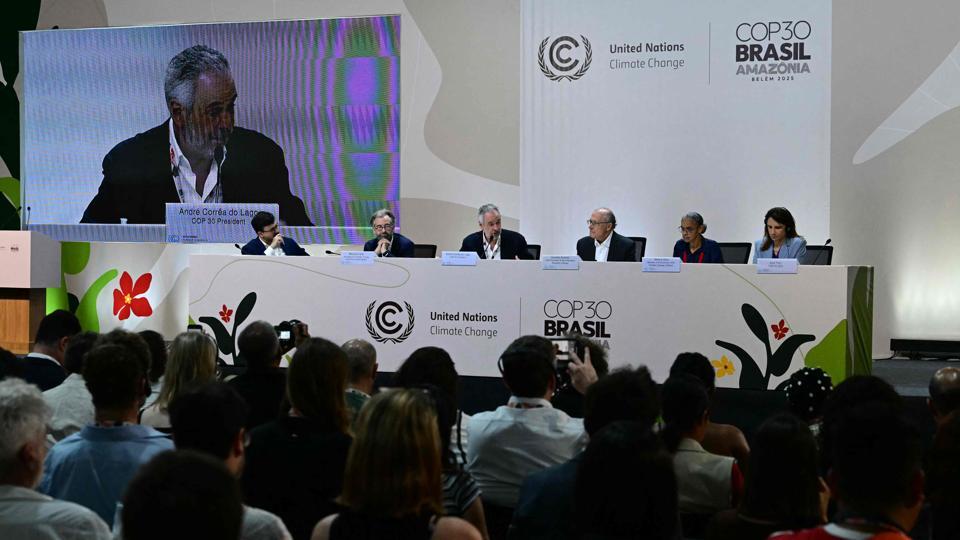
On Tuesday, COP30 host Brazil proposed the draft text of “Global Mutirao: uniting humanity in a global mobilisation against climate change”. This draft is based on the four outstanding issues that were part of COP30 Presidency consultations, two of these were pushed by the Global South and two others by the Global North and vulnerable island nations. These have been extremely contentious issues because of their impact on the development space available for developing countries like India.
The draft text covers implementation of Article 9.1 of the Paris Agreement which mandates that rich nations pay for climate action in developing countries; promoting international cooperation and addressing the concerns with climate change related trade-restrictive unilateral measures, also a major issue for India as it prepares for the operationalisation of EU Carbon Border Adjustment Mechanism from 2026; responding to the synthesis report on nationally determined contributions and addressing the 1.5°C ambition and implementation gap, an issue of survival for island nations and reporting and review pursuant to Article 13 of the Paris Agreement: Synthesis of biennial transparency reports, something rich countries have been pushing.
On Article 9.1, one option, recommended by India, according to developing country negotiators is a three-year Belem work programme and legally-binding action plan on the implementation of Article 9, paragraph 1, with a view to, inter alia, developing a common climate finance reporting and accounting methodology, improved budgetary processes and fair burden-sharing arrangements among developed country Parties. “This is a good option and we feel it may help address the issue of the ambiguous definition of climate finance,” said a negotiator.
“What is promised under the New Collective Quantified Goal (NCQG) is a mobilisation goal. Now we are talking about implementation under Article 9.1 on delivery of finance. Rich countries see this as a red line. They are instead asking developing countries to accelerate mitigation. How is that possible without implementation of 9.1?” asked a developing country negotiator on Monday.
There are also other options such as launching of a work programme focussed on the needs of developing countries; convene an annual high-level ministerial roundtable to reflect upon the implementation of NCQG, including the different elements related to provision of finance, but importantly there is also a “No text” option. The issue of Article 9.1 is a red line for developed nations as they feel the issue of finance was already addressed in the NCQG decision from Baku.
Opportunity to reshape global climate finance
For India, it is top of agenda: On Monday, union environment minister, Bhupender Yadav who is leading India’s delegation said: “Developed countries must reach net zero far earlier than current target dates, fulfil their obligations under Article 9.1 of the Paris Agreement, and deliver new, additional, and concessional climate finance estimated to be in trillions of dollars.”
The PMO wrote on X on Tuesday: Union Minister @byadavbjp highlights that there is a strong opportunity to reshape global climate finance with greater transparency and common standards. He points to India’s draft Climate Finance Taxonomy and growing domestic green finance as examples of pragmatic leadership that can guide a more effective global architecture for the future.”
The draft also notes with great concern that the $100 billion (promised for 2020) has not been met, noting that only around $60 billion received by developing country Parties on average over two years according to the Biennial Transparency Synthesis report (BTR), which also revealed the lack of a common accounting methodology for reporting of Article 9.1.
On unilateral trade measures also there are a number of options including establishing a Platform on Unilateral Trade-Restrictive Measures Related to Climate Change to examine the nature, scope and cross-border impacts of such measures, with particular attention to their economic, social and developmental implications for developing country Parties, in accordance with Article 3.5 of the Convention and the principles of equity, common but differentiated responsibilities and respective capabilities and sovereignty.
On the loss of Paris Agreement’s lower limit, 1.5°C goal, the Presidency has an option of launching the “Belem Roadmap to 1.5”, aiming at addressing the ambition and implementation gap of nationally determined contributions, to identify opportunities and actions to accelerate the implementation of, and international cooperation and investments in NDCs, and requests the Presidencies to produce a report summarising the work. It recognises the need for urgent action and support to achieve deep, rapid and sustained reductions of greenhouse gas emissions in line with 1.5°C pathways, noting that finance, capacity-building and technology transfer are critical enablers of climate action.
On BTRs also, the document provides options such as establishing an annual consideration of the NDCs synthesis report and the BTR synthesis report to address the ambition and implementation gaps, enabling sharing of knowledge and good practices, to strengthen and implement NDCs, with a view to aligning them with 1.5°C pathways, also suggests launching a “Global Implementation Accelerator”.
There are draft Presidency documents also on Global goal on adaptation, UAE Just Transition Work Programme among others.