
 E-Paper



Disguised and in Danger: How a Nobel Peace Prize Winner Escaped Venezuela
Opposition leader María Corina Machado slipped through 10 military checkpoints to reach a fishing boat bound for Curaçao and a private jet to Norway.


 Prefer HTon Google


Wearing a wig and a disguise, María Corina Machado began her escape from Venezuela on Monday afternoon.
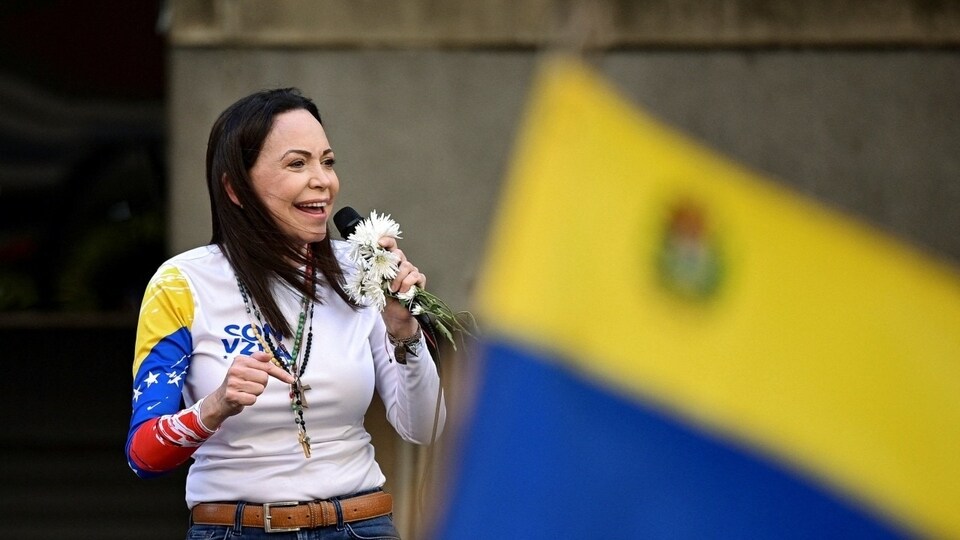
The Venezuelan opposition leader was trying to get to Norway by Wednesday in time to receive the Nobel Peace Prize that she won for challenging the country’s authoritarian leader, Nicolás Maduro. First she had to get from the Caracas suburb where she has been in hiding for a year to a coastal fishing village, where a skiff awaited her.
For 10 nerve-racking hours, Machado and two people helping her escape hit 10 military checkpoints, avoiding capture each time, before she reached the coast by midnight, said a person close to the operation.
She rested for a few hours, the person said, before the next leg of her journey: a perilous trip across the open Caribbean Sea to Curaçao. She and her two companions set out on a typical wooden fishing skiff at 5 a.m., the person said, with strong winds and choppy seas slowing them down.

She had almost completed an escape that had been in the works for about two months and was carried out by a Venezuelan network that has helped other people to flee the country, the person close to the operation said. The group made an important call to the U.S. military before they set out, warning American forces in the region of the vessel’s occupants. The U.S. has bombed more than 20 other similar vessels in the past three months, killing more than 80 people it accuses of smuggling drugs.
“We coordinated that she was going to leave by a specific area so that they would not blow up the boat,” said the person close to the operation.
The Trump administration was aware of the operation, said people familiar with the matter, but the extent of its involvement was unclear.
The U.S. Navy and the Pentagon referred questions to the White House, which didn’t respond to a request for comment.

Around the same time of their crossing, a pair of U.S. Navy F-18s flew into the Gulf of Venezuela and spent roughly 40 minutes flying in tight circles near the route that would lead from the coast to Curaçao, according to flight-tracking data. It was the closest incursion of U.S. aircraft into Venezuelan airspace since the U.S. military buildup began in September.
Machado arrived in Curacao around 3 p.m. Tuesday. She was met by a private contractor who specialized in extractions. Exhausted by the long trip, Machado checked into a hotel and stayed overnight, the person said.
As the sun rose in Curaçao and as guests began to gather in Oslo, an executive jet provided by a Miami associate took off from the island and headed for the Norwegian capital, the person said. Before boarding the aircraft, Machado recorded a short audio message thanking “so many people…[who] risked their lives” so she could leave Venezuela.
She was expected to arrive shortly after midnight local time in Oslo, or around 6 p.m. on the U.S. East Coast.
Her escape was kept so closely held that the Nobel Institute told Norwegian media it didn’t know where she was as the prize award ceremony in Oslo began. Jørgen Watne Frydnes, the chair of the Norwegian Nobel committee, told the award ceremony that she had been through “a journey in a situation of extreme danger.”
Machado’s daughter accepted the award on her behalf on Tuesday. “She will be back in Venezuela very soon,” she told the audience, which included U.S. lawmakers, international supporters and foreign leaders.
On arrival in Oslo, Machado plans to rest for a few days. She has been living in a completely isolated place, and hasn’t been eating well. After about a week, she intends to tour European countries to drum up support for the Venezuelan cause. Eventually she will also visit Washington, said a person who talks frequently with Machado.
On Wednesday evening, as her supporters and foreign officials sat down for a five-course dinner served on a special Nobel dining service in the banquet hall of Oslo’s Grand Hotel, details of Machado’s escape circulated among the guests, according to U.S. and Venezuelan attendees.


Machado is expected to greet supporters from the balcony of the Grand Hotel, her daughter said.
Meanwhile in Caracas, Vice President Delcy Rodriguez accused Machado and the opposition of working to advance U.S. imperialist interests to loot Venezuela’s vast oil and mineral wealth. “The show failed. The lady didn’t show up,” she said. “Those extremist, fascist lackeys who have been asking for blockades, invasions and bombings against Venezuela are going to be defeated again, the same way their cheap show in Norway fell apart.”
Leaving the country carries the risk that Machado could be barred from returning. It could diminish her influence at home, as has happened to several opposition leaders forced into exile in the past. Venezuela’s attorney general, Tarek William Saab, has said that Machado will be considered a fugitive if she travels to Norway.
Venezuelan opposition activists said that having Machado out of Venezuela will energize their cause, allowing the charismatic opposition leader to more effectively lobby foreign governments than she could from a remote video connection, and push for more economic and political pressure on Maduro. Machado has voiced support of Trump’s military buildup in the region, and argued that a credible threat of force is needed to push him from power.
“Maduro started this war, and President Trump is ending it,” she said in November.
Write to José de Córdoba at jose.decordoba@wsj.com, Vera Bergengruen at vera.bergengruen@wsj.com and Alex Leary at alex.leary@wsj.com


