Over half of the world’s glaciers, by number, could disappear, while melting polar ice sheets push the global sea higher even if global warming is restricted to 1.5°C, findings of two new reports released on Monday have revealed.
The reports, Overshoot and the Cryosphere: Averting Global Meltdown and State of the Cryosphere 2026: The Cost of Overshoot, were released jointly by the International Cryosphere Climate Initiative (ICCI) and the United Nations Environment Programme (UNEP) – ahead of the 31st Conference of Parties (COP31) in Türkiye next week.
The reports state even at current warming levels of around 1.4°C, significant and irreversible ice loss has already been set in motion, underlining the long-term consequences of climate change even if countries meet the Paris Agreement’s temperature target.
The reports examine the consequences of global temperatures temporarily exceeding the 1.5°C threshold, known as overshoot, and the possibility of bringing temperatures back below it through emissions cuts and carbon removal.
Also Read: If current policies continue, warming could reach 2.8°C within this century: UN report
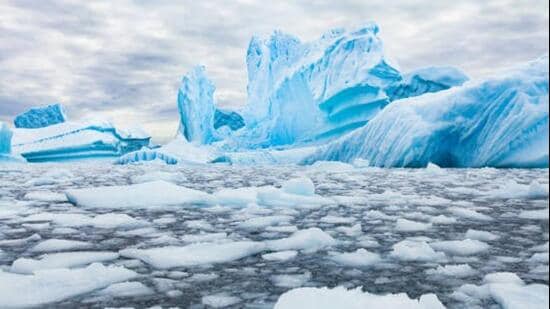
“Even in scenarios where global warming remained at 1.5°C, ice loss will continue for millennia,” the State of the Cryosphere 2026 report said, noting that temperatures at this level had, in the Earth’s past, resulted in sea levels around 2-9 metres higher than today, owing to the loss of portions of the West Antarctic, Greenland and possibly East Antarctic ice sheets.
{{/usCountry}}“Even in scenarios where global warming remained at 1.5°C, ice loss will continue for millennia,” the State of the Cryosphere 2026 report said, noting that temperatures at this level had, in the Earth’s past, resulted in sea levels around 2-9 metres higher than today, owing to the loss of portions of the West Antarctic, Greenland and possibly East Antarctic ice sheets.
{{/usCountry}}The Overshoot report said that the delayed response of ice sheets to warming meant that substantial irreversible losses were already committed. The threshold for long-term ice loss in Greenland could be crossed well below 2°C, possibly closer to 1.5°C, while parts of West Antarctica could be vulnerable at even lower temperatures.
It said the best-case scenario at a constant 1.5°C would be for sea levels to reach this higher level of 2-9 metres over centuries to millennia – giving some coastal communities time to adapt or relocate.
Also Read: September 2026 second warmest on record, global temperatures exceed: C3S
“Latest scientific evidence suggests that a truly ‘safe’ temperature limit for stable polar ice sheets lies at or below 1.0°C,” it added.
“One-third of glacier ice in Hindu Kush Himalaya and Central Asia could disappear”
The report also highlighted the risks to mountain glaciers, including those in the Hindu Kush Himalaya (HKH), which are critical to water availability for communities downstream. Even at 1.5°C of warming, around one-third of glacier ice in the Hindu Kush Himalaya and Central Asia could disappear, it said, adding in regions such as the Caucasus, Scandinavia, Iceland and the North American Rockies, only 18-35% of the ice that existed in 2020 would remain after several centuries at this temperature level.
The report warned that more than half of the world’s glaciers, by number, could face extinction even without temperatures exceeding 1.5°C.
Mid-latitude glaciers would continue their steep decline for several decades before stabilising at significantly diminished levels. Snowpack would also stabilise at higher altitudes and latitudes, with rainfall replacing snowfall at lower altitudes and latitudes, affecting water resources.
The report also flagged growing hazards in the Indian Himalayan region.
In the Alaknanda basin in Uttarakhand, one of the two main headwaters of the Ganga, rising temperatures and changing precipitation patterns are causing glaciers to thin and detach, leaving ice perched on steep slopes. The report cited research showing that exposure to hazards from such hanging glaciers in the Ganga headwaters is nearly 20 times higher today.
The findings come against the backdrop of the Rasuwa disaster in Nepal in August, which the reports cited as an example of the growing risks associated with cryosphere loss. The reports warned that glacier retreat, changing snow patterns and permafrost destabilisation could increase the likelihood of landslides, floods and other mountain hazards.
However, the reports add it is still possible to limit the worst impacts through rapid emissions reductions and carbon removal.
Even the most ambitious plausible climate action would allow global temperatures to peak at around 1.7°C for approximately two decades, before falling below 1.5°C by 2100 and below 1°C by 2150. Reaching net zero by 2050, followed by sustainable carbon drawdown, would be key to this pathway.
The reports call for emissions to be reduced by at least 5% annually, alongside a rapid phaseout of fossil fuels and cuts in methane and black carbon emissions. They said returning temperatures below 1.5°C could allow some glaciers and sea ice to begin recovering over decades to centuries, while also slowing the rate of sea-level rise to give coastal communities more time to adapt.
Also Read: PM Modi says United Nation’s limitations ‘clearly visible’ amid changing world order
“There are no good outcomes in exceeding 1.5°C. To contain the global fallout and damage from ice loss in the world’s polar and mountain regions, overshoot needs to be kept to the absolute minimum. Temperatures must be returned to well below 1.5°C again as quickly as possible to reduce the risks,” said James Kirkham, coordinating lead author of Overshoot and the Cryosphere.
The annual State of the Cryosphere report was peer-reviewed by 60 leading cryosphere and climate scientists, while the companion report was prepared by more than 80 international scientific experts.
Chen Zhao, Senior Research Fellow – Ice Sheet Modelling at the University of Tasmania said while one can use different ways to bring the temperature back on track, it doesn’t mean the entire earth system gets back on a ‘normal’ track.
“With the current level of warming, some level of Antarctica ice sheet mass loss has been locked in. Greenland’s ice sheet will also lead to at least a 27 cm sea level rise. It will happen in the next few centuries. So, the ice mass loss is already committed based on the current warming level and these kind of changes cannot be reversed,” said Zhao, stating every fraction of degree warming can thus increase risks of triggering their irreversibility. “That’s what we really don’t want to see happen, because that puts us in a situation that we cannot stop from happening,” she said.