
 E-Paper



Ex-SL Navy chief lobbied for Chinese spy ship docking at Hambantota Port
Since 2020, 53 so-called Chinese research vessels have been monitored in the Indian Ocean Region as not less than three to five such spy ships are operating in the area at any given time.

 Prefer HTon Google


The Chinese satellite and intercontinental ballistic missile tracker strategic support ship Yuan Wang 5 under the guise of Marine Scientific Research Vessel was allowed by the Sri Lankan government to dock at Hambantota Port, leased to Beijing for 99 years, at 4.00 am this morning. This ship will be at the Chinese port till August 21.
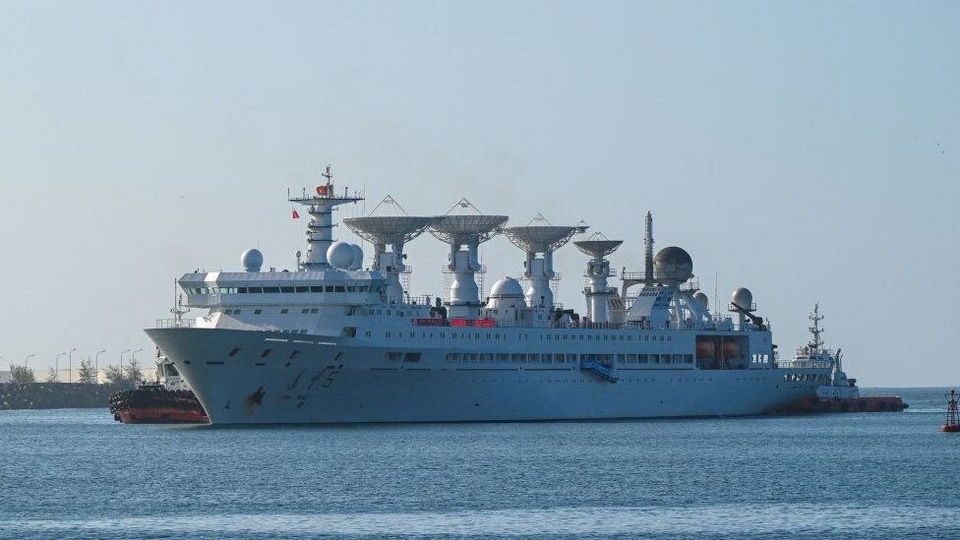
After deferring the docking of the spy ship at Hambantota port between August 11-17 on grounds of further consultation, the Ranil Wickremesinghe government could not stand up to the pressure of the Xi Jinping regime amidst threats of Beijing possibly trying to block much needed IMF loan to officially bankrupt Colombo.
Fact is that when the Wickremesinghe government deferred the arrival of the spy ship, his government came under pressure from none other than former Public Security Minister and ex-Navy Chief Rear Admiral Sarath Weerasekara, who openly questioned the move.
Such is the Chinese clout within Sri Lanka, that the now lawmaker on August 8 lobbied in favour of the ship being allowed to dock notwithstanding what he called were Indian concerns in front of President, PM and Beijing’s close friend Mahinda Rajapaksa.
According to diplomats based in Sri Lanka, the number of Chinese spy ships in the guise of research vessels have steadily increased in the past decade in the Indian Ocean Region (IOR). It is understood that since 2020, 53 so-called Chinese research vessels have been monitored in the Indian Ocean Region as not less than three to five such spy ships are operating in the area at any given time.
The deployment of such vessels serve the Xi Jinping regime as a tool for maritime diplomacy in the form of joint surveys with IOR littoral states and provider access to strategically important areas within the exclusive economic zone of a third country.
Analysis of the so-called research vessel deployments in the IOR shows that these spy ships are operating in the following areas :
1. Ninety Degree East Ridge for deep sea prospecting for rare earth minerals and could be a precursor to China applying for exploration rights with International Seabed Authority (ISA)/
2. South West Indian Ridge for deep sea exploration for mining polymetallic sulphides in areas allocated by ISA.
3. Pakistan and Myanmar EEZ for geological survey for petroleum exploration, marine surveillance and hydrography.
4. Sri Lanka EEZ, Bay of Bengal, Arabian Sea and Rest of IOR for ocean bed mapping, testing salinity for sonar applications and surveillance.
At a given time, there are around 300 Chinese flagged merchant vessels and 200-300 Chinese fishing vessels operating in the IOR on an average. While the so-called research vessels are said to be carrying out hydrological surveys and metal prospecting, fact is that vessels like Yuan Wang 5 are monitoring satellite activity and missile test firing in the region with focus on India, US and Australia.


