France has been rocked by violent protests, resulting in thousands of arrests, widespread looting, and destruction in multiple French cities as huge crowds agitated over the weekend against rising living costs.
‘Felt like a war,’ say French citizens
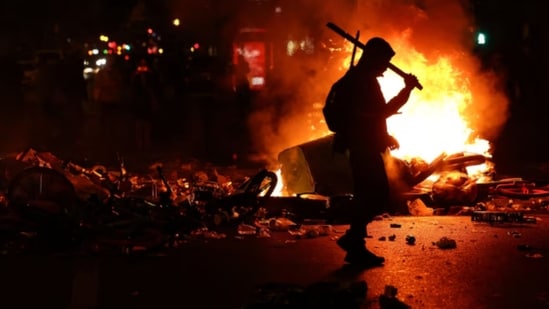
The scale of October 17’s unrest left France facing a major crisis by Sunday, with looting across multiple. Police arrested around 2,400 people following the demonstrations. “It’s like we had a war,” a 78-year-old resident in central Paris, Mehmet Ozeden, told AFP.
Police used tear gas and water cannons against masked protesters in Paris and other cities, AFP reported. Some protesters also reportedly threw objects and aimed fireworks at police. Several parked cars were burned in the capital, and smoke could be seen over the center.
Deep Dive
Why did protests in France turn violent?
Who took part in the France protests, and whom did Macron blame for the violence?
What was damaged during the protests in France?
Protesters set a tourist office on fire in the center of Lyon. They also broke into town halls in Marseille and Lille, and into a police compound in Bordeaux, and damaged the buildings before leaving.
The Retail and Trade Federation reported that damage to around 1500 businesses had resulted in financial losses reaching hundreds of millions of euros. Amid the destruction, Paris resident Anita Gras, who was jogging through the affected streets, witnessed a group of men stealing goods from a sports footwear store, AFP reported.
Dozens of shops were looted in Paris, Marseille, Nice, Bordeaux and Lille. An Apple store in Lille was stripped bare.
More than 300 protesters tried to walk up the Champs-Elysees, which is home to flagship luxury stores, as per AFP. Police fired tear gas to block them.
Limoges historic Town Hall burnt down
The historic Town Hall in Limoges collapsed after a massive fire engulfed the historic building as it failed to survive the violent clashes that broke out between police and protesters.
The landmark, which had survived the World Wars, was built in 1873 and inaugurated in 1883. The town hall in Limoges was "largely lost" to the fire, the region's top official told news agency AFP, calling the damage to the historic building a "catastrophe for heritage" and condemning it as a "deliberate act by hooligans".
President Macron blames ‘far-left groups’ for violence
Addressing the unrest on Sunday, French President Emmanuel Macron acknowledged the frustration and humiliation felt by the citizens following incidents of looting and rioting during protests over rising living costs and deteriorating school conditions.
Macron also pointed to far-left groups as a factor behind the protests, alleging that the activists had targeted public buildings and law enforcement officers in an effort to spread turmoil.
“Those who looted will have to pay for the damage, and those who sought to bring down the Republic will be held accountable,” Macron said in an address to the nation, adding that at least 2,400 people had been arrested.
He condemned “unrestrained violence” by “insurrectionist elements from radical far-left groups, joined by numerous criminals.”
Who's behind the protests?
The protests were held by several groups, including the Yellow Vests movement, Bloomberg reported. The group began in 2018 to fight rising living costs, after a planned fuel-tax rise under Macron that they felt hurt rural and working-class people who depend on cars. The movement faded over time but has never fully stopped taking to the streets.
Saturday’s call was first suggested by a TikToker with no clear political agenda, the report mentioned. Yellow Vests activists then used the chance to try to bring their movement back.
High school students have reportedly been protesting for more than three weeks over classroom conditions, teacher absences and university admissions. According to a Cluster 17 poll published October 11, about 57 per cent of French people support them.
The government has promised to consider the students’ complaints but cannot greatly raise the education budget. The unrest comes as France prepares for elections in six months to replace Macron.
(with inputs from agencies)