
 E-Paper



Healthy ageing in South-East Asia: Opportunities ahead
Regional data from 2024 show a higher prevalence of insufficient physical inactivity in older people compared to younger age groups.

 Prefer HTon Google


The South-East Asia Region is undergoing one of the most profound demographic shifts in its history. By 2050, the proportion of people aged 60 years and above will nearly double — from 11.3% in 2024 to 20.9%. That means, 441 million older people — one in five — will call this region home. This transformation is both a triumph of public health and a test of our collective will and capacity to adapt.
Healthy ageing is not about adding years to life alone, but about adding life to years. It is defined as enabling older people to maintain the functional ability to do what they value — whether caring for grandchildren, participating in community life, or contributing to the economy. When older people are supported to live well, they are not a burden, but a vital social and economic asset.
However, as more people live longer, noncommunicable diseases (NCDs) and mental disorders are contributing to increases in disability prevalence (WHO definition of disability). We are committed to addressing the health and well-being challenges that NCDs bring to older people, including those related to declines in physical and mental capacities, nutrition and mental health.
Regional data from 2024 show a higher prevalence of insufficient physical inactivity in older people compared to younger age groups, increasing the risk of cardiovascular disease and diabetes. Body mass index trends show a complex landscape including the double burden of malnutrition. Undernutrition and micronutrient deficiencies remain prevalent in some countries, while others are experiencing a growing shift toward overweight and obesity. Older women are more at risk of obesity and related NCDs in the region.
The prevalence of dementia is expected to rise sharply (approximately 9.6 million by 2030) in South-East Asia, placing immense pressure on healthcare systems, caregivers and families. Reduced mental well-being, inequity, loneliness and social isolation, especially in older women, all impact healthy ageing. Each challenge also has social and economic consequences. For instance, the annual costs associated with dementia care in the South-East Asia region have been estimated at around US$7.3 billion, a figure that is expected to rise as the number of affected people increases.
Other drivers impacting the health and well-being of older people in the region are climate change, urbanisation, migration patterns, and changing family structures.
The WHO South-East Asia Regional Strategy on Healthy Ageing (2024–2030), aligned with the UN Decade of Healthy Ageing, offers clear pathways to help older people lead healthier lives. We are committed to combating ageism through policies, laws, and intergenerational solidarity; fostering age-friendly environments by improving housing, transport, and community infrastructure; delivering integrated primary health care that responds to evolving needs, including rehabilitation and palliative care; and ensuring access to long-term care that is equitable, sustainable, and supportive of families and caregivers.
Primary health care is central to this vision. This requires reorienting systems to serve as the first point of contact for older people, expanding community-based care, and coordinating health, well-being, and social support. Evidence shows that investing in healthy longevity brings enormous economic and social returns, with benefits far outstripping those of tackling single diseases in isolation. The Region must seize the opportunity and invest now in healthy ageing, to be ahead of the game, before we are defined as ‘ageing society’.
But governments cannot do this alone; a whole-of-society approach is essential. Armed with evidence and data, we need to engage with finance, transport, housing, and labour sectors to implement needed actions. We must empower civil society, academia and the private sector to be part of the solution. And most important of all, older people themselves must be given a leading role to drive this change, as they often face intersecting forms of discrimination that lead to exclusion from services, decision-making, and protection systems. This is especially so for older women, many who live alone for extended periods, which affects their physical health, psychological well-being, and economic security.
Collectively, our region needs to adopt an integrated, human-centred approach to address the needs of older people. Older people should not merely be recipients of care, but active agents in shaping the policies and services that affect their lives.
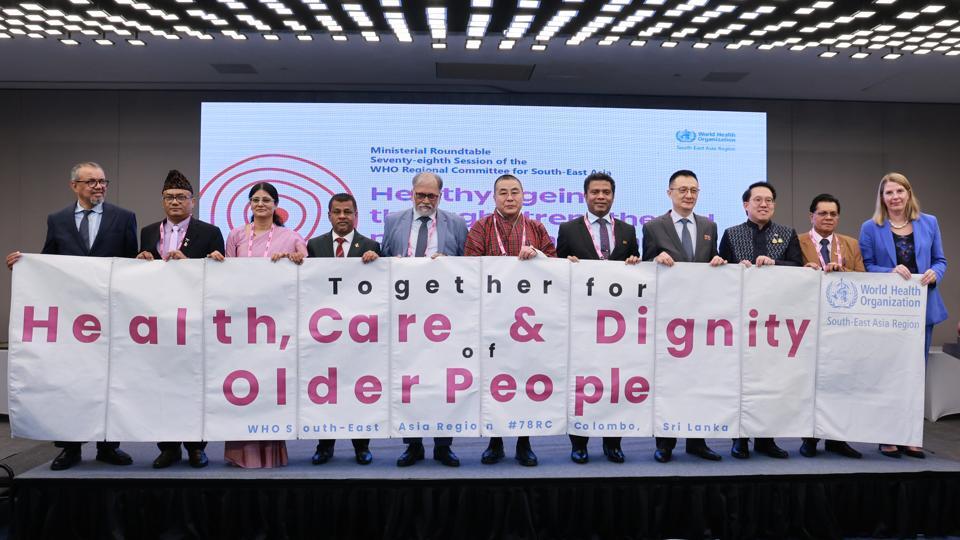
As we, ministers of health of the South-East Asia region countries, gather here in Colombo for the 78th session of the WHO Regional Committee, the stakes could not be higher. This is the moment to commit to age-responsive, integrated primary health care systems that uphold dignity, equity, and resilience.
The demographic shift ahead is an immense opportunity. By embracing healthy ageing as a priority, South-East Asia can lead the way in showing that societies that invest in older people reap dividends that benefit all generations.
Authors of this article are:
JP Nadda, Minister of Health and Family Welfare, Government of India
Dr Tedros Adhanom Ghebreyesus, Director-General, World Health Organization
Dr Catharina Boehme, Officer-in-Charge, WHO South-East Asia
Nurjahan Begum, Adviser, Ministry of Health and Family Welfare, Government of the People’s Republic of Bangladesh
Lyonpo Tandin Wangchuk, Minister of Health, Royal Government of Bhutan
Dr Jong Mu Rim, Minister of Public Health, Democratic People’s Republic of Korea, Government of the Democratic People’s Republic of Korea
Mr Abdulla Nazim Ibrahim, Minister of Health, Government of the Republic of Maldives
Dr Purna Bahadur Nepali, Ambassador Extraordinary and Plenipotentiary of Nepal, Government of Nepal
Dr Nalinda Jayatissa, Minister of Health and Mass Media, Government of the Democratic Socialist Republic of Sri Lanka
Mr Pattana Promphat, Minister of Public Health, Royal Thai Government
Dr Élia António de Araújo dos Reis Amaral, S.H., Government of the Democratic Republic of Timor-Leste


