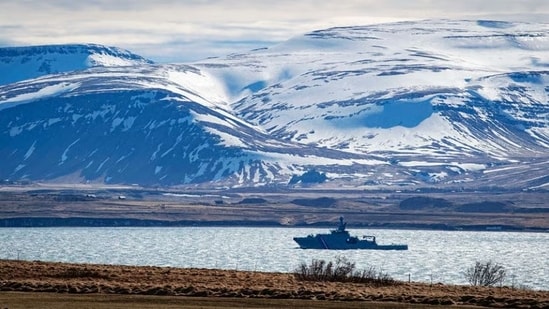
Zipping over lava fields and fjords, the Icelandic coastguard were putting a chopper crew through its paces. The coastguard, which Iceland relies on instead of an army, does everything from rescuing wayward tourists to protecting undersea cables from sabotage. But they are starting to feel a bit overstretched. “Three helicopters, two ships and one aeroplane is not enough,” sulks one officer after dropping off a colleague next to a steaming volcano.
A founding NATO member, Iceland has relied mainly on
Zipping over lava fields and fjords, the Icelandic coastguard were putting a chopper crew through its paces. The coastguard, which Iceland relies on instead of an army, does everything from rescuing wayward tourists to protecting undersea cables from sabotage. But they are starting to feel a bit overstretched. “Three helicopters, two ships and one aeroplane is not enough,” sulks one officer after dropping off a colleague next to a steaming volcano.
A founding NATO member, Iceland has relied mainly on America for its defence. But as Europe rearms and the Americans call out laggards, it is feeling the heat. “They are putting pressure on us,” admits Thorgerdur Katrin Gunnarsdottir, the foreign minister. Iceland has spent just 0.2% of its GDP on defence in recent years.
Home to some 400,000 people, the island matters. Americans use it as a base to watch for Russian submarines sneaking into the Atlantic. This geographical importance has allowed Iceland to outsource its own defences. “We need to do more,” says Thorgerdur. There are plans to boost spending, perhaps to 1.5% of GDP. That will help keep watch over the Atlantic and build infrastructure that American and European ships, submarines and planes could use as wartime staging posts.
But neglect leaves Iceland vulnerable elsewhere. It could be cut off if its cables were severed. It has no intelligence service to hunt saboteurs and spies. Thorgerdur says she supports setting one up. The coastguard would struggle if multiple ships sank simultaneously; Iceland has only recently begun spending on unmanned submarines and anti-drone technology. A cross-party task force is discussing what else to consider.
Some want to take the next step. Arnor Sigurjonsson, until recently the Icelanders’ top defence official, says the government in Reykjavik should bite the bullet and create an army. It is infantilising to outsource defence, he argues. He wants a thousand-strong force to defend airports and harbours in emergencies and says Icelandic infrastructure could be targeted by Russian strikes. “They say that we are too few and too poor,” he says. “This is simply not true.”
Such views were once laughed at, but no longer. Though most remain sceptical about Arnor’s proposal, Icelanders generally agree they should spend more. Thorgerdur takes no position on the need for an army, but notes that Luxembourg has a small force. Malta too has a proper fleet. “I am not afraid of this debate,” she says. “The main question is: how do we defend Iceland?”
The issue has become more pressing because of Donald Trump’s threats against (relatively) nearby Greenland, which Icelanders have followed with alarm. It is Mr Trump who would decide whether America will defend Iceland. He must surely be displeased that Americans have been footing the island’s defence bill.
It is a geological fact that Iceland is being torn apart as Europe and America drift away from each other. Volcanoes testify to this. Now Icelanders worry it could become a political reality too. That is rekindling debate over whether to join the European Union. A referendum is planned on resuming accession negotiations. Polls indicate it will pass. Icelanders, says Pawel Bartoszek, a pro-European MP, are looking towards Europe more than ever. The two people doing most to convince them to join the EU, he says, are “Vladimir Putin and, in many ways, Donald Trump”.
To stay on top of the biggest European stories, sign up toCafé Europa, our weekly subscriber-only newsletter.
One Subscription.
Get 360° coverage—from daily headlines
to 100 year archives.
Archives
HT App & Website