
 E-Paper



Imran Khan attempted to sack Pakistan army chief Gen Bajwa: Report
Imran Khan hoped the sacking of army chief Gen Qamar Bajwa would help him overcome the no-trust vote in the National Assembly that was ordered by the Supreme Court.

 Prefer HTon Google


Cricketer-turned-politician Imran Khan made one final desperate attempt to cling on to power by trying to sack Pakistan army chief Gen Qamar Bajwa but a notification was not issued by the defence ministry, according to media reports.
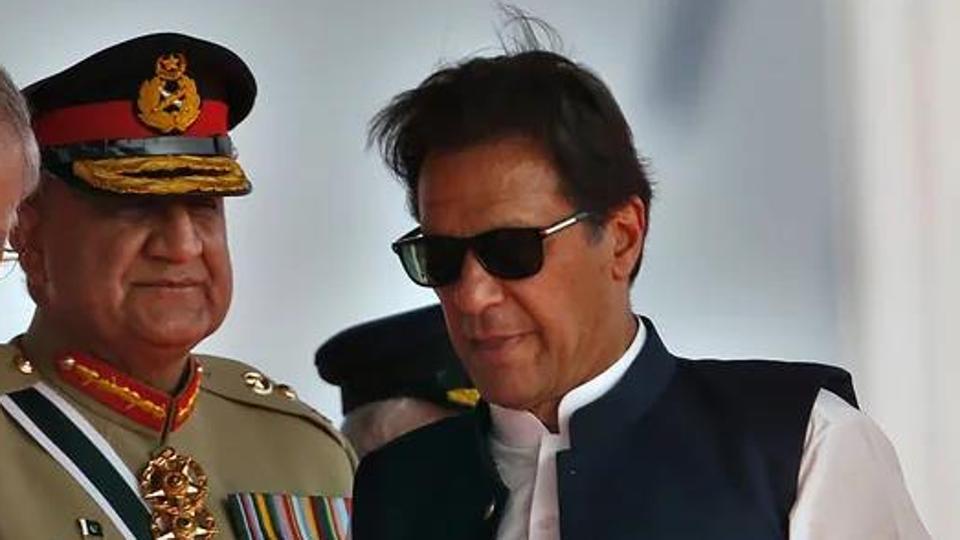
BBC Urdu was the first to report the development though it did not name Bajwa and said that Khan had sought the “removal of a senior official” who arrived in a helicopter at the Prime Minister’s House in Islamabad for a meeting with Khan.
According to Reuters, Bajwa and Inter-Services Intelligence (ISI) chief Lt Gen Nadeem Anjum held a meeting with Khan late on Saturday night, shortly before the 69-year-old premier was ignominiously ousted in a vote of no confidence in the National Assembly.
On Sunday, the Pakistan Army rejected the BBC Urdu report as "totally baseless and a pack of lies" and “part of an organised disinformation campaign.” A statement from the army said, "The typical propaganda story lacks any credible, authentic and relevant source and violates basic journalistic ethos.”
Khan became the first Pakistani prime minister to lose a no trust vote, with the combined opposition casting 174 votes – two more than needed in the 342-member House – to remove him from the position. Members of Khan’s Pakistan Tehreek-e-Insaf party walked out of the House before voting began.
According to BBC Urdu, “two uninvited guests” reached the Prime Minister’s House, which was blanketed in extraordinary security, by helicopter on Saturday night and met Khan in private for about 15 minutes. An hour before this meeting, Khan had ordered the removal of a senior official who was at the meeting, the report said.
However, an official notification was not issued by the defence ministry for dismissing this senior official and appointing his successor, “thus thwarting the Prime Minister’s House’s attempt at a ‘revolutionary’ change”, the report said.
Khan had been expecting the helicopter but he believed it would be carrying “his newly appointed officials”, the report said. Khan had also hoped the sacking of Bajwa would help him overcome the no-trust vote in the National Assembly that was ordered by the Supreme Court.
BBC Urdu further reported that arrangements had also been made to declare any notification regarding the sacking of Bajwa “null and void” by challenging it in the Islamabad high court. An advocate named Adnan Iqbal had filed an urgent petition in the high court to challenge any possible notification issued by Khan’s government to remove the army chief. In this context, Islamabad high court chief justice Athar Minallah had reached the court, which was opened at 10pm on Saturday.
Several Pakistani media reports hinted that Bajwa had, during the meeting with Khan, urged the former premier to accept his fate and not to interfere any more with the holding of the no trust vote.
Subsequently, National Assembly Speaker Asad Qaiser, who belongs to Khan’s party and had repeatedly attempted to stymie the vote on Saturday, arrived in Parliament from the Prime Minister’s House and announced his resignation within the House. This paved the way for the selection of an officiating speaker to conduct the vote of no confidence.
There has been speculation in Islamabad for months that Khan was keen on appointing former ISI chief Lt Gen Faiz Hameed, currently the commander of the Peshawar-based corps, as the next army chief. Khan had held up Hameed’s transfer from the ISI for weeks last year, leading to strained relations with the military leadership that had facilitated his rise before the 2018 general election.



