
 E-Paper



In a first after Partition, Pakistan brings back Sanskrit, eyes Gita and Mahabharata studies: ‘It is ours too’
Dr Shahid Rasheed said he is often questioned about his choice to study Sanskrit, a language commonly associated with Hindu religious texts.

 Prefer HTon Google


For the first time since Partition, Sanskrit is returning to a Pakistani classroom. The Lahore University of Management Sciences (LUMS) has reportedly introduced a four-credit course in the classical language, marking a rare institutional push to revive Sanskrit studies in the country.
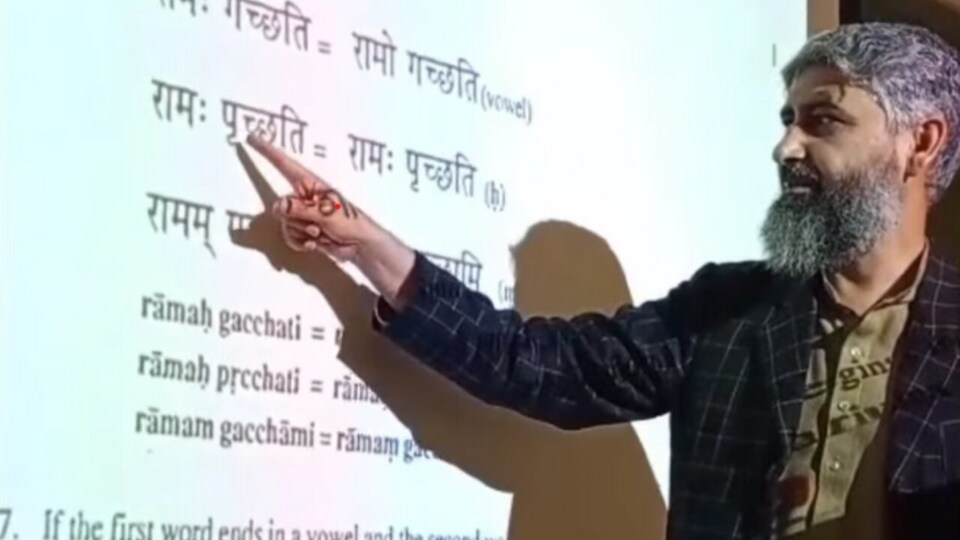
The renewed focus on Sanskrit has been driven largely by the efforts of Dr Shahid Rasheed, Associate Professor of Sociology at Forman Christian College, who has spent years studying the language.
“Classical languages contain much wisdom for mankind. I started with learning Arabic and Persian, and then studied Sanskrit,” Dr Rasheed told The Tribune. He added that much of his learning came through online platforms.
“It took almost a year to cover classical Sanskrit grammar. And I'm still studying it,” he said.
The course, which grew out of a three-month weekend workshop, drew strong interest from students and scholars.
Dr Ali Usman Qasmi, Director of the Gurmani Centre at LUMS, said Pakistan holds one of the richest yet least-explored Sanskrit collections in the region. Speaking to The Tribune, he pointed to the Punjab University library’s vast archive of palm-leaf manuscripts.
“A significant collection of Sanskrit palm-leaf manuscripts were catalogued in the 1930s by scholar JCR Woolner, but no Pakistani academic has engaged with this collection since 1947. Only foreign researchers use it. Training scholars locally will change that,” he said.
‘It is ours too’
Dr Rasheed said he is often questioned about his choice to study Sanskrit, a language commonly associated with Hindu religious texts.
“I tell them, why should we not learn it? It is the binding language of the entire region. Sanskrit grammarian Panini's village was in this region. Much writing was done here during the Indus Valley Civilisation. Sanskrit is like a mountain – a cultural monument. We need to own it. It is ours too; it's not tied to any one particular religion,” he told the English daily.
Rasheed argued that wider engagement with classical languages across borders could reshape regional relations. “Imagine if more Hindus and Sikhs in India started learning Arabic, and more Muslims in Pakistan took up Sanskrit, it could be a fresh, hopeful start for South Asia, where languages become bridges instead of barriers,” he said.
Language as a bridge, not a boundary
A separate report by ThePrint adds a more personal dimension to Dr Rasheed’s journey. For the 52-year-old academic, language is “a bridge” rooted in shared history, one that begins at home. His first student was his daughter, who is now fluent in the Devanagari script.
He traces his ancestry to a village in Karnal, while one of his grandmothers came from Sheikhpura in present-day Uttar Pradesh — connections he sees as reminders of a shared civilisational landscape divided by borders and politics, ThePrint reported.
“Devanagari attracted me. It is so artistic, I found it profound,” he recalled, according to ThePrint.
Plans for Gita and Mahabharata courses
The initiative does not stop with a single course. According to Dr Qasmi, the university plans to expand its offerings to include structured studies of the Mahabharata and the Bhagavad Gita.
“In 10–15 years, we could see Pakistan-based scholars of the Gita and the Mahabharata,” he told The Tribune.
As part of the Sanskrit programme, students are also being introduced to cultural material linked to Sanskrit literature, including the Urdu rendition of “Hai katha sangram ki”, the iconic theme song from the Mahabharat television series.


