British Prime Minister Boris Johnson is expected to launch a new trade pact on his visit to India on April 26, his first major international visit after the United Kingdom left the European Union. Johnson’s visit to New Delhi - the United Kingdom has indicated he would like to travel to Mumbai, Pune, Bengaluru and Chennai as well -- is seen to underline the importance of the Indo-Pacific region which the UK says, is “critical to our economy and security”.
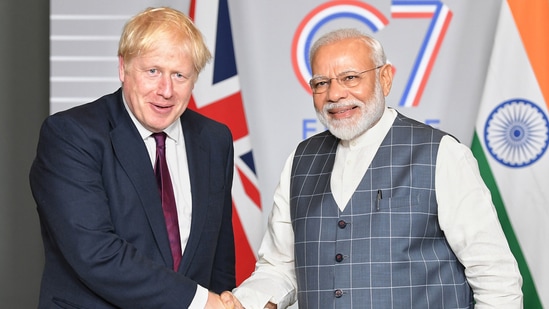
“The British Prime Minister’s itinerary in India is yet to be finalised,” a senior government official said, pointing that Boris Johnson was keen to travel to the four cities after wrapping up the formal engagements in New Delhi on April 26.
Johnson, who had spoken warmly about PM Modi at an international conference this week and hailed his “fantastic leadership”, was scheduled to be in the national capital as the chief guest at the Republic Day parade in January. But he had to cancel the trip at the last minute after a new strain of the Sars-CoV-2 virus led to a surge of coronavirus cases in his country.
PM Johnson, who was down with Covid-19 last year, was given the first dose of the vaccine on Friday. The Oxford/AstraZeneca vaccine is being manufactured by the Serum Institute of India, the world's largest vaccine manufacturer headquartered in Pune, one of the four cities on his itinerary.
{{/usCountry}}PM Johnson, who was down with Covid-19 last year, was given the first dose of the vaccine on Friday. The Oxford/AstraZeneca vaccine is being manufactured by the Serum Institute of India, the world's largest vaccine manufacturer headquartered in Pune, one of the four cities on his itinerary.
{{/usCountry}}Indo-Pacific Pivot
The official confirmation this week about Boris Johnson’s India visit coincides with his country recalibrating its foreign and defence policy to tilt toward the Indo-Pacific region. India, along with other Asian powers such as Japan and South Korea, is key players in Britain’s new foreign policy calculus.
“The region is already critical to our economy and security; is a focal point for the negotiation of international laws, rules and norms; and will become more important to UK prosperity over the next decade,” Britain’s integrated review of security, defence, development and foreign policy, ṭhe most comprehensive since the end of the Cold War, said.
Boris Johnson had been working on this approach months in advance. Like when his government sounded out India, before Johnson’s November 27 phone call with PM Modi, that he was open to travelling to Delhi to be the chief guest at the Republic Day parade.
Or when his government announced in December that it was going to send its biggest warship, the 65,000-tonne HMS Queen Elizabeth, to the Indo-Pacific region on her maiden deployment in 2021. The review, which referred to China’s increasing assertiveness, noted that much of the UK’s trade with Asia depends on shipping that goes through a range of Indo-Pacific choke points.
Local media reports indicate that the £3 billion ( ₹27,177 crore) Royal Navy aircraft carrier, which can carry up to 40 fighter jets, spent much of this week at an ammunition jetty in western Scotland for loading operational stores to prepare for this deployment to the Mediterranean, Indian Ocean and East Asia.
Trade Pact
Apart from cementing the Indo-Pacific pivot, officials said trade is likely to remain a key focus point of Boris Johnson’s discussions in view of Brexit.
Britain is keen to deepen economic ties with India, the second-largest investor in the British economy, and has been trying to persuade New Delhi for a two-step free-trade deal. India is the UK’s sixth-largest trading partner outside the European Union. In 2019-20, UK-India bilateral trade increased by over 11 per cent to nearly 24 billion pounds. The UK was the largest European market for India’s goods exports in the 2019-20 financial year.
Officials said an Enhanced Trade Partnership between the two countries, reviewed in February at a ministerial level, would be launched during Johnson’s trip to India. "We have been undertaking steps to remove barriers to trade and the hope is that an Enhanced Trade Partnership will lead to a positive free trade agreement (FTA) with India in future,” Lord Tariq Ahmad, minister for the commonwealth in the foreign, commonwealth and development office, said in January. "The ultimate goal is an FTA”.
The two sides are also expected to try to finalise trade pacts in areas such as pharmaceuticals, fintech, chemicals, petroleum and food products, described by officials as early harvest deals, to give bilateral trade a hard push.
PM Modi and PM Johnson are also expected to talk about cooperation in science and technology, health, and the G7 Summit to be held in June in Cornwall’s Carbis Bay. PM Modi, along with the leaders of Australia and South Korea, has been invited to this year’s summit as “guests”. The UK, US, Germany, France, Canada, Italy and Japan make up the G7.
The Serum Institute of India is one of the key suppliers of the coronavirus
A delayed shipment of AstraZeneca Plc’s Covid-19 vaccine from India is behind a cut in the UK’s supply starting later this month, according to a person with knowledge of the situation.
Change in approach but...
Indian officials underline that there has been a discernible change in London’s attitude towards New Delhi under the Boris Johnson administration, particularly in the context of India’s concerns over terrorism, security and interference in its internal affairs. This change in approach came through, an Indian official said, when foreign secretary Harsh Shringla briefed his UK counterpart in November last on Indian concerns around terror emanating from Pakistan. Or when UK Homeland Secretary Priti Patel conveyed to New Delhi that London would not allow a repeat of the anti-CAA protests.
But New Delhi was upset when lawmakers participated in a debate on farm laws and criticised the Indian government on account of pressure from a large number of the Indian diaspora, many of them from Punjab. New Delhi summoned the British envoy Alex Ellis to lodge a protest against what it said was an “unwarranted and tendentious” debate in the UK Parliament.
New Delhi is also concerned at the pace at which the extradition proceedings are moving in the case of fugitive businessman Vijay Mallya and diamantaire Nirav Modi. Officials said India and Britain signed an extradition treaty in 1992. But so far, only one extradition has taken place from the UK to India under the arrangement - Samirbhai Vinubhai Patel, who was sent back to India in October 2016 to face trial in connection with his alleged involvement in the post-Godhra riots of 2002. Officials said Mallya and Nirav Modi, on the other hand, were using all legal and political tools to ensure that they are not extradited.
The Indian govt is also concerned over a continuing effort by MPs with a large proportion of their electorate from Mirpur in Pakistan-occupied Kashmir, to further Islamabad's agenda by claiming human rights violations in Jammu and Kashmir issue to target New Delhi.