
 E-Paper



British foreign secretary begins visit on Dec 16 to focus on trade and security
South Block officials said that there has been a sea change in Britain’s attitude towards India under the Boris Johnson administration.

 Prefer HTon Google


As the United Kingdom prepares for an uncertain future outside the European Union, British foreign and commonwealth secretary Dominic Raab will begin a two-day visit to India from December 16 that is expected to extensively focus on bilateral trade and security. First Secretary of State Raab and foreign minister S Jaishankar are expected to review the progress made in the effort to draw up a 10-year roadmap “for a quantum jump” in the relationship between the two countries as well as the finalisation of the defence logistics agreement, according to people familiar with the matter.
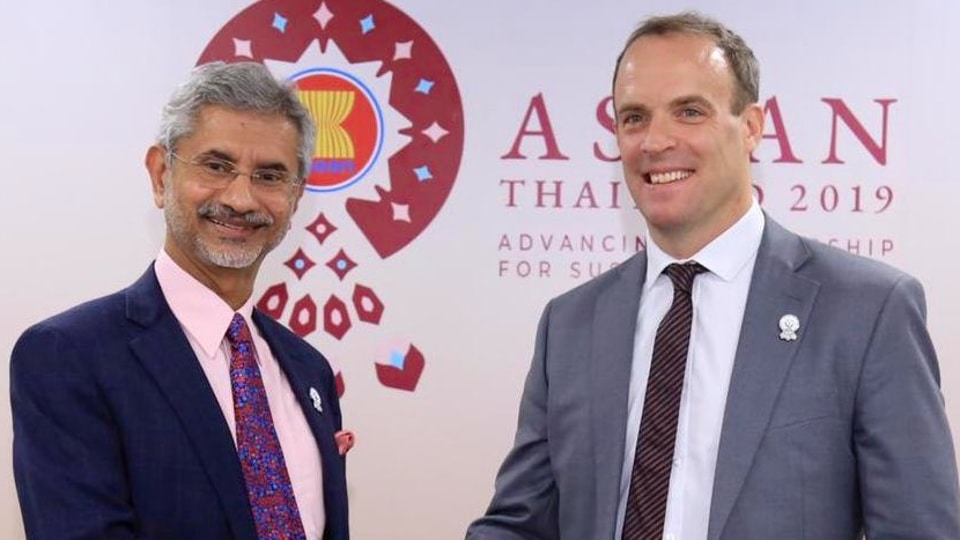
The visit is also seen as a precursor of the British Prime Minister Boris Johnson’s visit to New Delhi in light of Prime Minister Narendra Modi’s invitation to visit India when they last spoke on November 27. PM Modi had then asked Boris Johnson to be the chief guest at India’s Republic Day parade on January 26.
In the same conversation, PM Modi had tweeted that the two leaders had discussed “an ambitious roadmap for India-UK ties in the next decade” and agreed “to work towards a quantum leap in our cooperation in all areas — trade and investments, defence and security, climate change and fighting Covid-19.
India’s external affairs ministry hasn’t spoken on the invite to Boris Johnson, underlining that it only comments on visits by foreign dignitaries closer to the date.
South Block officials said that there has been a sea change in Britain’s attitude under the Boris Johnson administration with London demonstrating sensitivity to India’s concerns over terrorism, security and interference in its internal affairs.
In contrast to 4 September 2019 when anti-CAA protesters broke glass panes of Indian High Commission in London, this time Britain responded swiftly to India’s message on anti-farmers protest on Monday. While the Khalistan supporters infiltrated the protests, the London police not only arrested the protestors but also used smoke bombs to disperse the largely Punjabi activists.
It is understood that UK Homeland Secretary Priti Patel sent a message to New Delhi that London would not allow a repeat of the anti-CAA protests.
While the UK has always been soft on terrorism emanating from Pakistan, Foreign Secretary Harsh Shringla found acceptance of India’s concerns when he briefed his UK counterpart on November 3.
Johnson has already offered a free trade agreement with India and is keen to bolster economic ties with India against the backdrop of Brexit. India-UK trade was worth £24 billion last year, and India is now the second-largest investor in the British economy. There is uncertainty in UK about trade and commerce with European powers playing hard ball and the incoming Biden administration not so convinced over Brexit. It is only natural that UK would like to strengthen trade ties with the largest democratic market in the world.
From a security perspective also, officials indicated that Dominic Raab’s visit would lay the groundwork for a quantum leap for the relationship between the two countries, particularly given how the British government lately appeared to recalibrate its approach towards New Delhi and, as one academic described it, move beyond attempts to balance relationships.
When news of India and the United Kingdom negotiating the defence logistics pact emerged in October, Avinash Paliwal at the School of Oriental and African Studies had interpreted it to imply a foreign policy shift in London vis-a-vis China and Pakistan. “Such a defence logistics pact affords clarity of intent i.e. the UK is increasingly wary of China and is unlikely to let Pakistan’s sensitivities hinder a truly strategic partnership with India (something that has been the case for many years),” Paliwal had said.
Boris Johnson has already announced its decision to send its largest warship, HMS Queen Elizabeth, and its strike group to the Mediterranean, the Indian Ocean and East Asia in 2021, a move aimed at China amid concerns over its increased assertiveness, and the UK’s concerns over the political crackdown in its former colony of Hong Kong.
The deployment is seen to be part of what has been described by London as a shift towards greater engagement with the Indo-Pacific.


