
The continuing closure of the Strait of Hormuz is beginning to hit Americans’ wallets far beyond the pump. Companies say they are raising prices on products ranging from french fries and beer to paint and packaging to offset their own rising commodity and freight costs.
Samuel Adams brewer Boston Beer, Sherwin-Williams, International Paper and Unilever—maker of Dove soap and Hellmann’s mayonnaise—are among the companies that have told investors in recent days that they have raised prices or plan to soon
The continuing closure of the Strait of Hormuz is beginning to hit Americans’ wallets far beyond the pump. Companies say they are raising prices on products ranging from french fries and beer to paint and packaging to offset their own rising commodity and freight costs.
Samuel Adams brewer Boston Beer, Sherwin-Williams, International Paper and Unilever—maker of Dove soap and Hellmann’s mayonnaise—are among the companies that have told investors in recent days that they have raised prices or plan to soon to compensate for more expensive raw materials.
The price increases have been cheered by investors, who have bid up shares of several companies following notice of increases. Sharp gains in shares of manufacturers, materials producers and makers of consumer staples have helped buoy the broader stock market as concerns about the data-center splurge have dragged down technology stocks that powered major indexes to new highs earlier this year.
Yet higher prices on everyday items threaten to ignite a new round of inflation that could muddy the path of interest rates and become a big factor in this autumn’s midterm elections.
“Investors in these particular companies celebrate every price increase announcement, but of course collectively all of these price increase announcements are very bad for the economy, and they are problematic for interest rates,” said Adam Josephson of Sakonnet Research.
The cost of living was already a hot political issue in late February when the U.S. began bombing Iran, which retaliated by restricting passage through the Strait of Hormuz. Roughly 20% of the world’s oil supply moved through the strait before the war, as well as much of its aluminum, fertilizer and other raw materials.
Prices at the pump immediately surged, straining household budgets and boosting costs for businesses. Traders went from expecting the Federal Reserve to reduce borrowing costs to positioning bets in the futures market in anticipation of the energy shock necessitating rate increases, according to CME Group data.
Fed officials on Wednesday voted 9-3 to leave interest rates unchanged. The central bank’s rate-setting panel is scheduled to next meet in September.
“What we’re trying to understand is to what extent are these shocks broadening in their effects, broadening in their impact on prices that are quite far removed from it,” Fed Chairman Kevin Warsh said.
Benchmark U.S. crude futures traded around $85 a barrel on Friday, up about 25% since the war began. Prices for gasoline, diesel and many petrochemicals have risen even more sharply and aren’t expected to ease until normal tanker traffic through the strait resumes. The national average for a gallon of regular unleaded gasoline was about $4.11 on Friday, up from $2.98 at the start of the conflict.
Household-products maker Unilever attributed less than 15% of its first-half sales growth to higher prices, as opposed to greater volume. But executives told investors that will likely flip during the remainder of the year due to higher commodity prices.
“We expect pricing to lead growth during the second half of the year,” Chief Financial Officer Srinivas Phatak told investors.
Sherwin-Williams shares jumped more than 8% on Tuesday, their biggest one-day gain in more than four years, after the Cleveland paintmaker said it would raise prices 8% effective Sept. 1 to offset rising materials costs, including oil-linked inputs. It forecast that prices for its raw materials would rise further in the second half of the year by a percentage in the high-single digits.
“We were able to delay this increase for customers and avoid disrupting their business during the height of the paint-selling season,” said Chief Executive Heidi Petz.
Illinois Tool Works shares shot up more than 10% Tuesday after CFO Michael Larsen assured investors that it raised prices during the spring quarter to more than make up for costlier inputs, like the resins consumed by units that make automotive components and plastic six-pack rings.
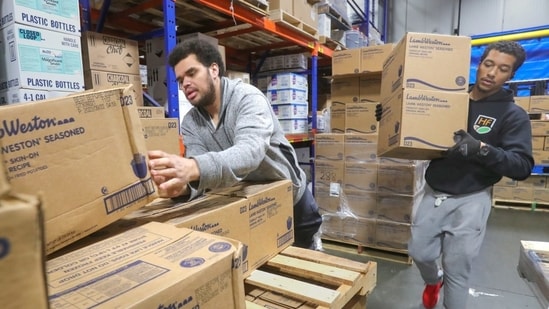
Idaho french-fry maker Lamb Weston Holdings said it raised prices in North America to counteract rising costs for everything but potatoes. Higher crude oil prices have lifted the company’s transportation costs and spilled into the market for edible oils, which motor-fuel makers are guzzling up given national average diesel prices that have surged above $5 a gallon.
“Demand for biodiesel has driven up the cost of most edible oils,” finance chief James D. Gray told investors.
Packaging expenses have become especially problematic. Plastic bottles and bags are made from oil and natural gas derivatives. Meanwhile, aluminum supplies have been reduced because a big chunk of global supply is stuck behind the strait.
Boston Beer executives said more expensive commodities, including aluminum, which is also subject to President Trump’s tariffs, partially offset price increases last quarter.
Few companies will be immune to rising prices for corrugated boxes, which are used to move everything from produce to factory parts around the country.
All three of the largest U.S. box makers announced price increases in quick succession in July. International Paper, Smurfit Westrock and Packaging Corp. of America have cited rising costs, including recycled boxes and freight, as well as tight supplies due to a historic run of containerboard mill closures that eliminated about 10% of the country’s capacity to produce the thick paper that is folded into shipping boxes.
Write to Ryan Dezember at ryan.dezember@wsj.com
One Subscription.
Get 360° coverage—from daily headlines
to 100 year archives.
Archives
HT App & Website