
TEL AVIV—After facing a long series of difficult decisions in its nearly two-year war against Hamas, Israel finds itself weighing another critical move—whether to fully occupy the Gaza Strip.
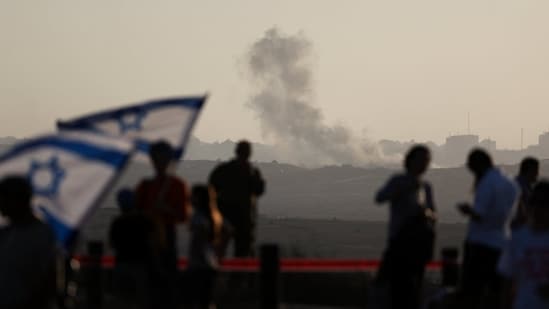
Domestic media in recent days has been floating suggestions that Prime Minister Benjamin Netanyahu has already decided to take control of Gaza entirely despite the opposition of the chief of staff of the country’s armed forces. Some Israeli government officials have been publicly pushing the idea, while Israel’s political opposition has
TEL AVIV—After facing a long series of difficult decisions in its nearly two-year war against Hamas, Israel finds itself weighing another critical move—whether to fully occupy the Gaza Strip.
Domestic media in recent days has been floating suggestions that Prime Minister Benjamin Netanyahu has already decided to take control of Gaza entirely despite the opposition of the chief of staff of the country’s armed forces. Some Israeli government officials have been publicly pushing the idea, while Israel’s political opposition has been adamant in criticizing it.
On Monday, Netanyahu said he would convene Israel’s security cabinet this week to direct the armed forces on how to achieve the country’s war aims, namely to defeat Hamas and ensure it never returns as a threat to the Israeli state, and free the remaining hostages seized in October 2023. He said he held a three-hour long security consultation with the Israeli army chief on Tuesday.
The growing anticipation of some greater involvement in Gaza comes as Israel tries to find a way forward, as cease-fire talks continue to stall and its initial military operation leaves its war aims unfulfilled. Some on the right are anxious to see Israel follow through on its military campaign.
“The chief of staff must clearly state that he will fully comply with the directives of the political echelon, even if a decision is made for conquest and decisive action,” said Israel’s far-right national security minister, Itamar Ben-Gvir, in an X post Tuesday.
The Israeli military chief of staff, Eyal Zamir, has indicated that he prefers a more limited effort that keeps pressure on Hamas through “precise firepower,” which he has said would allow Israel to scale down its troops’ presence in Gaza and give them rest after nearly two years of war.
“We will reduce the fatigue of our troops and avoid falling into Hamas’ traps,” he said on Friday.
Critics of the occupation plan, largely from the left and center but also some on the right, say Israel should focus its energy on securing a cease-fire both to free the remaining hostages and ease the growing humanitarian cost of the war, which has left the country increasingly isolated internationally.
Netanyahu himself hasn’t publicly weighed in on the debate and his spokesman didn’t respond to a request for comment.
Militarily speaking, it wouldn’t be difficult for Israel’s military to conquer Gaza, say Israeli security analysts. Israel already controls around 75% of the Strip and Hamas no longer has any organized military force to stand in the way.
The challenge for Israel would come after it has taken full control of Gaza, much of which has been destroyed by the fighting. By occupying the Strip, Israel would be responsible for the daily lives of the territory’s 2 million residents, including food, healthcare, education, sanitary services and all other facets of civilian life. Israel would also require a substantial military force inside Gaza to maintain security amid a largely hostile population.
It would be expensive. It would cost Israel some 35 billion shekels, or around $10 billion, to pay for soldiers and fund civilian services in Gaza, according to a study by Prof. Esteban Klor, an economics professor at the Hebrew University in Jerusalem. That amounts to about 2% of Israel’s GDP that hasn’t been budgeted for. It also doesn’t include the cost of rebuilding Gaza’s infrastructure, a bill Israel may have to pick up if potential donor countries refuse to work with it.
Israel previously funded a military government in Gaza from 1967 to 2005 mostly by using tax revenue generated in the Strip before relinquishing its settlements there. Klor said that was likely not a viable option given the state of Gaza’s economy after nearly two years of war.
Nor is it clear whether a military occupation would defeat or potentially embolden Hamas, Israeli security analysts say.
Hamas’s fighters, who have fought the entire war in civilian clothing and from within populated areas, would be able to continue their guerrilla warfare tactics. An occupation could further swell their ranks while giving them better access to target Israeli troops permanently stationed inside of Gaza to manage the military government. Israel’s move would also likely incur a major international backlash, with much of the world demanding an immediate end to the war already.
The Israeli military so far has refrained from ground operations in densely-populated areas of Gaza over fears it could endanger hostages still there. Critics of the occupation plan also worry about the cost in lives and suffering, for both Gaza’s civilian population and Israeli soldiers.
Some critics fear a military occupation would pull Israel further from its war aims by sparking the death of the remaining captives while strengthening Hamas’s hand in both Gaza and on the world stage.
“We see what’s happening now. It will just make it worse. I’m not sure to what extent Israeli society will support occupying all of Gaza,” said Avner Golov, a former senior director at Israel’s National Security Council and now vice president of MIND Israel, a security-focused nonprofit based in Tel Aviv.
The war has devastated much of the Gaza Strip’s infrastructure.
Other analysts said Netanyahu could be using the threat to create pressure on Hamas to accept Israel’s terms for a cease-fire.
In a poll released Sunday by the Tel Aviv-based Institute for National Security Studies, 27% of respondents said they would support the establishment of a military government in Gaza, compared with 50% who supported the establishment of a technocratic government proposed by Egypt’s government. Another 12% said they support the West Bank-based Palestinian Authority taking control of Gaza, a move that has been flatly rejected by Israel’s leadership.
Those who support a full military takeover in Gaza argue there will be short-term pain, but long-term benefits.
Israel would prevent Hamas from ever reconstituting itself in Gaza, after 20 years of persistent attacks from the group, they say. Over time, Israel would stabilize the territory, and thereby remove the intense international gaze it is currently under. It would also be able to oversee the education system and enact a deradicalization program, an issue Netanyahu and his top ministers have said is crucial to their vision of peaceful relations with Palestinians.
An essential component for a successful military occupation, said Amir Avivi, a former Israeli defense official who is close to the current government, would be the implementation of an Israeli relocation plan for Gazans who wish to move to a third country, an idea raised by President Trump earlier this year.
While Israeli officials say their relocation would be voluntary, critics say the devastation wrought by Israel throughout Gaza constitutes coercive measures for their expulsion from the Strip.
“If most of them will relocate, then it is a game changer,” Avivi said.
Write to Dov Lieber at dov.lieber@wsj.com
One Subscription.
Get 360° coverage—from daily headlines
to 100 year archives.
Archives
HT App & Website