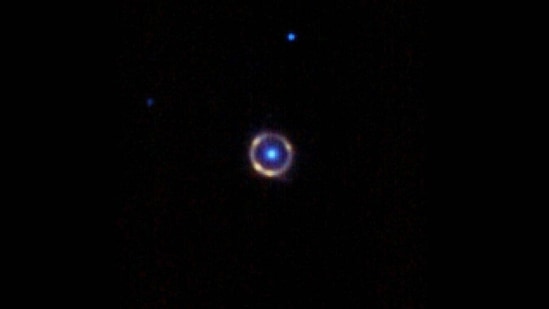
A near-perfect ‘Einstein ring’ in space. Courtesy: James Webb Telescope
James Webb Telescope ‘Einstein ring’: Einstein Ring was first discovered in 1988 as the phenomenon of bending of the light was predicted by Alert Einstein.
The James Webb Space telescope captured an image of an almost perfect “Einstein ring" which is a ring of light created when light from a galaxy, star or other cosmic objects passes near a massive object before reaching Earth. This image reached the James Webb Telescope, deployed in space by American space agency NASA which snapped a photo of this special case of gravitational lensing.
James Webb Space Telescope: The Einstein Ring as seen by the telescope.
{{^htLoading}} {{/htLoading}}
The colourised picture was recently shared by a Reddit user.
{{^usCountry}}{{/usCountry}}
Space.com said that this image was posted by Reddit user Spaceguy44 on the r/Astronomy subreddit on the platform. Spaceguy44’s Reddit bio notes that the user is an astronomy graduate student.
Einstein Ring was first discovered in 1988 as the phenomenon of bending of the light was predicted by Alert Einstein. The James Webb telescope captured the image from a distant galaxy - SPT-S J041839-4751.8 - which lies around 12 billion light-years from Earth.
Earlier, NASA's Hubble Space telescope had captured images of several "Einstein Rings" but the one shared by James Webb is crucial as the telescope has offered the most detailed image owing to its high-powered lenses.
Follow the latest breaking news, major developments and agenda-setting stories from India and around the world with the newsdesk at Hindustan Times. Operating round the clock, the desk brings together experienced editors, reporters and correspondents to deliver fast, accurate and contextual reporting across subjects that influence public policy, governance, business, society and international affairs. The HT News Desk covers politics, elections, government policies, the economy, business and markets, science and technology, the environment, law and order, infrastructure, education, climate issues and geopolitics, while closely tracking developments across states, institutions and global capitals. The team also leads coverage of major breaking news events, policy announcements, court proceedings, natural disasters, public emergencies and significant international developments. Reports published by the newsdesk are based on information gathered from reporters on the ground, official statements, government agencies, court records, regulatory filings, recognised institutions and other authoritative sources. Stories undergo editorial scrutiny and verification processes to ensure accuracy, fairness and relevance, and are updated as events evolve and additional information becomes available. Whether covering a key political decision in New Delhi, an economic policy shift affecting millions, a landmark court ruling or a major global event, the HT News Desk aims to provide readers with reliable, fact-based journalism that delivers not only the latest developments but also the context and analysis needed to understand their wider implications.
Get the latest World News, breaking headlines and global updates from the US, UK, Pakistan, Bangladesh, Russia and other countries. Follow major international events on Hindustan Times.
Get the latest World News, breaking headlines and global updates from the US, UK, Pakistan, Bangladesh, Russia and other countries. Follow major international events on Hindustan Times.
Home/World News/A near-perfect ‘Einstein ring’ in space. Courtesy: James Webb Telescope
{{^htLoading}}
Advertisement
{{/htLoading}}
SHARE THIS ARTICLE ON
{{#usCountry}}{{/usCountry}}
Notifications
Get breaking alerts directly from the newsroom
Notifications are on!You'll be notified when news breaks