With 90 per cent of the votes counted 9pm local time on Wednesday, no clear winner has emerged in the widely watched Israeli elections. According to the Israeli Central Elections Committee, the ruling coalition of Benjamin Netanyahu's Likud party was poised to bag 53 seats in the 120-seat Knesset, and the Opposition, led by Gadi Eisenkot, had 48 seats based on the interim results.
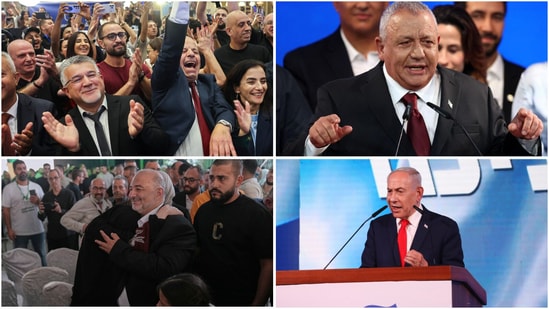
While there is no clear winner in sight, the two Arab parties - the Joint List and Ra'am - and their possible role in the new government are under the spotlight.
Also Read | Israel election: The numbers, alliances and 61-seat mark that decides who governs
Deep Dive
What is the difference between the Joint List and Ra'am in Israel's election?
Why might the Joint List and Ra'am not become kingmakers despite winning 19 seats?
How could Arab parties help form Israel's next government?
As per the election committee, the Arab parties could secure up to 19 seats - meaning whichever bloc they join, that coalition will form the next government.
About Joint List and Ra'am
Joint List
The Joint List is a political alliance of Arab-majority parties in Israel formed in 2015. The alliance comprises Hadash, Balad and Ta'al.
Ra'am too was part of this bloc until 2021. Despite being an alliance, the Joint List often contests elections as a standalone party.
In 2015, the Joint List emerged as the third-largest party in the Knesset with 13 seats and 10.6 per cent of the vote share. The Joint List regained its title as the third-largest party in the 2019 elections, with 15 seats.
{{/usCountry}}In 2015, the Joint List emerged as the third-largest party in the Knesset with 13 seats and 10.6 per cent of the vote share. The Joint List regained its title as the third-largest party in the 2019 elections, with 15 seats.
{{/usCountry}}However, due to the inability to produce a coalition government in 2019, Israel voted again in 2020, where the Arab alliance won 15 seats.
The alliance ran again in 2021 without Ra'am and won six seats, recording a sharp decline in its voter share. In the next few years, as Ra'am, Ta'al, and Balad moved away from the alliance, the Joint List disbanded.
For the 2026 elections, in the backdrop of the war in Gaza and Lebanon, the Joint List re-emerged, this time with Hadash, Ta'al, Balad, while Ra'am contested alone.
Led by Yousef Jabareen, the Joint List has focused on the larger conflicts Israel is involved in and called for a shift in focus to investing in life, rather than war.
The alliance has also advocated for better housing, wages, free education, improving the Israeli-Arab society, and workers' rights. The list also called for a plan to eradicate organised crime, which is a key issue for Arab society in Israel.
"Investment in economic development. Restore the rule of law. Hit the pocket - sever the alliance between crime, corruption and privatisations. Strengthen the Arab local authorities and protect them. Move from a culture of 'fixes' to a culture of lawful arrangements. Build a genuine partnership between the state and Arab society - the Coalition for Life against the crime coalition. Ensuring genuine civil equality," reads a statement from the alliance that accompanied the alliance's manifesto for the 2026 polls.
Ra'am
Ra'am, also known as the United Arab List, is a conservative political party in Israel with Islamist roots. The party was established before the 1996 elections in Israel.
Ra’am has contested every Israeli election since 1996, mostly as part of alliances with other Arab parties. In 2021, running on its own, it won four seats and joined the coalition government led by Naftali Bennett and Yair Lapid. It was the first independent Arab party ever to join an Israeli governing coalition.
In 2022, the party returned to the Opposition, with leader Mansour Abbas stating that the party was open to working with "anti-Netanyahu voices."
While starting out as a southern faction of the Islamic Movement, the party announced its separation from the movement in 2025 and functioned as a "civic party."
The Arab party is known to support the two-state solution between Israel and Palestine; however, its manifestos do not "emphasise the need to end Israeli occupation of Palestinian territories."
Under leader Masour Abbas, the Ra'am party focuses on full-fledged political involvement in the Knesset and to improve the quality of life for Arab Israelis.
The party's voters mostly consist of nationalist Israeli Arabs, especially from the Bedouin community.
Can the Arab parties be 'kingmakers'?
The 19 Arab seats could take the Netanyahu or Eisenkot blocs over the 61 majority mark.
However, an anti-Arab veto limits the parties. This informal veto refers to the reluctance of Jewish-led political parties to form a coalition with Arab-led factions.
This was also reflected in a move by the Netanyahu-led bloc to bar Arab parties such as the Joint List and Ra'am from contesting the elections, a move later struck down by the Supreme Court.
Also Read | Israel election: Arab parties projected to win record seats but may not be 'kingmakers'
If Eisenkot wishes to remove the Netanyahu government, teaming up with the Arab parties will be the only way out.
For Netanyahu, who is facing the ultimate test, a coalition with Arab parties may help him secure another term amid the ongoing wars and a corruption trial. However, the incumbent has stated that a coalition with Arab parties would be "a shame and disgrace."
Joint List leader Jabareen has stated that the main aim of the alliance will be "getting rid of Netanyahu and changing the political situation in Israel," adding that working with Eisenkot may also be a challenge due to the bloc's support for Israel's military campaign in the Gaza Strip and the occupation of southern Lebanon.
Meanwhile, Ra'am leader Abbas has signalled a willingness to join a new governing coalition, stating that working from within the system was the best way to address issues.
"If we join a government of change, we will be able to see substantial changes, not just empty talk," Abbas told Ynet news after the first exit polls were released on Wednesday.
But teaming with Arab parties could be an anathema to Jewish-led parties after the October 7, 2023, attacks by Hamas.
If both blocs refuse to join hands with Arab parties, Israel could face another election, with Netanyahu staying on as the caretaker leader.