Montana Governor Greg Gianforte has just returned from a trade mission to India, a trip that drew a wave of online abuse amid a broader rise in anti-Indian sentiment in the US. In a wide-ranging interview with HT, Gianforte brushed off the backlash, saying the visit had made significant progress despite the noise. He pitched India on buying more of Montana's farm produce, while courting Indian technology and pharmaceutical companies to set up shop in his state.
Governor, you were just in India and Sri Lanka as part of a trade mission. Could you talk to us a little bit about what you're bringing home from that experience?
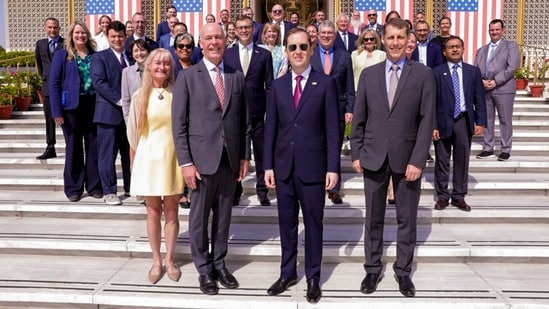
As you know, India is one of the world's biggest and fastest growing markets. It's the fifth largest economy and projected to be the third largest by 2030. So this is an opportunity. Montana and India already trade with each other. India buys Montana pulse crops, which includes lentils, peas, and chickpeas. We're the largest producer of these products in North America, and India also buys commercial aircraft parts that are manufactured here. The two economies are very complementary. India brings scale, technology, talent, and capital. Montana brings pulse crops, critical minerals, photonics, quantum expertise, and a fast-growing economy. So, our relationship is broadening, and the purpose of this trip was really to deepen existing relationships and find new opportunities.
You mentioned the agricultural sector. India has agreed to open up some of its agricultural sector to US exports as part of a US-India trade deal. What exactly are Montana's farmers looking for?
We need a two-way street. Businesses in India and the US both need certainty. Agriculture is a $6.2 billion industry in Montana. As I mentioned, Montana is the US’ largest producer of peas, lentils, and chickpeas. India's demand for pulses makes it a natural long-term market for us. And the central ask for us on this trip to our buyers in India was: we want fair and stable market access. Otherwise, our farmers don't have the certainty to plant the crops that India needs. With other foreign markets - China excepted - we have long-term relationships and decisions about what crops go in the ground are generally made a year before they're harvested. If a farmer doesn't know that the market's available, he's not going to plant the crop. So, for our farmers, we need stable and fair access to a market that gives predictability-which might mean multi-year contracts. It means baseline buying. This is the stability that we're looking for in the relationship.
{{/usCountry}}We need a two-way street. Businesses in India and the US both need certainty. Agriculture is a $6.2 billion industry in Montana. As I mentioned, Montana is the US’ largest producer of peas, lentils, and chickpeas. India's demand for pulses makes it a natural long-term market for us. And the central ask for us on this trip to our buyers in India was: we want fair and stable market access. Otherwise, our farmers don't have the certainty to plant the crops that India needs. With other foreign markets - China excepted - we have long-term relationships and decisions about what crops go in the ground are generally made a year before they're harvested. If a farmer doesn't know that the market's available, he's not going to plant the crop. So, for our farmers, we need stable and fair access to a market that gives predictability-which might mean multi-year contracts. It means baseline buying. This is the stability that we're looking for in the relationship.
{{/usCountry}}Also read | Indian IT giants radically reduced green card applications even before US crackdown, data shows
You met people in the tech sector. You were also talking about minerals and mining on your trade mission. What sort of companies and sectors in India showed an interest in investing in Montana?
I'll highlight three. Montana is a prime market for investment. It's also a natural gateway to the North American marketplace for Indian companies. Montana is the fifth fastest growing economy in the US. Real GDP grew over 16% from 2021 to 2025, outpacing the growth of the overall US marketplace, and it was ranked the best place to start a business in 2025. That includes the best 10-year survival rates for startups. So, three areas that we focused on while we're there. The first is bioscience. Montana recently expanded our right to try law. This opens up new opportunities for clinical research and access to qualifying experimental treatments at a level not available in any other state. Indian biotech and pharmaceutical companies expanding into the world's largest market for those products, which is the US, can utilise Montana clinics for trials in a way that's not available in any other state. This will dramatically lower the cost of entry to the marketplace. So that's number one. Number two is agri-tech. Both India and Montana are fundamentally agricultural markets. Just as India has adopted innovation and technology, so has Montana. Precision agriculture and agri-tech were discussed. We have some upcoming visits from Indian agri-tech businesses looking at establishing a presence here in Montana. So, like India, Montana is home to world-class researchers. So we're looking at collaboration between our universities on practical use technology like agriculture. And the third and last one I'll mention is aerospace and advanced manufacturing. Boeing has a presence here in Montana. We visited the Boeing facility in Bengaluru. Janicki (Industries) just located here. They're going to hire about 2000 people making aircraft parts. We have a Department of War office in Montana. It's an on-ramp for smaller companies to do business with the US Department of War. So this is a third area of potential collaboration.
Also read | Indian IT firms among 8 hit by US green card curbs as America widens visa crackdown
You went to IISc and met Indian researchers. What role do you see as that role that Indian students and researchers can play in Montana's universities?
Well, Indian students in the Montana university system make up the second largest foreign student population, second only to Canada, who’s our northern neighbor. So, Indians are already present here in our university system, and there's tremendous opportunity, particularly for Indian companies as they establish their North American beachhead in Montana, for jobs for these American-trained Indians to work with them and to further research, whether it's in aerospace, bioscience, or agri-tech. So this is not something new. This is really just the next step in the relationship.
To be blunt, there has been an outpouring of anti-Indian sentiment online recently, much of it coming from America. You faced a great deal of online vitriol over your visit to India. How does this impact what you’re trying to do?
We were there for one purpose, and that's to further Montana's interests in a way that benefits both Indian India, Montana and the US. The benefits are very clear. When we work together, we get groundbreaking research. We get jobs in Montana. We feed and provide protein to India. So everybody benefits. And frankly, in today's environment, you can't do anything without getting a little bit of pushback. But I'm confident that we made good progress. We deepened existing relationships and we made new ones. And I'm looking forward to fruit that's going to come from our efforts on this trip. And we were very clear that our relationship is based on long-term relationships, not transactions that are squeezed out of another party.
Also read | Trump admin plans $70,000 fee on post-study work programme, Indians likely to be hit hardest
You’ve made a pitch for more connections between universities, researchers and companies. Of course, one recent concern about Indian companies and talent has revolved around moves by the Trump administration to restrict immigration to the US. How do you square the two?
Indian students in our university system represent the second highest population of any foreign country. Again, second only to Canada. So this is a solved problem. Montana also has the highest per capita concentration of optics and photonics companies and research institutions in the US with over 80 companies. So there's 40 years in this particular industry. So there's an opportunity for collaboration. The US Patent Office recently moved from Denver, Colorado, to Montana. Montana State University alone had almost $300 million of research last year. I was really pleased to visit IISc there in Bangalore, and it turns out the gentleman who heads up our photonics work at Montana State University graduated from IISc. So again, these bridges have been built. There's always going to be a little noise around the process, but this is a solved problem.