E-Paper



Number Theory: Understanding the past, present and future of Brics
If Brics countries, given their clout in global economy, can negotiate an emissions path with developed nations, it’ll be a win for both development and climate
Updated on: Aug 24, 2023, 18:40:28 IST

 Prefer HTon Google
Share via


Copy link

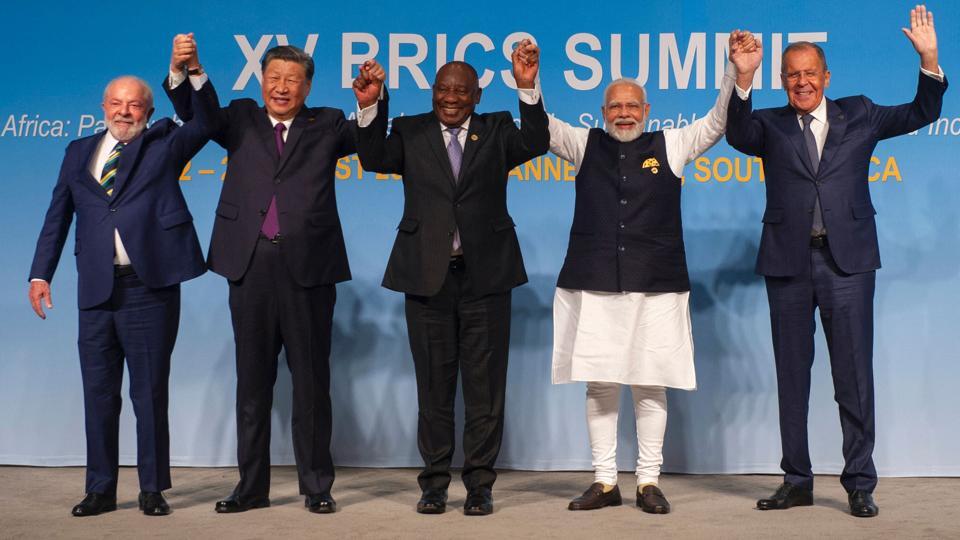
The 2011 Sanya declaration — the first at a Brics summit after South Africa joined the BRIC (Brazil-Russia-India-China) grouping — called for “establishing a more equitable and fairer world” while celebrating the fact that “BRICS and other emerging countries have played an important role in boosting global economic growth”. How successful has the grouping been in achieving this objective? And what will be its contribution to global economic growth in the future? While one must wait for the joint declaration by the 15th Brics summit — it ends on August 24 — it is useful to look at some key statistics to answer this question.
 Rise of BRICS and the decline of G7In 2011, the year the first BRICS summit was held, combined GDP (in current dollars) of member countries accounted for 19.6% of global GDP. This number had increased by 6.2 percentage points in the last ten years. The global economic weight of BRICS has only increased since then and combined GDP of these five countries have a share of 26% in 2022. To be sure, BRICS still lags the economic might of G7 countries – an informal group of “major advanced economies” consisting of US, UK, France, Italy, Japan, Canada, and Germany – which has a share of 44% in global GDP. However, the fact to be noted is that the share of BRICS countries in global GDP has been rising, while that of G7 has been falling.
- Which also means that BRICS is an important driver of global growthAnother way to look at the economic importance of BRICS in the global economy is to look at its contribution to global growth. This number was 12.8% between 1990 and 2000, increased to 28.5% between 2000 and 2010 and was 41.6% between 2010 and 2022.
- To be sure, China is the biggest contributor to BRICS’s economic weightChina constituted 42% of the BRICS nations’ total GDP in 1980. This number reduced to 30% in 1990 but increased to 44% and 70% by 2000 and 2022. By 2028, the latest year for which projections are available in the WEO database, China’s GDP share within BRICS is expected to be 71%. India’s GDP share in BRICS was 13% in 2022 and expected to reach 14.5% by 2028.
- The geopolitical context around BRICS is very different compared to when it was formedThe formation of BRICS was aimed creating a multipolar world order, and by extension, pivoting it away from US dominance. With Russia engaged in a war in Europe and significant deterioration in relations between China and western world as well as India, it is difficult to envisage that BRICS will have the same unity of purpose which it had when it was formed two decades ago. That India is pivoted strongly towards a strategic alliance with the US is a clear proof of this fact.
- But BRICS can still play a big role on fronts such as the climate crisisThe trajectory of the combined emissions of these five countries has the potential to change the trajectory of global emissions currently. This is because they account for almost half (45%) of global fossil emissions, a share that continues to increase. However, this share is unlikely to decrease without the biggest emitters among them doing so. China, India, and Russia alone account for around 31%, 7%, and 5% of global emissions, while Brazil and South Africa account for only around 1% of global emissions. The former three are unlikely to agree to decrease their emissions immediately, given the differences around how the burden of climate finance should be distributed given the difference in historical emissions. China, India, and all five BRICS countries combined only account for 3%, 7%, and 26% of cumulative fossil emissions from 1850 to 2021. In comparison G7 countries have a share of 44% in cumulative emissions from 1850. Clearly, if the BRICS countries – given their current clout in global economy – can negotiate an emissions path with developed countries that does not affect the former’s development, it will be a win for both development and climate.