Pope Francis III, who is in the hospital for the treatment of double pneumonia, is not out of danger as yet, one of his doctors said on Friday. His medical team however added that the Pope is expected to survive.
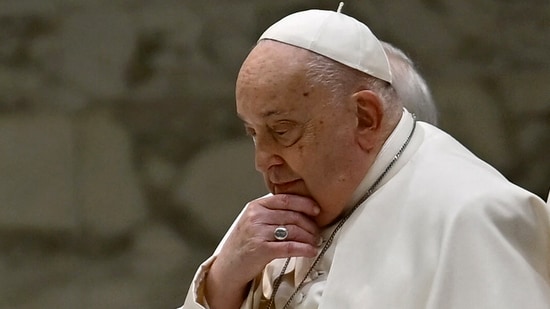
Francis was admitted to Rome's Gemelli Hospital on February 14 after he reported breathing issues for several days.
"If the question is whether he is out of danger, the answer is no. But if you're asking whether he is currently in life-threatening danger, the answer is also no," said Dr Sergio Alfieri told a press conference.
As per the doctors, Pope Francis has double pneumonia is a serious condition in which both lungs become scarred and inflamed, making it difficult for the infected person to breathe.
Meanwhile, the Vatican has described the Pope's infection as "complex" because it is polymicrobial, meaning it is being caused by two or more micro-organisms.
Pope Francis to remain in the hospital for the coming week
As far as his current state is concerned, Pope Francis was able to get out of bed, sit in an armchair to do some work, and even visit the chapel in his self-contained apartment within the hospital, his medical team said.
{{/usCountry}}As far as his current state is concerned, Pope Francis was able to get out of bed, sit in an armchair to do some work, and even visit the chapel in his self-contained apartment within the hospital, his medical team said.
{{/usCountry}}But they predicted he would remain at the facility "at least" through the coming week.
Also Read | Pope Francis health: Preparations for possible funeral begin as Pontiff warns aides of death
Alfieri, on the medical staff at Gemelli, said that given the pope is 88, with prior health concerns, he was obviously a fragile patient.
He told reporters that the pope did not have sepsis, a potentially life-threatening condition when the body responds to an infection by harming its own tissue and organs.
However, Alfieri said there was still a risk that the infection could spread.
"If, unfortunately, one of these germs were to enter the bloodstream, any patient would develop sepsis, and sepsis, combined with his respiratory condition and age, could be very difficult to overcome," said Alfieri.