New Delhi: The Quad Leaders Summit in Tokyo next week will discuss challenges and opportunities across the Indo-Pacific and focus on ways to deliver on the vision of a free, open and inclusive region, foreign secretary Vinay Kwatra said on Saturday.
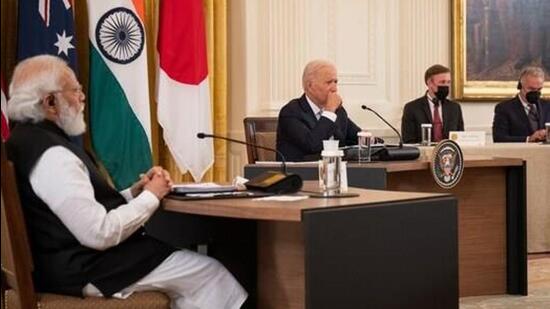
The Quadrilateral Security Dialogue or Quad is implementing a positive and constructive agenda and the summit on May 24 is expected to focus on issues such as post-Covid recovery, building health security, climate action, sustainable infrastructure projects and creating resilient supply chains, Kwatra told a news briefing ahead of Prime Minister Narendra Modi’s visit to Japan during May 23-25.
Kwatra also indicated differences between India and the other members of Quad – Australia, Japan and the US – on the Ukraine conflict are unlikely to come in the way of overall cooperation in the Indo-Pacific. The world community and major partners, he said, have shown “complete understanding and appreciation” for India’s position, which includes a call for the immediate end to hostilities and a return to the path of diplomacy and dialogue.
Asked specifically if the Quad leaders will discuss the challenge posed by China’s actions across the Indo-Pacific, Kwatra said the discussions will be in the context of the “challenges and opportunities” confronting the region.
{{/usCountry}}Asked specifically if the Quad leaders will discuss the challenge posed by China’s actions across the Indo-Pacific, Kwatra said the discussions will be in the context of the “challenges and opportunities” confronting the region.
{{/usCountry}}Cooperation within Quad is anchored in a commitment to democracy, international law, the rules-based international order and the vision of a free, open and inclusive Indo-Pacific. “Since its first summit, Quad has been working to implement a positive and constructive agenda with a strong focus on enabling peace, prosperity and stability in the Indo-Pacific region,” he said.
The cooperation so far has included working on climate action, which involves creating a decarbonised green shipping network in the Indo-Pacific, using clean hydrogen and making it more accessible, and helping countries in the region for climate monitoring and information-sharing.
Quad’s infrastructure coordination group has focused on supporting sustainable and demand-driven infrastructure in a “manner that does not burden countries of the region with unsustainable debt”, and there has also been cooperation on critical and emerging technologies, diversification of the semiconductor supply chain, and security of critical cyber infrastructure.
As part of the continuing and evolving cooperation for the Covid-19 response and post-pandemic management of economy and health infrastructure, the Quad members have focused on last mile delivery, health security, genomic surveillance, clinical trials and pandemic preparedness. The Quad will also organise a special session on the sidelines of the World Health Assembly on promoting vaccine confidence and fighting the infodemic on May 24.
Besides participating in the third Quad Leaders Summit, Modi will have bilateral meetings with Japanese Prime Minister Fumio Kishida and US President Joe Biden in Tokyo. He is also expected to meet the new Australian prime minister following the election held on Saturday.
Modi will also hold a business roundtable with around 30 Japanese industry representatives and have a few one-on-one meetings with prominent business leaders. He will also interact with the Indian community in Tokyo.
The bilateral meeting with Biden will mark a continuation of high-level dialogues and provide guidance and a vision to take the India-US relationship forward. “Our long-standing cooperation in diverse areas ranging from trade, defence, security, climate, education and energy is on an upward trajectory,” Kwatra said.
The meeting between Modi and Kishida will be an opportunity to carry forward high-level engagement between the two sides and to advance the cooperation agenda. Kishida’s visit to India in March saw the two sides set a target of five trillion yen ($40 billion) in public and private investments and financing over the next five years and the adoption of an Industrial Competitiveness Partnership Roadmap, a Clean Energy Partnership and a Sustainable Development Initiative for the north-eastern states.
Responding to a question on India’s policy on the Ukraine crisis, Kwatra said New Delhi had made it very clear since the hostilities began in February that it wanted an “immediate and early cessation of hostilities”, and the resolution of the situation through diplomacy and dialogue.
Asked whether the Quad has a security dimension, Kwatra said it is important to understand the proper context of the functioning of the grouping. “What we need to keep in mind is that Quad is a group of countries that share the core values of democracy, pluralism and market economy. Quad’s cooperation is shaped principally by the goals of promoting peace, stability and prosperity in the Indo-Pacific,” he said.